Wrap up
![Bulgaria, OECD See Accession Completed in 2026]()
![Bulgaria, OECD See Accession Completed in 2026]() In the photo: (left to right) outgoing Minister of Foreign Affairs Georg Georgiev, OECD Secretary-General Mathias Cormann, outgoing Prime Minister Rosen Zhelyazkov, and outgoing Finance Minister Temenuzhka Petkova, Council of Ministers, Sofia, February 5, 2026 (BTA Photo/Blagoy Kirilov)
In the photo: (left to right) outgoing Minister of Foreign Affairs Georg Georgiev, OECD Secretary-General Mathias Cormann, outgoing Prime Minister Rosen Zhelyazkov, and outgoing Finance Minister Temenuzhka Petkova, Council of Ministers, Sofia, February 5, 2026 (BTA Photo/Blagoy Kirilov)
site.btaBulgaria, OECD See Accession Completed in 2026
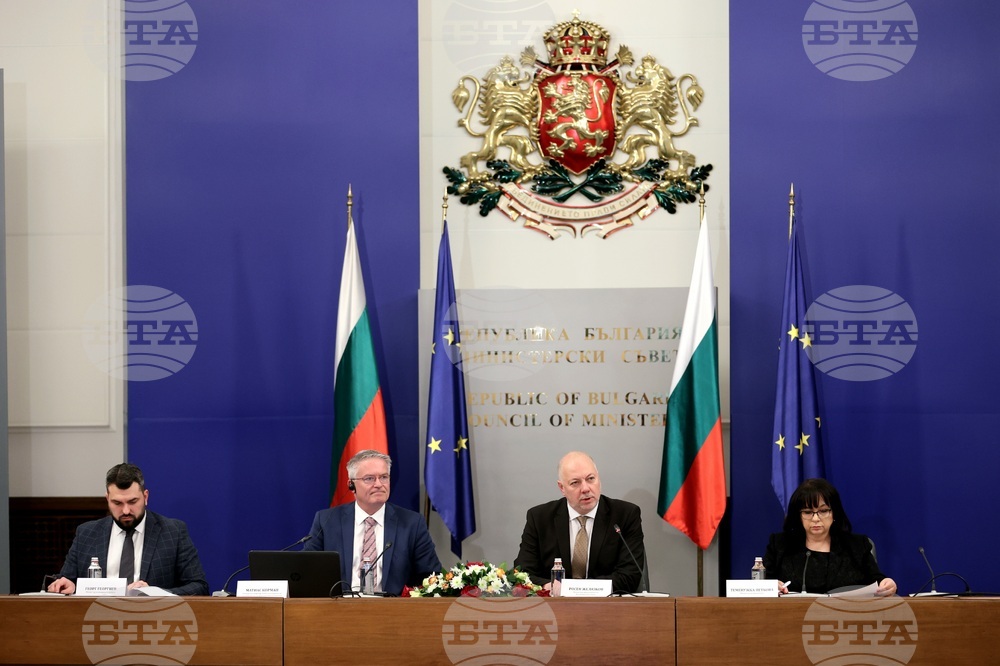
Bulgaria and the OECD are working to complete Bulgaria’s accession to the Organisation for Economic Co-operation and Development in 2026, as OECD Secretary-General Mathias Cormann presented the OECD Economic Survey of Bulgaria 2025 in Sofia and Bulgarian officials outlined the remaining steps and priorities on Thursday.
Cormann spoke at a press conference in the Granite Hall at the Council of Ministers, where he said Bulgaria’s progress towards OECD membership has been very good in recent months and that the government’s engagement over the past 12 months is highly valued, adding he hopes the process can be concluded successfully by the end of 2026.
“In recent years, Bulgaria has steadily narrowed income disparities compared with OECD countries. The reforms adopted as part of the country’s accession process to the OECD will allow for further progress by strengthening competition and supporting the fight against corruption,” Cormann said. “Public debt is low, but prudent fiscal policy is now needed to preserve long-term fiscal sustainability and help bring down elevated inflation. Raising business productivity – in particular by reducing barriers to market entry – and improving the school system should be key structural policy priorities,” he added. Outgoing Prime Minister Rosen Zhelyazkov, outgoing Finance Minister Temenuzhka Petkova and outgoing Foreign Minister Georg Georgiev attended the briefing.
Zhelyazkov said OECD accession is Bulgaria’s next major economic and political task and argued that membership is not just a matter of prestige but a factor for investment potential and the environment in which Bulgarian society and business develop. He outlined the process as organized into 25 thematic working groups, reported progress in completed reviews, and said Bulgaria’s key challenges relate to competitiveness, rooted in better education, a stronger labour market, an improved investment climate and more effective public administration. He expressed hope the effort would yield membership “as early as 2027”, while also arguing that successive governments would remain committed to the goal.
National Assembly Chair Raya Nazaryan met with Cormann during his official visit to the National Assembly. Nazaryan said Bulgaria continues work on meeting OECD recommendations and aims to complete the accession process in 2026, describing OECD membership as a cross-party national priority involving all competent institutions.
She highlighted Parliament’s role in expediting OECD-related legislation, saying that over the past 18 months the National Assembly has passed 11 bills amending existing legislation tied to implementing OECD recommendations, most recently in January, and noted the establishment in May last year of a Subcommittee to Support Bulgaria’s OECD Accession Process with MPs from all parliamentary parties. Nazaryan said Bulgaria remains committed to macroeconomic stability and fiscal discipline and is addressing recommendations related to competitiveness, innovation and human capital, the energy and digital transitions, transparency and combating corruption.
The OECD Economic Survey of Bulgaria concludes that stronger and more resilient growth would be supported by boosting business productivity and addressing fiscal pressures, recommending front-loaded fiscal consolidation and longer-term measures to manage pressures related to defence spending, the green transition, ageing and investment needs, including by reducing informality and improving tax compliance. It says Bulgaria’s income has continued to converge towards OECD advanced economies, though at a slower pace than some regional peers, while the productivity gap remains relatively large, and urged a gradual rebalancing of growth from consumption to investment.
“Education outcomes are weak. The population is ageing rapidly, and outward migration has reduced the supply of workers, even though net migration has turned positive in recent years,” the Survey reads. It projects real GDP growth of 3.0% in 2025 and 2.6% in 2026, and advises reforms to improve the business environment, remove obstacles to market entry, support innovation and competition, and step up anti-corruption efforts, alongside measures in climate and energy policy and further education reforms.
/RY/
news.modal.header
news.modal.text