site.btaUPDATED Outgoing PM Zhelyazkov: Bulgaria's Push for OECD Membership Key Economic, Political Goal
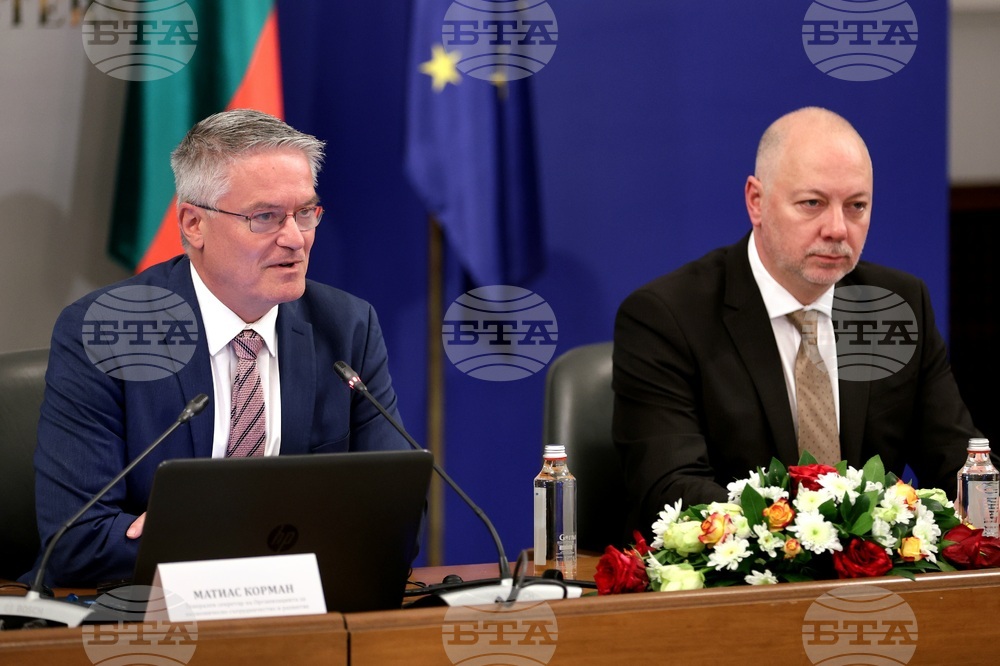
Outgoing Prime Minister Rosen Zhelyazkov said on Thursday that Bulgaria’s push to join the Organisation for Economic Co-operation and Development (OECD) was the country’s next major economic and political task.
Zhelyazkov spoke at a press conference at the Council of Ministers where OECD Secretary-General Mathias Cormann presented the OECD’s annual report on Bulgaria’s economic development, with Outgoing Minister of Foreign Affairs Georg Georgiev and Outgoing Minister of Finance Temenuzhka Petkova also attending.
Zhelyazkov said that the OECD brings together 38 developed countries worldwide. He added that Bulgaria is nearing the end of its third roadmap: the first covered the 2018-2020 period, the second 2021-2023, and the third 2023-2025.
He said the accession process was organised into 25 thematic working groups, where discussions were held and progress was assessed. By early 2025, seven of the 25 groups had completed their reviews, Zhelyazkov said.
Zhelyazkov said that so far in 2025 Bulgaria had completed a further nine reviews, with two more nearing completion, bringing the total to 11. He added that seven remained and were expected to be finalized successfully this year, enabling Bulgaria to join the organisation.
Zhelyazkov said this was not merely a matter of prestige, but also a key factor for the country’s investment potential, the environment in which Bulgarian society develops, and the conditions that enable Bulgarian businesses to perform successfully.
He said Bulgaria’s main challenges were linked to competitiveness, and that the foundations of competitiveness lay in better education, an improved investment climate, a stronger labour market, and broader measures to enhance the effectiveness of the public administration.
He added that this meant creating conditions for higher value added and stronger labour productivity in Bulgaria, while taking into account all challenges, including demographic trends and the pressure on the country’s social systems.
After Cormann presented the OECD report, Zhelyazkov said that Bulgaria has always found a way to succeed, though it has invariably come at a high cost. Bulgaria’s EU accession was preceded by a crisis, while entry into the banking union and the path toward Schengen and the euro area were marked by years of instability.
Now, once again, the country is experiencing a period of political uncertainty over how it will meet these challenges, Zhelyazkov said. He expressed hope that this national effort would yield a positive outcome and secure OECD membership as early as 2027. Competing in a challenging regional environment alongside Romania and Croatia, Bulgaria is poised to become the OECD’s 39th member, Zhelyazkov said, adding that he is confident successive governments will remain committed to that goal.
Bulgaria was invited to open accession negotiations with the OECD in 2022 after the OECD Council adopted an accession roadmap, and the Bulgarian Council of Ministers later set up an interdepartmental coordination mechanism for the process. Bulgaria’s cooperation with the OECD dates back to the early 1990s, while the first formal expression of interest in joining dates from 2007 and was reaffirmed most recently in 2017.
Over the past year, there has been a steady increase in the number of OECD committee reviews completed in the accession process.
In late April 2025, Foreign Minister Georg Georgiev said during Question Time in Parliament that 11 of the 25 expert committees had completed in-depth reviews, with additional reviews scheduled through the end of 2025. Bulgaria had adhered to 32 OECD legal instruments and requested accession to another six, and that it joined the OECD Nuclear Energy Agency effective January 1, 2021.
In April 2025, the Agriculture Ministry reported the completion of Bulgaria’s agricultural policy review at the OECD Committee for Agriculture. In June 2025, the OECD Education Policy Committee issued a positive opinion concluding its technical review of Bulgaria’s education system, and later that month the Health Ministry reported that Bulgaria passed the Health Committee’s technical review in Paris.
In early June 2025, Foreign Minister Georg Georgiev and OECD Secretary-General Mathias Cormann signed an agreement on privileges, immunities and facilities granted to the OECD, which is a required step in the accession process. The Foreign Ministry reiterated an ambition to complete the technical phase by the end of 2025 or early 2026, targeting full membership later in 2026. By October 2025, Georgiev said reviews had been completed in 14 of 25 committees, with the Health Committee and the Committee for Scientific and Technological Policy “practically completed” pending formal opinions, which would raise the total to 16. Georgiev set out a timeline aimed at completing technical reviews by end-2025/early-2026, securing an invitation by mid-2026 and completing accession by end-2026.
Late-2025 reporting highlighted remaining technical reviews, notably tax and competition. In November 2025, National Revenue Agency officials said Bulgaria was awaiting an OECD opinion on transfer pricing legislative changes, with the aim of concluding taxation-related reviews by January. In December 2025, OECD Competition Committee finalized Bulgaria’s competition policy review (December 4), and Bulgaria’s OECD accession coordinator Elizaveta Simeonova said reviews had been completed in 17 of 25 thematic committees, with tax policy review finalization expected soon; she said completion of the technical phase by end-2025 or early-2026 would enable the OECD Council to take a political decision to invite Bulgaria in 2026, followed by ratification.
/RY/
news.modal.header
news.modal.text