site.btaMedia Review: February 25
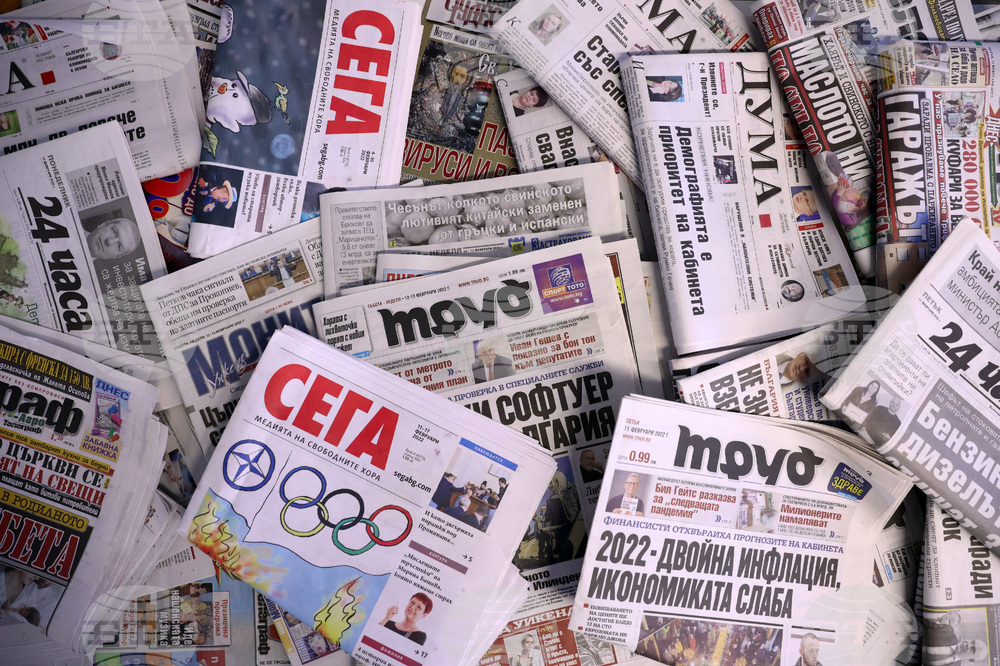
HOME SCENE
Bulgarian National TV (BNT) reported on Tuesday that the Sofia City Prosecution Office has ordered a preliminary check into the actions of caretaker Interior Minister Emil Dechev following three reports alleging pressure on investigators working on the Petrohan–Okolchitsa case, the prosecution service said.
The check has been assigned to the General Directorate for Combating Organized Crime (GDBOP). According to the prosecution, the first signal was submitted by members of parliament, while two additional reports were later filed by senior Interior Ministry officials. The statements reportedly describe similar allegations of direct interference and pressure by the Interior Minister on the objective course of the investigation. The three reports have been consolidated into a single file. Prosecutors said they are legally obliged to verify whether there is evidence of a crime.
Speaking on Bulgarian National Radio (BNR), Dechev rejected the allegations, describing the move as a “panic attack” by the prosecution against him. He said the signal resembled a scripted scenario and accused the prosecution of diverting attention from unresolved criminal cases. Dechev added that he had been informed by GDBOP leadership about the ordered check and stressed that he would not interfere in the investigations into the Petrohan and Okolchitsa cases. He also expressed readiness to cooperate with the review.
The developments come amid escalating tensions between the Interior Ministry and the prosecution service over the handling of high-profile investigations.
***
BNR: Caretaker Prime Minister Andrey Gurov said on Wednesday that an “intimidation operation” had been launched against Interior Minister Emil Dechev.
At the start of Wednesday’s government meeting, Gurov announced that the session would be held in Dechev’s absence.
“Not because he will disappear, not because he has torn a meniscus [apparently referring to Interior Ministry deputy secretary general Yavor Serafimov, who was nowhere to be found by Dechev, after which it turned out the former was hospitalized with a torn meniscus], but because an intimidation operation has been set in motion against him,” Gurov said.
He added that when a minister begins to “clean the Interior Ministry of dependencies,” reactions follow swiftly. “Scriptwriters appear, signals appear, prosecutors appear. This will not stop us,” the Prime Minister said.
BNT and NOVA TV and bTV also cover the topic how Gurov alleges that an intimidation operation has been launched against the caretaker Interior Minister.
***
NOVA TV: Journalist Yovo Nikolov said that every new government seeks to make changes in senior positions, describing it as normal for top officials to be replaced. Speaking on NOVA TV’s morning programme, he added that removing acting Prosecutor General Borislav Sarafov would be more difficult, but described as commendable the steps reportedly being taken in that direction by caretaker Justice Minister Andrey Yankulov.
PR expert Diana Damyanova said she does not view the current reshuffles by the Cabinet of Andrey Gurov as a political purge. However, she argued that Gurov’s mistake was replacing GERB-affiliated appointees with those linked to Continue the Change, warning that this could carry an electoral cost.
Nikolov cited data from the Bulgarian Helsinki Committee indicating that 260 magistrates out of 4,000 had been subjected to surveillance over a ten-year period, claiming they are under serious pressure from law enforcement bodies. He added that it remains unclear where certain documents allegedly used to exert pressure are located.
Damyanova also commented on a request by the Anti-Corruption Fund for access to information under the Access to Public Information Act concerning an organization linked to Ivaylo Kalushev, which had been described by critics as an attempt to pressure state security institutions. She argued that the document in question had been prepared by the organization itself and handed to the Fund for submission.
Nikolov further warned of attempts to delegitimize NGOs, saying this risks eroding civil society. He concluded that authorities may be underestimating the resilience of the status quo in their push for reforms.
***
bTV leads with a story about how former Bulgaria international Dimitar Berbatov has been appointed adviser to caretaker Prime Minister Andrey Gurov on youth and sports.
Berbatov will assist the Prime Minister and the government in developing and implementing policies related to sport, active lifestyles and youth development, the Council of Ministers said. He said he would take on the role without remuneration, motivated by a desire to contribute to a sustainable and long-term policy framework in the sector.
As a first step, Berbatov will launch a dialogue with the sports community by sending a strategic questionnaire to all licensed sports federations to gather objective data on the condition of various sports and the needs of clubs. The collected information will serve as the basis for an expert analysis intended to support the development of comprehensive long-term policies by a future regular government.
Berbatov said sport should be elevated to the level of a national strategy, adding that the Prime Minister’s personal engagement signals the State’s commitment to promoting sports activities.
Born in 1981, Berbatov had a distinguished playing career with clubs including Manchester United, Tottenham Hotspur and Bayer Leverkusen, winning two English Premier League titles and finishing as the league’s top scorer in the 2010–11 season. He is Bulgaria’s all-time leading goalscorer and a seven-time Bulgarian Footballer of the Year. After retiring, he founded the Dimitar Berbatov Foundation and has been active in football administration and commentary.
The news of Berbatov’s appointment is also covered by the major media outlets.
ECONOMY
Capital: Bulgaria’s three largest telecom operators - A1 Bulgaria, Vivacom and Yettel Bulgaria - continued their upward trajectory in 2025 after posting record results in 2024, according to reported first-half financial data.
Industry figures show growth across all key indicators, reflecting the sector’s ongoing transformation beyond traditional voice and internet services into content, streaming, fintech and B2B IT solutions. According to official reports by the Communications Regulation Commission (CRC), the telecom market expanded by 50% between 2020 and 2024, reaching an estimated value of around EUR 2.1 billion in 2024 — roughly matching the combined annual revenues of the three operators that year.
Data for the first six months of 2025 indicate that the growth trend is continuing. Combined revenues of the three telecoms rose by nearly 7% year-on-year to approximately EUR 1.05 billion for the period.
A1 Bulgaria, part of A1 Telekom Austria Group, maintained its market leadership with revenues of EUR 404 million in the first half of 2025, up from EUR 368 million a year earlier. Service revenues increased to EUR 321 million from EUR 301 million, while EBITDA rose to EUR 178 million from EUR 165 million. Equipment sales, including smartphones and devices, jumped nearly 25% to EUR 77 million.
Vivacom, owned by United Group, reported revenues of EUR 376.2 million for the first half of 2025, compared with EUR 357.3 million a year earlier. The growth was driven by organic increases in mobile and TV subscribers and the integration of satellite operator Bulsatcom, acquired in 2023. Vivacom posted EBITDA of EUR 159.7 million for the period and ranks second in revenue and first in profit within its group.
Yettel Bulgaria, part of e& PPF Telecom Group, generated revenues of EUR 272 million in the first half of 2025, up from EUR 261 million in the same period of 2024. EBITDA increased to EUR 77 million from EUR 75 million year-on-year. Its infrastructure subsidiary CETIN Bulgaria also improved performance, reporting revenues of EUR 83 million, compared with EUR 76 million a year earlier.
All three operators reported growth in both revenue and profit. In addition to service diversification, another key driver has been the migration of customers to higher-priced plans, a strategy commonly referred to by operators as upselling, further supported in recent years by price indexation linked to inflation.
***
Imports of dairy products have increased by 43% over the past five years, while the sector is nearly monopolized by two large Greek companies, Competition Protection Commission Chair Rossen Karadimov said.
Presenting an analysis of the food sector before mayors and representatives of 179 municipalities, Karadimov said the study identified serious imbalances, particularly in less developed regions. The report highlights significant trade mark-ups by major retail chains, often at the expense of producers. According to the data, mark-ups frequently increase even after suppliers grant mandatory discounts. He cited mark-ups reaching 77% for milk, 82% for cheese, 91% for yellow cheese, 89% for eggs, 73% for cream and up to 135% for mineral water.
Karadimov outlined three main factors behind the distortions: transport costs, compulsory discounts imposed by retail chains, and producers’ inability to supply the large volumes required by big retailers. He added that small shops face similar pressures due to intermediaries.
The analysis also shows declining domestic production: fresh milk output is down 8%, cheese 9%, yellow cheese 14%, eggs 17%, and raw milk production has fallen by 25%. Bulgarian milk purchases are increasingly being replaced by imports of powdered milk from Romania, contributing to livestock slaughter, depopulation of rural areas and worsening demographic trends, he said.
The full report and policy recommendations have been submitted to the Council of Ministers, relevant ministries and Parliament. As a possible solution, Karadimov proposed creating short supply chains through state-funded municipal logistics centres to support local producers.
He stressed that the Commission has no authority to regulate prices, noting that information has been forwarded to the National Revenue Agency and the Consumer Protection Commission. However, he said that since August last year, prices of basic food products have not increased, drawing a comparison with Greece, where similar stabilization followed the imposition of substantial fines.
Karadimov spoke during a discussion marking the 30th anniversary of the National Association of Municipalities, attended by caretaker ministers and local government representatives.
UKRAINE WAR - ANNIVERSARY
The fourth anniversary of Russia’s invasion of Ukraine and subsequent war dominates the headlines of Bulgarian media.
“Who Will Pay USD 600 Billion for Ukraine’s Reconstruction?” reads the headline of a signed commentary in Trud.
The article reflects on the fourth anniversary of Russia’s invasion of Ukraine, contrasting what it describes as European Commission President Ursula von der Leyen’s optimism about peace with more cautious assessments from major EU leaders and Western analysts.
According to the commentary, von der Leyen, speaking in Kyiv, suggested that peace could come immediately if Russian President Vladimir Putin accepted the terms of Ukrainian President Volodymyr Zelenskyy. Other EU leaders, however, reiterated that support for Ukraine would continue “as long as necessary,” while analysts in Western European media were described as largely pessimistic about a near-term end to the war, viewing the conflict as deadlocked.
The commentary notes that despite early forecasts four years ago predicting Ukraine’s collapse, the country has maintained resistance along a front line stretching over 1,000 kilometres. It cites statements by Ukraine’s top military commander Oleksandr Syrskyi that Ukrainian forces recently regained 400 square kilometres in the southeast, while Russia reportedly captured over 5,000 square kilometres in 2025.
At the same time, the article points to what it describes as heavy Russian losses in manpower and equipment, but argues that these have not weakened the Kremlin’s resolve. Western military experts are quoted as characterizing Ukraine’s recent gains as “symbolic progress” that does not reverse Russia’s gradual advantage.
The commentary also highlights economic and diplomatic constraints: Russia faces economic pressure, Ukraine depends heavily on Western support and lacks reserves, while negotiations remain stalled. It notes divisions within the EU, including Hungary’s opposition to additional sanctions and financial support packages, and Slovakia’s dispute with Ukraine over the Druzhba oil pipeline.
A central focus of the piece is the estimated cost of Ukraine’s post-war reconstruction. Citing a recent document by the World Bank, the article says rebuilding could require EUR 588 billion (about USD 600 billion), a figure that has sparked debate in Western European media.
The commentary questions who would shoulder the burden. It notes that around USD 250 billion in frozen Russian assets in Western countries could potentially be used for reparations, but argues that this would still leave a substantial funding gap likely to fall on European taxpayers, as the United States appears reluctant to commit further resources.
The piece concludes by warning of potential internal tensions within Ukraine between those who fought in the war and those perceived as having benefited from it, citing commentary in French and Italian media. It also refers to statements by President Zelenskyy in the European Parliament criticizing unnamed states as anti-Ukrainian and anti-European.
Overall, the signed commentary portrays the conflict as strategically stalled, with unresolved questions over peace terms and reconstruction costs posing significant challenges for Europe.
***
Mediapool: Prime Minister Andrey Gurov said Bulgaria’s caretaker government guarantees continued support for Ukraine during a rally in Sofia marking four years since the start of the war.
Dozens of Bulgarians and Ukrainians gathered near the Sveta Sofia Church on Tuesday to commemorate the anniversary. Among those attending were Sofia Mayor Vasil Terziev, Ukraine’s Ambassador to Bulgaria Olesya Ilashchuk, and MPs, mainly from Continue the Change–Democratic Bulgaria.
Addressing the crowd, Gurov said that over the past four years Ukraine has been fighting not only for itself but for a Europe and a world where the rule of law prevails over the rule of force. “We hope for peace and a strong Ukraine, but until that becomes a reality, we must continue to support Ukraine,” he said, adding that the caretaker government would ensure that this support continues.
Ambassador Ilashchuk thanked Bulgaria for its assistance, including support for Ukrainian refugees, and noted that 1,462 days have passed since the war began. “Ukraine wants peace and is defending itself,” she said.
Mayor Terziev stressed that while Ukraine is under physical attack, Bulgaria is not, but warned that the country faces other forms of aggression. He said Bulgaria and other European states are being targeted through disinformation, efforts to undermine trust in institutions, and attempts to sow division in society.
“War is waged not only with tanks, but also with disinformation, fear and division. When democracy is portrayed as chaos and authoritarianism as stability, that too is an attack,” Terziev said. He added that supporting Ukraine is not an abstract geopolitical gesture but a principled stance recognizing the difference between aggressor and victim.
The event concluded with a minute of silence in memory of the victims of the war.
***
Dnevnik: In a video address marking four years since the start of the war, Ukrainian President Volodymyr Zelenskyy delivered a message to the nation recalling the events of the first days of the conflict, the victims of Russian aggression, and the resilience of Ukrainian soldiers and society, Ukrainska Pravda reported.
Speaking from his bunker on Bankova Street in Kyiv - from where he has contacted world leaders to request military assistance - Zelenskyy reflected on the early days of the invasion.
“Today marks exactly four years since Putin said he would take Kyiv in three days. That says a lot about our resistance and how Ukraine has fought all this time,” he said. “Behind these words stand millions of our people. Behind them are great courage, hard work, endurance and the long path Ukraine has walked since February 24.”
Zelenskyy showed footage of the long corridors and offices inside the bunker, where hundreds of people are based and where daily meetings with the military, phone calls and decision-making processes take place.
/MY/
news.modal.header
news.modal.text