The World Ahead 2026 Sofia Gala Dinner
![Central Bank Governor: Process of Euro Adoption in Bulgaria Proceeding as Expected]()
![Central Bank Governor: Process of Euro Adoption in Bulgaria Proceeding as Expected]() Bulgarian National Bank (BNB) Governor Dimitar Radev during the conference segment of The World Ahead 2026 Sofia Gala Dinner, Sofia, February 12, 2026 (BTA Photo/Blagoy Kirilov)
Bulgarian National Bank (BNB) Governor Dimitar Radev during the conference segment of The World Ahead 2026 Sofia Gala Dinner, Sofia, February 12, 2026 (BTA Photo/Blagoy Kirilov)
site.btaCentral Bank Governor: Process of Euro Adoption in Bulgaria Proceeding as Expected
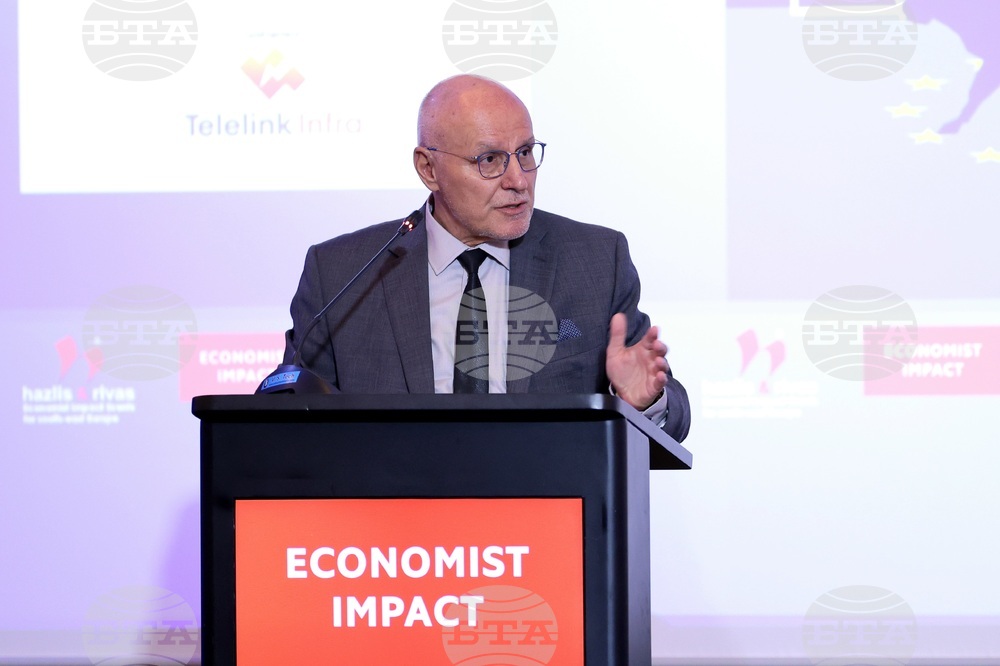
The available data so far indicate that the process of adopting the euro in Bulgaria is proceeding in line with preliminary expectations, both in terms of the technical transition and price dynamics in the country, Bulgarian National Bank (BNB) Governor Dimitar Radev said on Thursday during a conference segment of The World Ahead 2026 Sofia Gala Dinner, organized by The Economist, which took place at the Grand Hotel Millennium Sofia.
According to Radev, nearly 85% of lev banknotes and coins have already been withdrawn from circulation, while more than EUR 7 billion have been put into circulation in the country.
"The banking system, payment infrastructures, businesses and service providers have adapted within the planned parameters. This result reflects the accumulated preparation, institutional coordination and consistent communication with the public. It is precisely at moments when framework conditions change that the most lasting trust is built," he said.
Radev stressed that price stability remains a key component of public trust. For that reason, assessments of inflationary trends must be based on comprehensive data and rigorous analysis, rather than isolated observations or short-term perceptions.
He cited preliminary estimates published by the National Statistical Institute and Eurostat, according to which, based on the Harmonised Index of Consumer Prices, annual inflation in Bulgaria in January 2026 stood at about 2.3%, which he said "generally corresponds to price trends in the euro area".
"At an aggregate level, the adoption of the euro has not led to significant additional inflationary effects in the first month of the year. A preliminary analysis conducted by experts from the European Central Bank and the Bulgarian National Bank shows that the transition to the euro was associated with a limited and temporary price effect of around 0.3-0.4 percentage points in monthly inflation in January," Radev said.
He underscored that this effect was concentrated mainly in specific service categories and broadly corresponds to the experience of other countries that joined the euro area in the past.
Radev pointed out that a clear distinction should be made between short-term transition-related effects and longer-term price adjustment processes.
"The important question is not whether relative prices adjust, which is inevitable, but whether this adjustment takes place in an orderly manner and is driven by market forces," he said.
The BNB Governor emphasized that the euro entails a common monetary policy, but does not eliminate national responsibility in other key areas of economic policy, such as fiscal prudence, effective supervision and institutional discipline.
Radev also noted that interpreting corruption from an economic and institutional perspective, rather than a purely moral one, highlights its impact on trust and efficiency.
"When trust is undermined, the benefits of euro area membership cannot be fully realized. At the same time, anti-corruption efforts that are not embedded in a stable institutional framework rarely have a lasting effect," he said.
He added that European rules and mechanisms contribute to the predictability of processes, including in periods of domestic political instability.
"In this sense, a pro-European orientation and effective governance are not alternatives but mutually reinforcing elements. In today’s global environment, stability itself has become a strategic resource. For a small and open economy like Bulgaria, euro area membership changes the country’s risk profile. It reduces currency-related uncertainty, deepens financial integration and anchors the economy within established supervisory and crisis-management structures," Radev said, adding that in the long term improved financing conditions can be expected, provided policies remain consistent.
According to him, Bulgaria's euro area membership also has a regional dimension for Southeast Europe.
"The concept of 'sovereignty' is often interpreted in a symbolic sense. In today’s economic environment, sovereignty is increasingly measured by the ability of institutions to take decisions that are predictable, reliable and sustainable over time," Radev said, adding that from this perspective euro area membership does not represent a loss of sovereignty, but a transition to participation in a common institutional framework where decisions are taken jointly.
"The euro is not an end goal. It is a framework in which the quality of institutions and the sustainability of policies become even more visible," the BNB Governor added.
/RY/
news.modal.header
news.modal.text