The World Ahead 2026 Sofia Gala Dinner
![IMF Representative for Eastern Europe: Bulgaria’s Euro Adoption Must Be Accompanied by Good Policies to Guarantee Higher Standard of Living]()
![IMF Representative for Eastern Europe: Bulgaria’s Euro Adoption Must Be Accompanied by Good Policies to Guarantee Higher Standard of Living]() International Monetary Fund (IMF) Regional Representative for Central, Eastern and Southeastern Europe Carlos Mulas Granados, Sofia, February 12, 2026 (BTA Photo/Blagoy Kirilov)
International Monetary Fund (IMF) Regional Representative for Central, Eastern and Southeastern Europe Carlos Mulas Granados, Sofia, February 12, 2026 (BTA Photo/Blagoy Kirilov)
site.btaIMF Representative for Eastern Europe: Bulgaria’s Euro Adoption Must Be Accompanied by Good Policies to Guarantee Higher Standard of Living
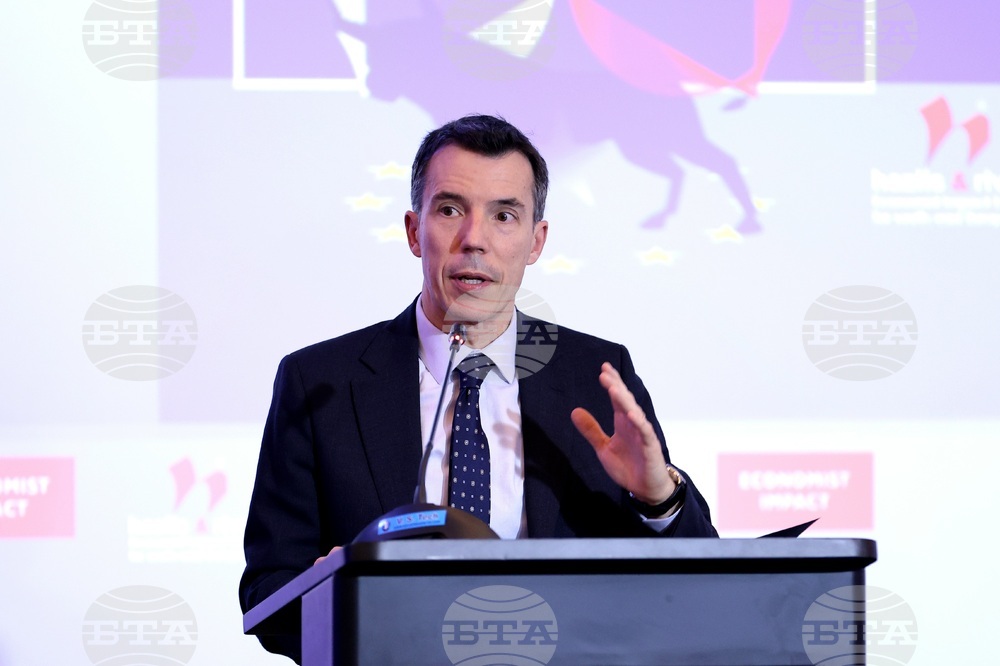
Bulgaria’s accession to the euro area is a historic moment, but it does not in itself guarantee a higher standard of living, International Monetary Fund (IMF) Regional Representative for Central, Eastern and Southeastern Europe Carlos Mulas Granados said at a conference segment of The World Ahead 2026 Sofia Gala Dinner on Thursday. The event was organized by The Economist.
Participants in the forum included Bulgarian National Bank Governor Dimitar Radev, Bank of Greece Governor Yannis Stournaras and European Central Bank Chief Economist Philip Lane.
Mulas Granados congratulated Bulgaria on joining the euro area and described the year as a key historic milestone, comparable to the country’s accession to the European Union nearly 20 years ago. He looked back to 2000, when Bulgaria began negotiations to join the EU, noting that at the time GDP per capita was below one third of the EU average, whereas today it has reached two thirds of the European average.
He stressed that although this represents important progress that has changed people’s lives, it is not sufficient, and adopting the euro must be accompanied by “good policies” in order to take convergence to the next level.
In the short term, the IMF recommends tightening fiscal policy to prevent potential overheating of the economy, as well as enhanced monitoring of credit and financial risks.
As a key medium-term challenge, Mulas Granados highlighted demographic trends. According to him, Bulgaria’s working-age population is expected to decline by up to 20 percent over the next 25 years — one of the fastest rates of decline globally. At the same time, labour productivity per person stands at only about 50 percent of the EU average. He also pointed to significant gaps in digital skills.
Regarding investment, the IMF representative noted that its share of GDP has gradually declined in recent years and is currently below the EU average. Expenditure on research and development (R&D) is among the lowest in Europe.
According to Mulas Granados, the solution begins with people — by encouraging economically inactive individuals to enter the labour market, hiring foreign workers and facilitating the return of skilled Bulgarians from abroad. Raising productivity will require better educational outcomes, improved digital skills and greater investment in research and development.
He underscored the importance of structural reforms to enhance competitiveness and attract foreign capital, as well as the role of better governance and the promotion of innovation. According to IMF estimates, if Bulgaria manages to overcome half of its structural deficits, this could lead to an increase in GDP of around 6 percent in the medium term.
Mulas Granados noted that Europe is currently discussing the deepening and completion of the Single Market. In this context, he gave the example that instead of having 27 different corporate regimes in the EU, a single regime — the so-called 28th regime — could be introduced, which the IMF supports as it would facilitate the growth of European companies.
To complete the final stage of its convergence, Bulgaria must be able to attract workers to ease demographic pressures and ensure accessible capital for its companies, Mulas Granados said.
In conclusion, he called on the country to use its new voice in the EU and the euro area to promote the completion of the Single European Market, which, in his view, would benefit both Bulgaria and its citizens, as well as the European Union as a whole.
/RY/
news.modal.header
news.modal.text