site.btaMicrobiologist Rusinova-Videva: Antarctic Yeasts Produce Unique Compounds with Anticancer Activity
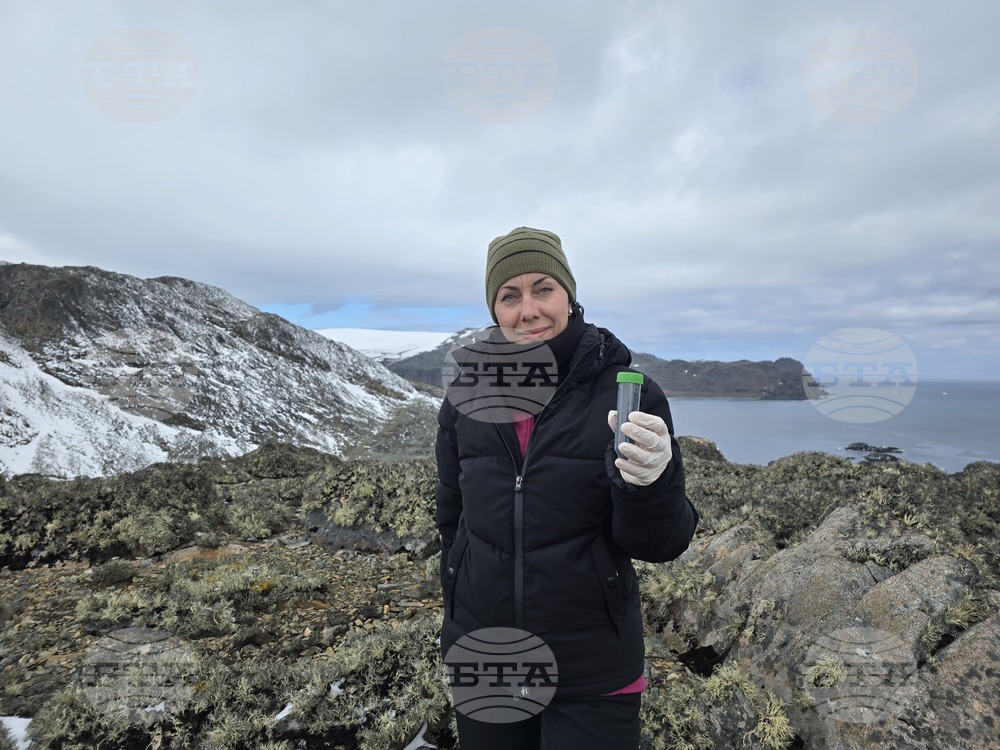
Antarctica’s extreme conditions prompt microorganisms to synthesize unique substances whose molecules act together to produce anticancer activity, microbiologist and senior assistant professor Snezhana Rusinova-Videva told BTA on Wednesday. Rusinova-Videva is part of the 34th Bulgarian Antarctic Expedition.
Rusinova-Videva is a Senior Assistant Professor at the Institute of Microbiology of the Bulgarian Academy of Sciences. She works with the team at its Plovdiv branch, which operates a biotechnology laboratory. This is her second participation in a Bulgarian Antarctic expedition, following a project she carried out in 2023.
She said that, during the earlier expedition, she personally collected samples for the first time and found them to be highly diverse. She described the discovery of new microorganisms as “the most joyful thing for a scientist,” as it expands the scope of research.
Rusinova-Videva said her team identified several yeast strains and evaluated them for anticancer potential, finding that some isolates exhibited strong cytotoxic activity against multiple cancer cell types. She added that her team was the first to publish such findings on the bioactive properties of Antarctic yeasts. Tests across different cancer models showed that the yeasts did not affect healthy cells, but selectively targeted cancer cells, she said.
This season, she hopes to discover new yeast species and expand Bulgaria’s only Antarctic yeast collection. The goal is to isolate new yeasts, identify some of the new isolates, and add them to the existing collection.
Rusinova-Videva said the project also aims to identify biopolymers, i.e. naturally produced polymers that could replace synthetic molecules in pharmaceutical matrices. Suitable yeast strains would then be produced biotechnologically in the laboratory, facilitating future scale-up and reducing the cost of the final product.
She noted that yeasts occur in soils and that sampling more habitats increases the chances of obtaining isolates. She added that a wide variety of yeasts can also be found on penguin feathers and in freshwater glacial lakes.
Sample storage and transport are now much easier thanks to the Bulgarian naval research vessel Sv. Sv. Kiril i Metodii (RSV 421), which allows samples to be frozen in the ship’s freezers, kept preserved through to Varna, and then transported to the Plovdiv laboratory, an essential step for the analyses her team performs.
Rusinova-Videva said that identifying anticancer properties is a major achievement for her team, but that the yeasts have demonstrated other applications as well. She said they developed creams in partnership with a Bulgarian company, creating a day cream, night cream and cleansing milk by replacing a specific synthetic ingredient with an Antarctic-yeast-derived component with superior properties. The cosmetics have shown beneficial effects for hydration and anti-ageing, and even provide a sun-protection factor, she said.
She added that the yeasts also have a filtration effect and can serve as “small treatment plants,” as they absorb metals from aqueous solutions.
Initial research is also under way into potential probiotic activity. Although so far tested only in fish, Rusinova-Videva said it may also prove beneficial for humans. She said preliminary studies showed a positive effect on fish gut microbiota, and that combining Antarctic yeasts with bacteria as a probiotic reduced pathogen levels in fish intestines, leading to fewer infections.
The Bulgarian naval research vessel Sv. Sv. Kiril i Metodii (RSV 421) departed for Antarctica from Varna (on the Black Sea) on November 7, 2025. After a month-long voyage across the Atlantic Ocean, the ship arrived at the Argentine naval base in Mar del Plata on December 13.
BTA has had a national press club on board the ship since 2022 and another on Livingston Island since February 2024. These are added to the news agency’s other 41 national press clubs (33 in Bulgaria, seven abroad in neighbouring countries and in nations with large Bulgarian communities, and one mobile National Book Press Club). BTA's Director General Kiril Valchev announced ahead of the fourth voyage to Antarctica on November 7, 2025 that the national news agency would send a special correspondent in January-February 2026.
He said the press clubs exist thanks to the generous support of RSV 421 and Bulgaria’s St Kliment Ohridski Base, which provide the necessary facilities.
The news items of BTA's special correspondents on RSV 421 and Antarctica are freely available in Bulgarian and English on the agency's website. They can be used free of charge by all media, with attribution to BTA. Valchev recalled that thanks to its correspondents, the news agency appears among the top results on Google when searching for the phrase “Antarctica correspondent”.
/КТ/

news.modal.header
news.modal.text