site.btaPrince Alexander I's Personal Archive Gifted to Bulgaria
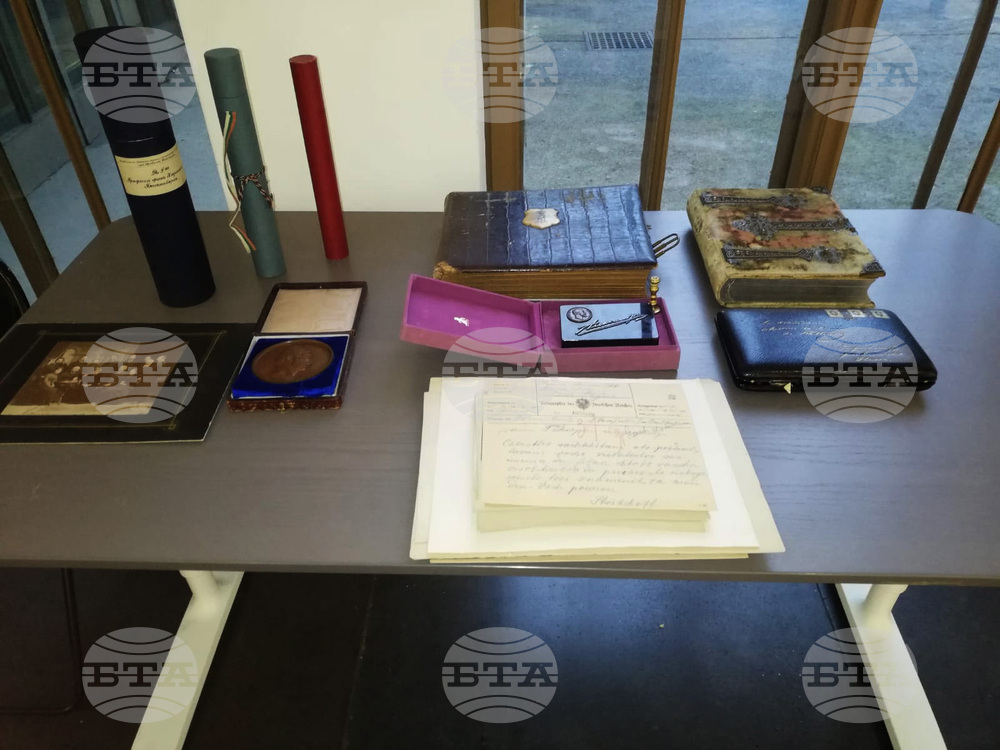
At a ceremony hosted by the Haus Wittgenstein Bulgarian Cultural Institute in Vienna on Wednesday, Michael Groller, a collateral descendant of the Battenberg family, donated the personal archive of Prince Alexander I to Bulgaria. The documents were received by Assoc. Prof. Mihail Gruev, President of the Archives State Agency.
Bulgaria's Ambassador to Austria Desislava Naydenova attended the ceremony.
The archive contains 44 documents and artefacts: family albums, photographs of Prince Alexander as a child and adolescent, documents and objects from the time during which he was head of State of newly liberated Bulgaria, and documents from later years showing his enduring links with the country. The objects include his personal seal and a jubilee plaquette, dated 1885-1886, referring to Alexander as "the first reigning prince of the Bulgarians, a victorious unifier of Northern and Southern Bulgaria".
Other items of great historic interest are a personal letter from Prince Alexander to National Assembly Chairman Panayot Slavkov, a copy of a November 1892 report from Prime Minister Stefan Stambolov to the Prince, a copy of a decree by Prince Ferdinand I of December 1891 granting Prince Alexander an annual pension of 50,000 leva, and a report by Prime Minister Stefan Stambolov requesting the grant of a pension to the former Bulgarian head of State.
The photographs in the archive include eleven photos documenting the Prince's participation in the 1877-1878 Russo-Turkish War and the Bulgarian Volunteer Corps.
Citations, medals and distinctions of Prince Alexander I, letters of gratitude and honours conferred on his wife, Johanna Loisinger, Countess von Hartenau, bear witness to the respect and connection of the Prince and his family after his death.
Born in Verona in April 1857, Prince Alexander of Battenberg was elected reigning Prince of Bulgaria in April 1879. In 1881 he suspended the Constitution and dissolved parliament, after which a newly elected Grand National Assembly granted him extraordinary powers for seven years. He endorsed the unification of the Ottoman autonomous province of Eastern Rumelia with the Bulgarian Principality in September 1885 and led the Bulgarian army to victory in the Serbo-Bulgarian War in November. Russophile officers deposed him in a coup d'etat and forced him to abdicate on August 9, 1886. The Prince was restored to the throne a couple of days later but, pressured by Russian Emperor Alexander III, left Bulgaria on August 26, 1886. Alexander married opera singer, pianist and actress Johanna Loisinger in Menton, France, in February 1889. They had a son and a daughter, whom he gave Bulgarian names: Assenne and Zvetana. The Prince died in Graz in November 1893. Respecting his wish, in 1898 he was buried in Sofia, in an expressly built mausoleum.
/LG/

Additional

news.modal.image.header
news.modal.image.text
news.modal.download.header
news.modal.download.text
news.modal.header
news.modal.text