Wrap-up
![Following Security Council Meeting, Cabinet Says Bulgaria Not Directly Threatened by Middle East Conflict]()
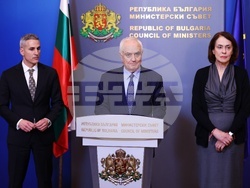
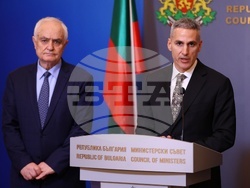
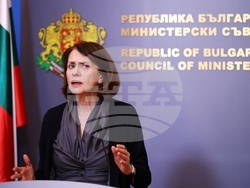
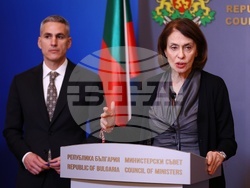
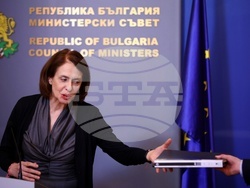
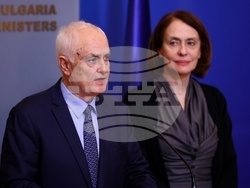
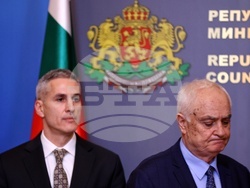
![Following Security Council Meeting, Cabinet Says Bulgaria Not Directly Threatened by Middle East Conflict]() Pictured from left: caretaker Defence Minister Atanas Zapryanov, Prime Minister Andrey Gurov, and Foreign Minister Nadezhda Neynsky at a news briefing following a meeting of the Security Council at the Council of Ministers (BTA Photo/Minko Chernev)
Pictured from left: caretaker Defence Minister Atanas Zapryanov, Prime Minister Andrey Gurov, and Foreign Minister Nadezhda Neynsky at a news briefing following a meeting of the Security Council at the Council of Ministers (BTA Photo/Minko Chernev)
![Министерски съвет - Съвет по сигурност - изявление]()
![Министерски съвет - Съвет по сигурност - изявление]()
![Министерски съвет - Съвет по сигурност - изявление]()
![Министерски съвет - Съвет по сигурност - изявление]()
![Министерски съвет - Съвет по сигурност - изявление]()
![Министерски съвет - Съвет по сигурност - изявление]()
![Министерски съвет - Съвет по сигурност - изявление]()
![Министерски съвет - Съвет по сигурност - изявление]()
![Министерски съвет - Съвет по сигурност - изявление]()
![Министерски съвет - Съвет по сигурност - изявление]()
![Министерски съвет - Съвет по сигурност - изявление]()
![Министерски съвет - Съвет по сигурност - изявление]()
site.btaFollowing Security Council Meeting, Cabinet Says Bulgaria Not Directly Threatened by Middle East Conflict
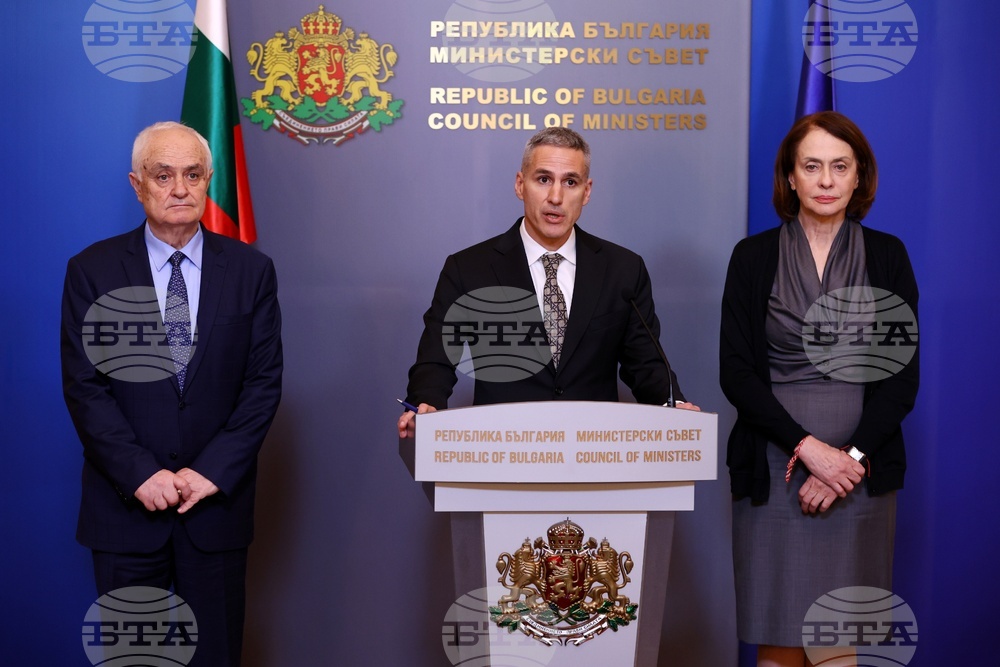
The Security Council with the Council of Ministers held a meeting here on Thursday to discuss the situation in the Middle East. The meeting, the second since the US and Israel launched attacks on Iran, was attended by representatives of the political forces in Parliament. Speaking at a news briefing afterwards, caretaker Prime Minister Andrey Gurov said that Bulgaria is not directly threatened by military actions. The evacuation of Bulgarian citizens from the conflict zone in the Middle East is continuing, caretaker Foreign Minister Nadezhda Neynsky added.
Addressing the media, Gurov said: Bulgaria is not a party to the conflict and does not participate in operations, and, as we heard from the NATO Secretary General, they are not involved in these military actions either. I also want to remind everyone that NATO’s missile defence has been designed precisely to counter attacks and threats from Iran. And, as we saw in the case of Turkiye, it worked flawlessly. For that reason, we can remain calm and rely on this collective defence. Panic must under no circumstances be used for political propaganda.
Caretaker Defence Minister Atanas Zapryanov said that the Defence Staff had activated forces and assets to strengthen the country’s air defence. He added that the Chief of Defence had presented a separate report at the Security Council meeting outlining the specific steps taken to reinforce Bulgaria’s air defence system. Zapryanov noted that the caretaker government was in contact with NATO and that a North Atlantic Council meeting scheduled for Friday would discuss air defence issues. The minister said readiness within NATO’s missile defence system would also be increased and that Bulgaria would request additional reinforcement if NATO’s supreme command deemed it necessary to provide stronger missile and air defence guarantees. Decisions on these matters were expected to be taken on Friday.
Caretaker Foreign Minister Neynsky added that the evacuation of Bulgarian citizens from the conflict zone in the Middle East was proceeding in a highly organized way. Ambassadors and consuls on the ground are involved in assisting and providing sufficient security for Bulgarian citizens, because the distances from hotels to airports are considered higher-risk areas, she said. All Bulgarian citizens have been evacuated from Iraq, while the Embassy in Jordan has assisted 130 people. "Evacuating citizens from Iran is proving difficult – this is currently our biggest problem, as the Iranian authorities at the border with Azerbaijan have stopped not only Bulgarian citizens but also citizens of other European Union countries," Neynsky noted. "We are in constant contact with our allies, including the United States, which has large military aircraft that could also take our compatriots on board," the minister added. She noted that Austria had provided assistance and that she had spoken with her counterpart from Greece, who had also offered help. According to her, evacuation of Bulgarian citizens has also been arranged from Oman. Neynsky said she had discussed possible assistance with the foreign minister of Turkiye in the event of a potential migrant flow. "At this stage there is no danger of a migrant flow, but we must be prepared," she added.
Commenting on a meeting that took place between GERB leader Boyko Borissov and caretaker Defence Minister Atanas Zapryanov ahead of the Security Council meeting, Gurov said that members of the caretaker cabinet had no place in party headquarters and should focus on their duties to ensure the security and peace of mind of Bulgarian citizens. In response, Zapryanov said that his talks with Borissov focused on two matters: whether GERB would maintain its support for the decision on the deployment of US aircraft, which he said it would, and forthcoming parliamentary decisions related to the EU SAFE instrument. Zapryanov added that he did not view the meeting as a party visit but as talks with a political force that shared responsibility for, and did not shy away from, the decision taken on February 17 and 18 regarding the stationing of US aircraft in Bulgaria. He recalled that the decision had been taken during the term of the government led by former prime minister Rosen Zhelyazkov, with GERB as the mandate-holding party. Zapryanov said he had signed the decision and informed both the political force and the prime minister at the time. The minister added that GERB’s continued support was important for the implementation of this decision under the caretaker Cabinet as well.
Representatives of political forces in Parliament spoke to reporters after the Security Council meeting, commenting on Bulgaria's security in the context of the war in the Middle East.
Continue the Change – Democratic Bulgaria MP and Yes, Bulgaria Co-chair Ivaylo Mirchev said that the government must take measures to prepare for potential a migrant wave, even though there were no indications of migrant waves at that point. He added that the Security Council was quite specific, and all questions had been answered. The reports from the special services, as well as those of the ministers, were adequate. At this stage, there is no direct threat for Bulgaria, but there are quite a few measures that need to be taken, he added.
BSP-United Left Floor Leader Nataliya Kiselova told journalists that the information presented at the meeting showed that there was no direct threat to Bulgaria, only possible asymmetric risks. She explained that “asymmetric” referred to the use of otherwise ordinary activities to disrupt the functioning of various civilian or state infrastructures, stressing that these were potential risks rather than concrete, real threats. In response to a question about whether the Cabinet had a plan to cope with the situation, Kiselova said that much of the preparatory work had already been carried out by the government of Rosen Zhelyazkov.
There Is Such a People (TISP) Floor Leader Toshko Yordanov accused the cabinet of trying to wriggle out of the questions they were asked. He added that many Bulgarians were asking questions because of the information available about US aircraft at Sofia Airport, as well as because of the tensions and military actions related to Iran. Yordanov described the recent events surrounding Iran as a conflict that was not provoked by Bulgaria and that is not a NATO operation. He emphasized that in such a situation, Bulgaria's defence is mainly linked to its membership in the Alliance.
The first meeting of the Security Council that discussed the Middle East conflict took place on February 28. Representatives of the political parties in Parliament were not invited. After the meeting, caretaker Prime Minister Andrey Gurov said that, based on information from the security services and the Defence Ministry, there was no direct military threat to Bulgaria. He added that the main priority at the time was to guarantee national security and ensure the safety of Bulgarian citizens in the region. Bulgaria is not a party to the conflict, the caretaker Prime Minister stressed, adding that the country is not involved in or participating in the military operation.
/IV/
Additional
news.modal.image.header
news.modal.image.text
news.modal.download.header
news.modal.download.text
news.modal.header
news.modal.text