site.btaRumen Radev Says He Will Set Up Political Party After Upcoming Elections
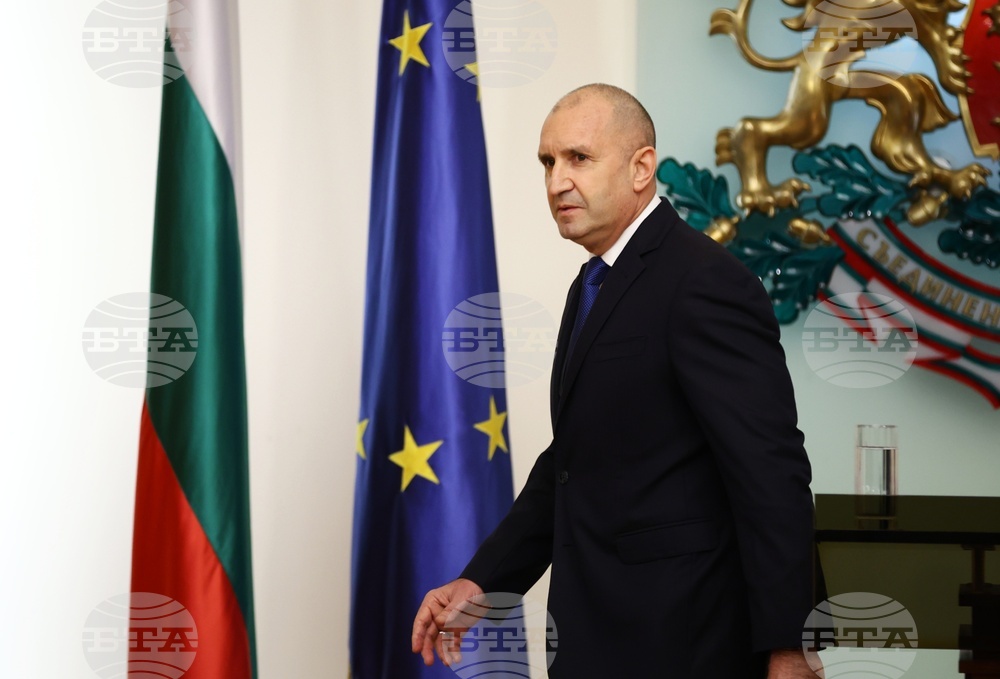
Interviewed on the Panorama talk show on the Bulgarian National Television on Friday, Bulgaria's former President Rumen Radev (2017-2026) said he intends to form a political party after the snap parliamentary elections, stressing that this would not be possible in time for the vote which is expected to be held in the coming spring.
"At this stage, it is not possible to create a party that could take part in these elections," Radev said, adding that he could not rely on setting up a new party at present. He noted that Bulgarian legislation clearly defines the deadlines for the registration of parties and coalitions, as well as for the submission of candidate lists ahead of elections. "We will comply with these deadlines, but I will refrain from going into details," he said. Asked under whose registration he would run in the elections, Radev said he could not disclose this at present, adding that there were various options. He reiterated, however, that it was currently impossible to set up a party for participation in the upcoming vote.
Radev announced his decision to resign the presidency on January 19 in an address to the nation. He tendered his resignation to the Constitutional Court on January 20.
Radev said the presidential institution was "in safe hands" with President Iliana Iotova, whom he described as having all the necessary qualities to select a caretaker prime minister. He accused the parliamentary majority of dramatically curtailing presidential powers and undermining the balance between institutions, adding that "the most convenient option for the oligarchy would have been for me to remain President".
Vice President Iotova stepped in as President after Radev's resignation. Under the Constitution, after failure to reach agreement on forming a government, the President holds consultations with the parliamentary groups and on the proposal of the candidate for caretaker prime minister, appoints a caretaker government and schedules new parliamentary elections within two months. Out of ten possible candidates, five have expressed readiness to accept a nomination as caretaker prime minister: Bulgarian National Bank Deputy Governor Andrey Gurov, Deputy Ombudsman Maria Filipova, Bulgarian National Audit Office (BNAO) President Dimitar Glavchev and BNAO Vice Presidents Margarita Nikolova and Silvia Kadreva.
According to Radev, Bulgarians have demanded an end to the existing model of corruption and lawlessness, and he considered it his duty to respond to those calls by entering parliamentary politics. He also asked citizens for forgiveness for having, at times, trusted the wrong people. Radev said public expectations had often gone beyond the President's constitutional powers, adding that citizens' patience had been put to the test.
Rumen Radev said he considers it his duty to respond to citizens' calls and to enter parliamentary politics. He noted that while travelling across the country, people had expected him to take actions beyond the scope of presidential powers. "During these nine years, when they clearly expected me to create a party, their patience has been tested," he added. He refrained from forming a party earlier because he had hoped the political class would meet citizens' expectations, which, he said, it did not.
Radev emphasized that he had not used his position as Bulgaria's President to establish a party. He accused the oligarchy of rushing to secure any name that appeared in public discussion as the name of a potential party or coalition. "Yesterday, I read that a name 'Our Bulgaria' had cropped up, and it was promptly reserved," he said. According to Radev, "these people try to obstruct the development of such a project through administrative measures".
"My goal is for Bulgaria to develop as a free, democratic, modern European state," Radev said. He identified the oligarchic model of governance as the main obstacle to achieving this vision. "This combination of concentrated public power and the seizure of vast public resources undermines statehood and blocks the country's economic development. It distorts market relations, extorts businesses, and seizes property. Instead of focusing on building a progressive, innovative economy based on free competition and productivity, the focus has been on the non-transparent distribution of public resources," Radev said.
According to him, the primary objective is to dismantle this system and strengthen state institutions. "If we fail, all future governments and their socio-economic programmes will again be hostage to the oligarchy, and we will remain at the bottom of Europe in terms of living standards and quality of life," he said. Radev added that his team is working on a comprehensive programme to block the oligarchy's access to government and political processes, cut off their control over public resources, and protect businesses from extortion. He stressed the importance of creating institutional models that prevent a recurrence of such abuses.
Asked if he intends to change Bulgaria's geopolitical position, and specifically whose territory Crimea belongs to, Radev said he would answer as he always has: "Under international law, Crimea is part of Ukraine. The reality, however, is that Crimea is part of Russia. These are facts, and no interpretation can change them," he said.
He added that any attempt to shift the focus of his campaign from domestic to foreign policy, particularly on this issue, would be "a huge gift to the oligarchy". According to Radev, the oligarchy has lost the support of the people but seeks backing from abroad, using every opportunity to cloak itself in the rhetoric of Euro-Atlanticism.
Radev said his assessments of the war in Ukraine are based on his professional military expertise and strategic training at the United States Air Force Academy, which he completed with distinction. "I apply exactly this experience when evaluating this war," he said. He questioned who encouraged Ukraine to launch its 2023 counteroffensive, which he described as "a real disaster for the Ukrainian army" and the starting point for the subsequent territorial retreat and destruction.
When asked about the status of Greenland, Radev said it is under Danish administration. He added it was surprising that Bulgarian political leaders swear allegiance to Europe yet have not taken a position on this issue. Radev also noted that Europe has learned the hard way that it is no longer at the centre of American policy, though the United States remains the most important partner and ally.
Asked whether Bulgaria should remain part of President Trump's Board of Peace, Radev said the Board declared its goal to restore peace, but "this does not override our Constitution or European law". He criticized the fact that the Bulgarian Prime Minister signed the document without a parliamentary vote and without notifying other institutions or even the Bulgarian public, saying it meant that Bulgarian policy was being conducted outside institutional channels, which he described as dangerous for the country.
/DD/
news.modal.header
news.modal.text