site.btaUPDATED December 14, 1955: 70 Years since Bulgaria's Admission to UN
Bulgaria became a Member State of the United Nations 70 years ago on Sunday, on December 14, 1955. By joining the World Body, the country emerged from international isolation in the post-Second World War period and embarked on the road to restoring its international standing and full-fledged integration into international relations.
The BTA archives keep records of the long diplomatic journey that made it possible for this country to enter the UN.
The Admission
News reports from December 1955 tell about a prolonged General Assembly debate, during which "most delegations" supported a proposal for the admission of 18 countries, listed in the order of their applications for membership: Albania, Mongolia, Jordan, Ireland, Portugal, Hungary, Italy, Austria, Romania, Bulgaria, Finland, Ceylon, Nepal, Libya, Cambodia, Japan, Laos, and Spain.
The resolution, approved by 52 votes in favour, required from the UN Security Council to revisit the issue of enlargement and recommend their entry into the organization.
The admission of Mongolia was vetoed by the Republic of China (Taiwan, then holding China’s UN seat). In response, the USSR exercised its veto power to block the accession of Japan.
To break this diplomatic deadlock, the Soviet Union proposed a "package deal" for the admission of 16 new members: Albania, Jordan, Ireland, Portugal, Hungary, Italy, Austria, Romania, Bulgaria, Finland, Ceylon, Nepal, Libya, Cambodia, Laos, and Spain. The Security Council approved the proposal by eight votes in favour and three abstentions: Belgium, Taiwan, and the United States.
The Security Council President, Sir Leslie Munro, described the day as "historic" for the UN, while Soviet representative Arkady Sobolev called it a "significant step towards an enlargement of the Organization to include states with different social and political systems".
The archive records document the final vote at the General Assembly, which convened on December 14, 1955 for a plenary session at 9:21 p.m. New York time (4:21 a.m. Bulgarian time on December 15) to approve the Security Council's recommendations for the admission of the sixteen countries as UN members. The Session, opened by the General Assembly President José Maza, admitted all 16 countries by a majority of more than two-thirds. Bulgaria's admission was approved by 50 votes in favour, two against (Taiwan and Cuba), and five abstentions (Greece, the Netherlands, the Philippines, the United States, and the Dominican Republic). Ethiopia's delegate, who entered the chamber just as the vote was being taken, also backed Bulgaria's bid. The votes on Italy, Austria, and Finland were unanimous, bringing the total number of UN Member States to 76.
In a Declaration on the occasion of the country's admission to the UN, December 15, 1955, the Bulgarian Government stressed its "profound satisfaction" with the decision and expressed gratitude to the countries that supported Bulgaria's application. The statement emphasized that Bulgaria had proven its right to be part of the UN by peaceful actions, including a reduction of the numerical strength of its armed forces and shortening the period of conscription. "The Government of the People's Republic of Bulgaria, believing in the noble mission being accomplished and to be accomplished by the United Nations, declares that the People's Republic of Bulgaria, as a member of this organization, will continue to spare no efforts for maintaining peace and security, pursuing friendly relations among peoples, and achieving cooperation in addressing international economic, social, cultural, and humanitarian issues," said Bulgarian Foreign Minister Mincho Neychev, quoted by BTA.
Another archived item is a letter of congratulations from UN Secretary-General Dag Hammarskjöld to Foreign Minister Neychev, dated December 15, 1955, by which the Swedish diplomat formally confirmed Bulgaria's admission and expressed his readiness to welcome the country's representative.
The news stories on file also bear witness to a broad public support at home for UN membership.
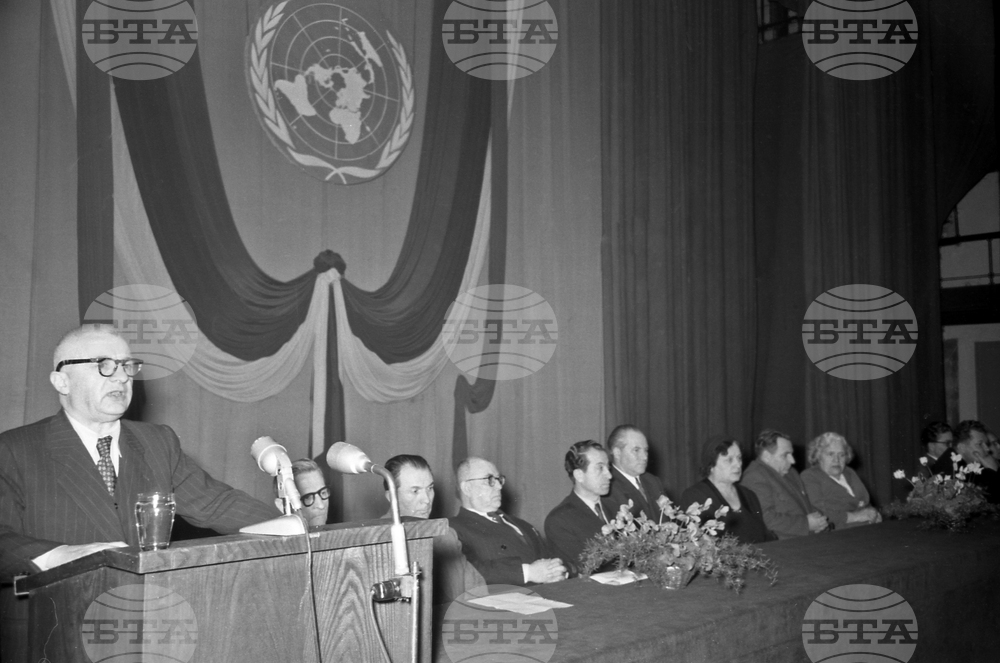
A large public meeting was held at the House of Culture of the Ministry of Interior on December 23, 1955. Attending were the Chairman of the Presidium of the National Assembly Georgi Damyanov, cabinet members, and representatives of public organizations.
Addressing the event, Academician Georgi Nadjakov emphasized that the people "expresses its deep gratitude to all countries" that had facilitated Bulgaria's admission to the UN.
In January 1956, Bulgaria's Council of Ministers decided to appoint Dr Petur Voutov (then Minister Plenipotentiary to India) as this country's first permanent representative to the UN. In mid-April 1956, Dr Voutov took office as Bulgaria's Ambassador to the United Nations (until 1959).
"By participating in the annual sessions of the UN General Assembly, in forums held under UN auspices, and in the activities of various bodies within the organization's system, Bulgaria contributes to the promotion of effective multilateralism, trust, security, and mutually advantageous cooperation in international relations," the Foreign Ministry in Sofia says on its website.
Bulgaria at the UN
Over the 70 years as UN member, Bulgaria has been elected three times as a non-permanent member of the Security Council for a two-year term, has served three times as President of the Security Council, and once as President of the General Assembly for one year.
In 2016, two Bulgarians were among the 12 candidates for UN Secretary-General, to succeed Ban Ki-moon, whose term expired that year. These were Irina Bokova, then Director-General of UNESCO, and Kristalina Georgieva, then Vice-President of the European Commission and Commissioner for Budget and Human Resources. At the first-ever public hearings in the history of the World Body, held at the UN Headquarters in New York City, Bokova placed fourth, while Georgieva shared the seventh and eighth place with Slovenia's Danilo Turk, as they scored equally.
/LG/
news.modal.header
news.modal.text