site.btaMedia Review: January 19
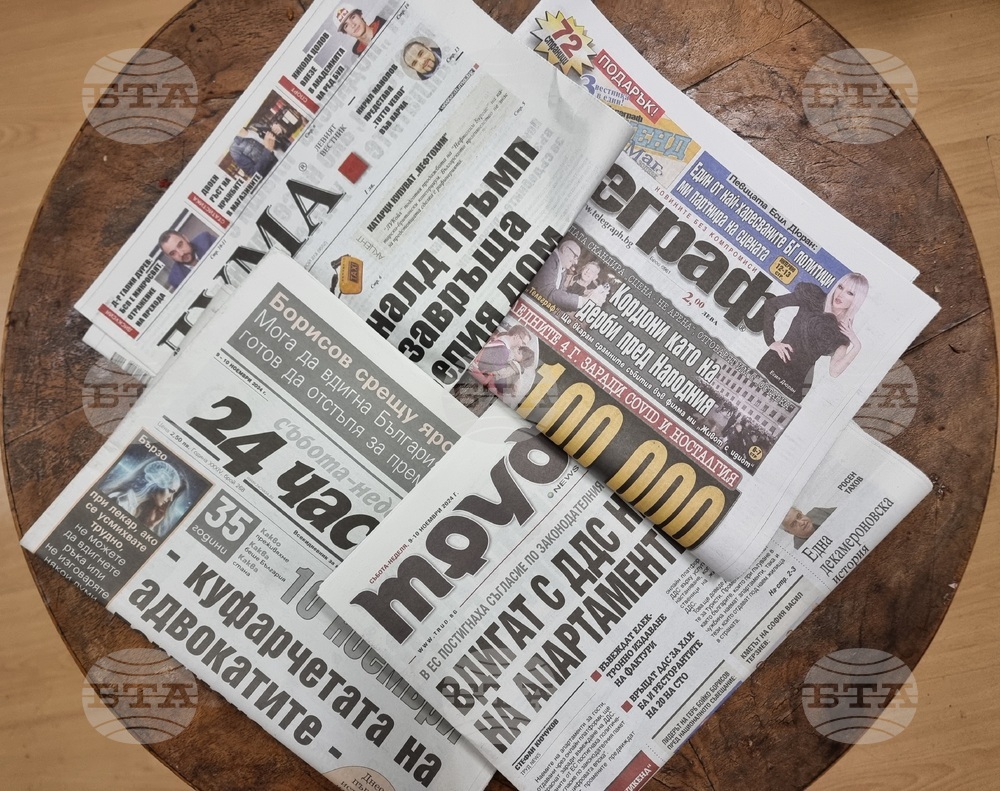
OVERVIEW
All media report on the potential change of the voting system in Bulgaria.
POLITICS
An article in 24 Chasa predicts that on Wednesday, President Rumen Radev will announce his resignation as head of State before the Constitutional Court and will enter politics to run in the early parliamentary elections. The text continues: "These are the latest expectations of politicians in the upper echelons in Sofia. According to them, the president will announce his entry into politics from Plovdiv, where he is expected on Wednesday, January 21. The position of head of State will be assumed by the Vice President, Iliana Iotova, as stipulated in the Constitution. And after being sworn in as President before the National Assembly, she will appoint a caretaker government.
"According to politicians, it has already been agreed that the Deputy Governor of the Bulgarian National Bank (BNB), Andrey Gurov, will become the caretaker prime minister, despite his controversial status among the possible prime ministers designate specified in the Constitution. Gurov is on extended leave from the BNB after the anti-corruption commission launched an investigation against him.
"Boyko Rashkov is supposed to become Minister of the Interior in the caretaker cabinet. He already held this position in Stefan Yanev's cabinet, and then in Kiril Petkov's. Rashkov is known as a staunch enemy of GERB leader Boyko Borissov and MRF [New Beginning] leader Delyan Peevski. While Rashkov was Minister of the Interior, the Ministry of the Interior arrested Boyko Borissov. The arrest was subsequently declared illegal."
* * *
Dnevnik.bg quotes the Economist Intelligence Unit's [EIU] operational risk report dedicated to Bulgaria, which points out that President Radev remains the most popular political figure in the country with an approval rating of about 45%. According to the report, if Radev founds a party, it could break the cycle of parliamentary elections producing the same result of a fragmented parliament. He could reshape the political landscape, especially if he was able to with the centre-right GERB and the centrist coalition Continue the Change - Democratic Bulgaria (CC-DB), the two largest formations in parliament today.
The EIU said that a potential cooperation between Radev and GERB would be more difficult to achieve, given the accusations that GERB has ties to the MRF - New Beginning and its leader, Delyan Peevski, who has been sanctioned under the Global Magnitsky Act for his extensive role in corruption in Bulgaria. CC-DB is described as initially formed with strong support from Radev, although they later disagreed on foreign policy issues, especially regarding Russia and Ukraine. Currently, Radev and CC-DB share a common criticism of the government and support for the protests.
The EIU writes that Radev often positions himself against traditional parties, criticizing corruption and oligarchic influence. A government led by him would likely remain formally pro-European and pro-NATO, but would pursue a more cautious foreign policy and a stronger state role in the security and strategic sectors. His government would likely take a more cautious, less confrontational line toward Russia, particularly with regard to sanctions, military aid to Ukraine, and energy policy.
The report warns that if Russia or Russia-affiliated actors decide to conduct hybrid operations and sabotage against arms manufacturers, pro-Ukrainian protests, NGO offices, and media headquarters, the goal would be to drive a wedge between pro-Russian and pro-Western segments of society.
* * *
In an interview for bTV, political scientist Ognyan Minchev compared the political status quo and the lack of information about Radev's plans for his career in politics with the situation before the 2001 parliamentary elections, when for months it was unclear whether and how Simeon Saxe-Coburg-Gotha would participate in politics. The latter was eventually proceeded to govern Bulgaria as prime minister between 2001 and 2005. According to Minchev, with just a few days to go before the start of the campaign for early parliamentary elections, there is still no definitive answer as to whether the head of State will interrupt his second term and run as a political leader, which seriously undermines the legitimacy of the presidential institution. He added that if Radev does decide to enter the party-political arena, this will bring clarity to the way the Bulgarian political system will function in the coming period.
Minchev also commented on the need for new political projects against the backdrop of persistently low voter turnout. According to him, the fact that no more than half of Bulgarian citizens vote in elections clearly shows the need for new parties and platforms that will engage non-voters. He added: "The real question is to what extent these new projects would offer real change in the public interest."
On the subject of electoral procedures, the expert criticized the practice of changing them immediately before elections. He emphasized that this contradicts international recommendations and the logic of the democratic process. According to him, the excessive focus on voting technologies, whether machine, paper, or combined, masks a deeper problem. He added: "The integrity of elections is not guaranteed by technology, but by political decisions and consensus among those involved in the process. When technology becomes the main focus, it speaks to political impotence."
* * *
Trud quoted MP Anna Aleksandrova, head of the parliamentary Committee on Constitutional and Legal Affairs, who proposed that the optical scanning devices for paper ballots should be introduced in 2027. If her proposal gets adopted, voting in the upcoming snap parliamentary elections will be similar to that in the previous ones, with both paper ballots and machines. It is unclear at this point whether the devices issuing printouts, which was removed as a process, will be reinstated, and whether the machines will be converted back into printers. Trud reports that elections experts urged lawmakers not to make major changes to election rules at the last minute, as such an approach would be risky and could increase distrust in the electoral process.
* * *
According to an op-ed published by Valeri Naydenov in 24 Chasa, implementing a majority voting system to change the current proportional representation would fix the ongoing political crisis in the country. The article reads: "Bulgarian politics is already in agony. It has undergone seven parliamentary elections over the past five years and is gearing up for an eighth, but pundits are already predicting another round of elections in the autumn, as it is clear to everyone that after the spring vote, it will be the same old story with a mishmash of parties. As will be the case after the autumn elections. How long will this continue? This is no longer a country; it is a disease.
"It could easily be cured with a therapeutic majority voting system, but neither the politicians, nor the oligarchs, nor the talking heads are willing to even mention it. [...]
"Isn't this conspiracy of silence strange, especially now that the disease is becoming terminal? Just 5 or 6 years ago, the topic of majority voting regularly reared its head in the commentary, and a referendum was even allowed in 2016. and in 2009, an experiment was even conducted with a minimal mixed system, in which only 31 MPs were elected by majority vote - just enough to spice up the bland soup.
"But even that meagre concession by the elite created a stable single-party majority (117 seats), which ruled for almost its entire four-year term, minus one month. Before resigning, that majority had miraculously grown to about 130 votes. [...] However miserable that majority experiment was, it showed that such a vote unites the leading parties and removes the unnecessary marginal players who only get in the way."
Naydenov writes that he does not mind whether the country implements machine-voting of paper ballots. He stated: "But if the parties really want to stop vote buying, the easiest way to do so is with a majority vote. It's simple arithmetic. Currently, parties buy only 3-4% of the vote, and whatever they pay for is what they get. But with a majority vote, you need 51 of the votes to get anything. If you have bought only 4 or 5%, you risk ending up with nothing and wasting your money.
"Imagine, for example, that in a single-member district with 20,000 voters, you have paid BGN 100 to 5,000 people – a total of BGN 500,000. This guarantees you 25% of the votes, but that is not enough if you need 51%. And then your opponent, without paying a single lev, gets those 51% precisely, because word gets out that you are buying votes in the ethnic neighbourhood, while giving nothing to us, the honest ones. And your BGN 500,000 goes up in smoke. Wouldn't it be wiser not to buy votes but to try to persuade people? With party-list voting, on the other hand, you don't lose a single lev, and with 25% nationally, you are guaranteed to be the leading party and will assemble a governing majority, so that you can divert a few more sacks of money to buy votes again."
* * *
Political experts Prof. Vanya Nusheva and Prof. Milena Stefanova discussed on Nova TV on Monday morning the possibility of introducing scanning devices in the voting process. According to Nusheva, such devices fail to address the key weaknesses in the electoral process, including controlled voting and the high proportion of invalid ballots. According to her, even members of parliament are not familiar with the technology they are proposing. The expert said that the new model requires significant changes, which include reformatting ballots, adapting machines, clarifying the scanning process and the electronic memory of the devices. She added: "All these details are unclear, and such a reorganization requires time, which we do not have at the moment."
Stefanova stated that the way politicians are trying to impose new technology is wrong and further undermines confidence in the electoral process. According to her, it is technologically impossible to introduce a new voting model on such short notice. She warned: "This should not be allowed under any circumstances, because it will deepen doubts about the fairness of the elections."
As a more reasonable approach at this point, Nusheva pointed out the need to focus on the human factor, which should include better training for members of section election commissions, preventing untrained or compromised individuals from participating, and making full use of the functionalities of existing machines. She stated: "The Bulgarian public is currently divided into two camps – supporters of paper and machine voting. At this stage, it is reasonable to retain both types."
FOREIGN AFFAIRS
Mediapool.bg quotes Prof. Stefan Popov, who teaches political philosophy at New Bulgarian University, who said in an interview for the Bulgarian National Radio (BNR) that US President Donald Trump's comments about Denmark are confusing, because there is no Russian threat, as he claims. No Russian or Chinese ships have been spotted there. There is no solid political substance behind Trump's statements.
The expert continued: "Trump must have a firm and clear policy of opposition against himself. He plans to wage war on Greenland? The US Congress is slowly but surely waking up, and all these things—such as the annexation of other territories—concern Congress. Neither joining or leaving NATO nor annexing foreign territory can happen without Congress."
Popov compared Trump to an F1 racing driver with the speed that he generates both national and international scandals. The professor added: "It is hard to say whether he follows any political line, although he is decisive, bold, daring, and quick. A year after taking office as president, his actions have been chaotic."
ECONOMY
In a position distributed by the Bulgarian Industrial Association and published by the BNR, 20 industry organizations in the field of food production, processing, and trade warned of a likely shortage of goods, limited supply, and growth of the grey sector, if the draft legislation on Price Control, adopted at first reading, is finally passed by the National Assembly. According to the organizations, the regulations on prices and markups are repressive, represent an extraordinary administrative burden, serious pressure on companies, and a direct factor in the destabilization of supply chains.
The businesses warn that the proposed bill can lead to a market crisis, shortages of goods, limited supply, a contraction in Bulgarian production, and ultimately an increase in unemployment, expansion of the grey sector, and the blocking and postponement of investments. The business community believes that the proposed bill is a gross interference in free pricing and market mechanisms, and that the introduction of the euro should not be an excuse for extraordinary measures that undermine competition and the free market.
TRANSPORT
The Bulgarian National Television has an article quoting Sofia municipal councillors from CC-DB who warned that Stolichen Avtotransport EAD intends to purchase second-hand buses for the capital's public transport network at a much higher price than that offered by German car dealerships. Councillor Boyko Dimitrov reported: "They are preparing an order for buses that cost EUR 15 to 20,000. Even if we add delivery, let's put them at EUR 20 to 30,000, yet they have set a projected value of EUR 100,000. In other words, even when they publish the order, it is abundantly clear that this opens the door to huge schemes."
Stolichen Avtotransport CEO Stilyan Manolov responded: "The buses to be purchased will meet all safety requirements. As CEO, I will not sign a single contract that violates the principles of safety and economic efficiency with regard to the vehicles serving the capital's residents and visitors."
/NZ/
news.modal.header
news.modal.text