site.btaPoll: Fairness of Elections Remains Key Concern and Source of Contention for Bulgarian Public
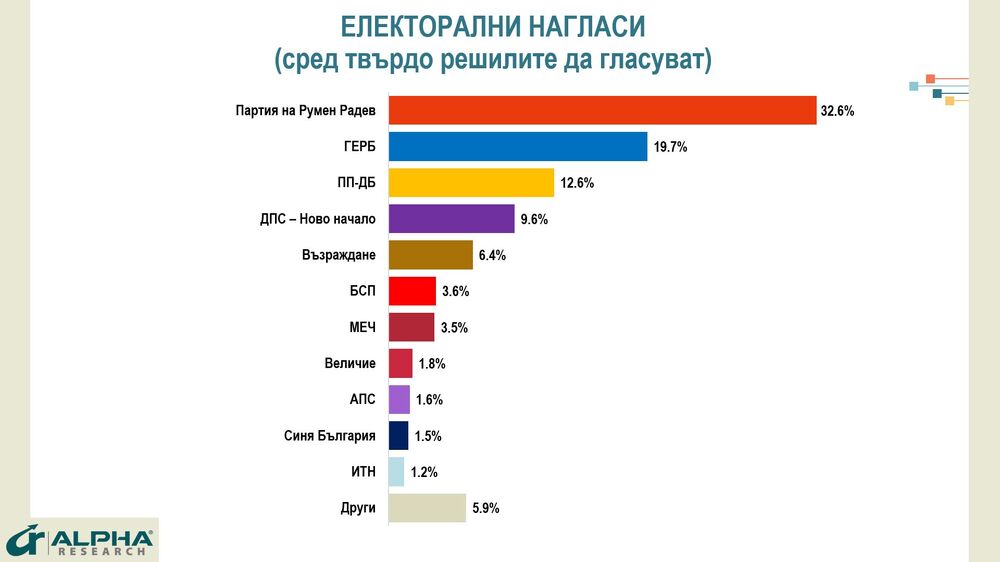
The issue of the fairness of elections remains at the center of public attention, but continues to divide Bulgarians, according to the Alpha Research polling agency, based on data from a nationally representative survey on public-political and electoral attitudes, the results of which were announced on Thursday.
The poll was conducted between February 23 and March 2, 2026, and is part of Alpha Research’s regular monitoring. It was carried out among 1,000 adult citizens from across the country. A stratified two-stage sample with quotas based on key socio-demographic characteristics was used. The information was collected through direct standardized interviews using tablets in the respondents’ homes.
Overall, 37% of respondents believe that the elections in April will be fairer than previous elections, compared with 34% who think they will be less fair. Alongside the motivation to support a particular party, expectations about the fairness of the vote are also a factor that encourages higher voter turnout, the pollsters note.
Regarding electoral attitudes, 32.6% would support a party of ex-president Rumen Radev (during the survey the name Progressive Bulgaria was not used).
According to Alpha Research, the electoral base of this new political actor consists of three large groups of voters – people who did not vote in the last elections, and former supporters of the Bulgarian Socialist Party (BSP) and Vazrazhdane. To a lesser extent, it also includes former supporters of There Is Such a People (TISP), MECh, Velichie, as well as voters from the periphery of GERB, CC–DB, MRF–New Beginning, and a number of smaller parties.
The survey shows that virtually no party will avoid electoral losses due to the appearance of the new political project. The heterogeneous nature of its voters places different and sometimes conflicting expectations on it, which is an advantage for its campaign but also a potential challenge to its political sustainability, the agency says.
According to the data, GERB continues the gradual decline recorded in December, but for the moment the party retains its core electorate at 19.7%.
Continue the Change–Democratic Bulgaria (CC-DB), whose support had risen to 17.8% due to the energy of the protests, has now fallen to 12.6%. The coalition maintains higher levels of support in the capital and the largest regional centers, but is experiencing erosion across the rest of the country, the analysts note.
MRF-New Beginning maintains support of 9.6%.
Losses to Vazrazhdane affect mainly its electoral periphery, which had fueled the party’s expansion since 2022. Its current support is at around 6.4%, although more significant fluctuations are also possible.
These are the five parties that will likely be represented in the future legislature, according to the survey data. The Bulgarian Socialist Party (BSP) and MECH are close to the electoral threshold, but for the moment remain below it, Alpha Research says.
The poll also observes a decline in electoral mobilization, which peaked immediately after the December protests and Rumen Radev’s announcement that he would step down as president to participate in the early elections. By the end of February, about 3 million people declare a firm intention to go to the polls, according to the survey.
A total of 42% of respondents express a preference for single-party rule, while another 40% favor a coalition government. The idea of a broad-based programme government is supported by 6% of adult Bulgarians, while 12% say they cannot decide.
Weeks after assuming the office of President, approval of Iliana Iotova stands at 49%, against 25% disapproval.
Public trust in political leaders is concentrated mainly within the narrowest cores of their own supporters, the survey also indicates. Distrust exceeds 50% for most leaders.
The two exceptions to this general trend are Rumen Radev and BSP leader Krum Zarkov, who are still building their positions in their roles as party leaders. At the moment, Radev has the approval of 37.1% of adult citizens, compared with 35.2% disapproval.
Protests at the end of last year and the resignation of the government have eroded approval for GERB leader Boyko Borissov, who has lost about three points of overall trust, although the party’s core supporters remain loyal. At the beginning of March, his approval stands at 18.4% against 62.6% disapproval.
The third position in terms of trust is held by the new leader of the BSP, Krum Zarkov. At the start of his tenure he is approved by 14.2% of the country’s adult population.
The leaders of CC–DB enjoy approval that comes mainly from their own parties: Assen Vassilev – 12.6% trust and 65.2% distrust; Ivaylo Mirchev – 11.7% trust and 59.4% distrust; Bozhidar Bozhanov – 10.9% trust and 57.3% distrust; Atanas Atanasov – 8.4% trust and 59.8% distrust.
A similar situation is observed among the leaders of the other parties represented in the current legislature. All of them have cores of loyal supporters, but also high levels of public distrust. Kostadin Kostadinov (Vazrazhdane) has 11.2% approval; Radostin Vassilev (MECh) has 9.8% approval, Slavi Trifonov (TISP) has 7.2% approval, Ivelin Mihaylov (Velichie) has 6 approval and Delyan Peevski (MRF-New Beginning) has 5.8% approval.
/RY/
news.modal.header
news.modal.text