site.btaWomen of 34th Bulgarian Antarctic Expedition Share What Drove Them to Join, Keeps Them Inspired
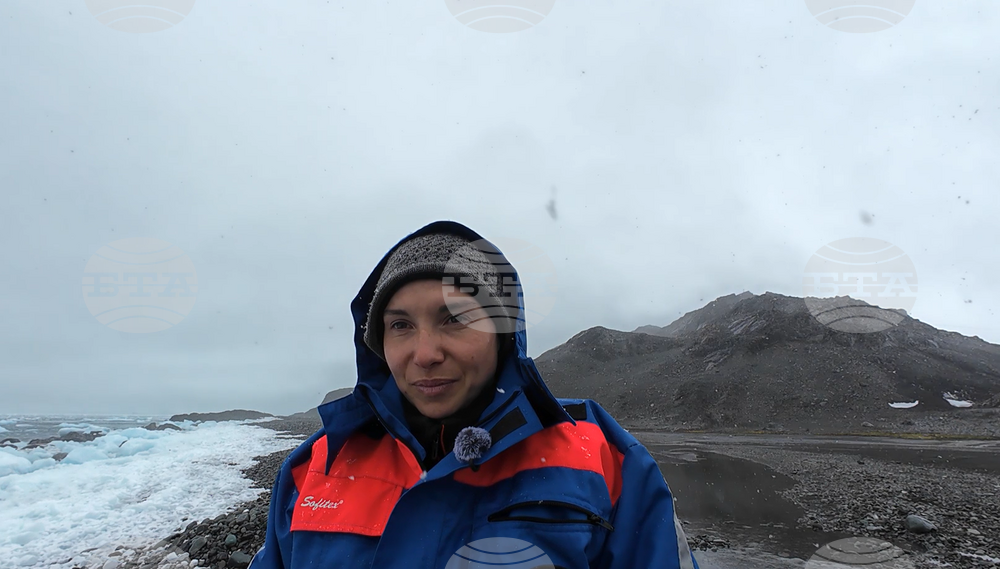
Speaking to the Bulgarian News Agency (BTA), Antoniya Tilyasheva, who is part of the logistics team at Bulgaria's St Kliment Ohridski Antarctic Base, shared that she liked the feeling that "Antarctica’s nature is more powerful than you."
The logistics team of the 34th Bulgarian Antarctic Expedition includes more women than any previous expedition. The women told BTA what motivated them to join and what continues to inspire them on the Ice Continent.
Tilyasheva has worked in Antarctica for 10 years, holding various logistics positions at the American Antarctic base McMurdo Station. This year marks her first time as part of the Bulgarian expedition. “The first time I went simply because I wanted to set foot on the continent,” she said. Tilyasheva noted that what amazes her most about Antarctica is the people and the nature.
“Until a few days ago, it felt like traveling back in time because we didn’t have internet, and everything was much more interesting. The feeling was that we were in a very special place,” she explained. “The people are very interesting — not everyone is drawn to the idea of going so far away, giving up many comforts, and working for relatively modest pay. Many are overqualified for the jobs they do here, just to have the chance to come,” she added.
Tilyasheva noted that on the Ice Continent one can learn to do many things one would never imagine doing in everyday life. “In my case — learning to operate heavy machinery, handle fuel, or help with construction. You have the opportunity to be useful in a very different way,” she said.
Another participant visiting the Bulgarian base for the first time is Velizara Nikolova. She works in dental medicine, although her responsibilities at the base are far broader. Most of her work is in the field — assisting scientists with sample collection and supporting various activities related to their projects.
“One of the most interesting projects this season was by Ecuadorians Carlos and Raquel, who were studying microplastics in coastal waters and in seal feces,” Nikolova noted. “The other project I take the greatest pleasure in is that of Oleg [Vasilev]. It involves mapping the Earth’s surface and placing markers with specific GPS coordinates that help measure distances from point A to point B,” she said.
She also mentioned her fieldwork with seismologist Gergana Georgieva, who studies glaciers. “Glaciers are unique — they hold so much within them, so much beauty and timelessness,” Nikolova said.
Elka Vasileva has been a boat operator on the Bulgarian Antarctic expeditions for five consecutive years. She was working on Christo’s project — the wrapping of the Arc de Triomphe — when she received a call from the deputy director of the Bulgarian Antarctic Institute, Dragomir Mateev. He offered her the position of boat operator in Antarctica. Twenty days later, Vasileva was at the airport, setting off on what would become a great adventure.
“I believe my position is the most interesting one at the base — I have the opportunity to work with many scientists. But it comes with challenges too: bad weather, long hours outside, and serious responsibility. A boat operator here is responsible for everyone on the water,” Vasileva told BTA.
She admitted that during her first expedition she was not sure she would be able to handle the task. However, she rose to the challenge and became not only the first female boat operator at the base but also held the position for five consecutive expeditions.
“For me, the most impressive thing about Antarctica is the nature — we navigate waters for which there are no maps. It’s the kind of challenge explorers in the past had to face,” she said.
Klimentina Straka is the other boat operator at the Bulgarian base. She is involved in sailing and came to Antarctica after an acquaintance connected her with Elka Vasileva, who mentioned that the base was looking for another boat operator. Straka told BTA that her job requires a high level of professionalism, as she is responsible for the lives of the scientists she transports. According to her, professionalism begins where heroism ends.
“I was drawn by Antarctica. I grew up in a family where nature was identified as a very high priority and value. Since I was little, I’ve dreamed of such wild places and this kind of landscape — so rarely seen and so little touched by humans,” Straka said. She has already spent several months in Antarctica, yet the natural surroundings continue to amaze her.
“The first penguin I saw so close to me — just two or three metres away — I remember the calmness of the animal. Then the seals. I continue to enjoy the wildlife and the nature. The weather, too — it’s constantly changing, very dynamic and beautiful. There is a certain harshness and rawness in the landscape — the glaciers, the icebergs, the beaches. You never tire of it. You wake up and see a bay, the sea, and a glacier. It continues to captivate me,” Straka said.
Women are also an important part of the crew of the Sv. Sv. Kiril i Metodii research vessel. Ivet Ilieva is a cadet at the Nikola Vaptsarov Naval Academy, specializing in Naval Communications and Radio Engineering Systems. This year marks her first voyage to Antarctica. “For me, this is something very significant — it gives me life lessons and experience that I wouldn’t gain anywhere else but here, in this remarkable place. Antarctica is untouched and uniquely beautiful — not everyone has the chance to visit it,” Ilieva said.
Radina Simeonova is an assistant cook aboard the research vessel and is on her second expedition to Antarctica, having previously taken part in the 32nd Bulgarian Antarctic Expedition. “I wanted to become part of the crew. I was drawn by the experience itself — to see places I had never visited or seen before. My dream was to see a whale. The first thing I saw when we reached Antarctica was a whale. My dream came true,” she told BTA.
The Bulgarian naval research vessel Sv. Sv. Kiril i Metodii (RSV 421) departed for Antarctica from Varna (on the Black Sea) on November 7, 2025. After a month-long voyage across the Atlantic Ocean, the ship arrived at the Argentine naval base in Mar del Plata on December 13.
BTA has had a national press club on board the ship since 2022 and another on Livingston Island since February 2024. BTA Director General Kiril Valchev said they exist thanks to the generous support of RSV 421 and Bulgaria’s St Kliment Ohridski Base, which provide the necessary facilities. These two press clubs are added to the news agency’s other 41 national press clubs (33 in Bulgaria, seven abroad in neighbouring countries and in nations with large Bulgarian communities, and one mobile National Book Press Club).
The news items of BTA's special correspondents on RSV 421 and Antarctica are freely available in Bulgarian and English on the agency's website. They can be used free of charge by all media, with attribution to BTA.
/IV/

news.modal.header
news.modal.text