Analysis
![Romania Begins Dismantling Its Special Pensions System]()
![Romania Begins Dismantling Its Special Pensions System]() An elderly man sporting a fur coat and hat walks downtown Bucharest, Romania, late afternoon, Jan. 31, 2024. (AP Photo/Vadim Ghirda)
An elderly man sporting a fur coat and hat walks downtown Bucharest, Romania, late afternoon, Jan. 31, 2024. (AP Photo/Vadim Ghirda)
site.btaRomania Begins Dismantling Its Special Pensions System
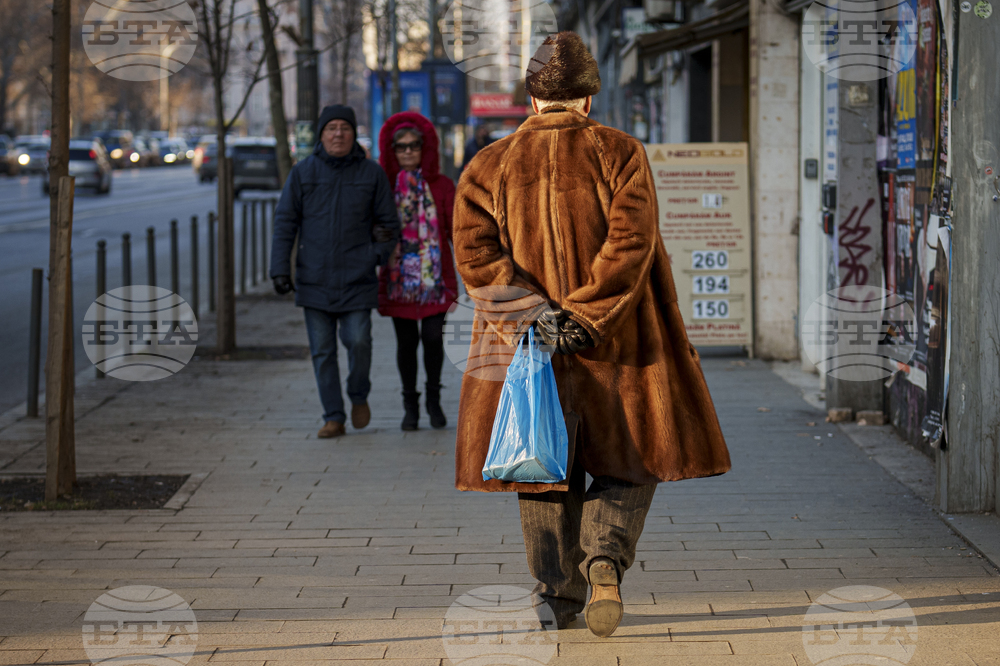
The issue of "special" pensions received by diplomats, military personnel, parliamentarians and magistrates is particularly sensitive in Romania, where the average pension amounts to about EUR 550 amid high inflation and austerity measures under which wages and pensions were frozen at their end-2024 levels.
Several professional categories retire earlier than others and receive pensions that are not calculated on the basis of paid social security contributions, but under special laws - often as a percentage of their last salary or average earnings toward the end of their careers. According to data cited in the Romanian media, "special" (or service) pensions account for more than 1% of gross domestic product (GDP) - a cost weighing like a millstone on the state’s finances as the country has for several years been struggling to reduce its excessive budget deficit, which reached 9.3% of GDP at the end of 2024.
Over the years, various Romanian governments have tried to eliminate unreasonable privileges, but most attempts were blocked by the Constitutional Court, which has defended service pensions as an acquired right and part of professional status.
For years, however, experts have warned that Romania’s pension system is extremely unsustainable and in need of deep reform, otherwise the generation born in the 1970s will be left without pensions. This is why pension reform was also included in the National Recovery and Resilience Plan, which provides EUR 21.41 billion in grants and loans for various reforms and projects.
The latest development on this issue has affected the pensions of judges and prosecutors, which currently amount to around EUR 5,000 in Romania. After a series of delays, Romania’s Constitutional Court ruled February 18 that a bill raising the retirement age of magistrates and capping their pensions at 70% of their last net salary does not contradict the Constitution.
Here is how the news was received in Romania:
An act of justice
"The Constitutional Court’s decision on reforming magistrates’ pensions is a gesture of justice long awaited by our society," President Nicusor Dan said, quoted by Agerpres.
Prime Minister Ilie Bolojan, who has assumed responsibility for the legislative act, said: “The reform of special pensions has been insistently demanded by Romanian society; we have taken a major step toward equality,” the government press office reported.
The leader of the largest party in the ruling coalition - the Social Democratic Party - Sorin Grindeanu commented that the issue of magistrates’ pensions “has cost the country and society dearly.”
The pro-reform Save Romania Union (Uniunea Salvati Romania, USR), which is part of the ruling coalition, said that the Constitutional Court’s decision was not a victory, but "a gesture of normality", Agerpres reported. "Today’s decision opens the way for reforms to reduce privileges and the influence of special interests," USR leader Dominic Fritz commented.
The party of Romania’s ethnic Hungarians - the Democratic Alliance of Hungarians in Romania (Uniunea Democrata Maghiara din Romania, UDMR), also part of the government - described the ruling as "good news long awaited by society", Agerpres reported.
“Society has long been waiting for justice to be restored, for there to be no special categories with the opportunity to retire at 50 with pensions far above what is reasonable,” said UDMR leader Kelemen Hunor, quoted by the news agency.
Even the opposition partially agreed with the government this time, as Senator Niculina Stela of the Alliance for the Union of Romanians (Alianța pentru Unirea Romanilor, AUR) wrote on Facebook that "the reform of magistrates’ pensions is a good thing". She was quick to add, however, that the law came "far too late" and "solves nothing", arguing that equality can only be achieved in the long term.
The judiciary's reaction
Justice Minister Radu Marinescu expressed confidence that magistrates would show understanding and continue to fulfil their mission of dispensing justice in a society that must remain governed by the rule of law, Agerpres reported. The Minister said that "there must be no war between the different branches of government".
The existence of an institutional conflict between the executive and the judiciary became evident from the fact that the complaint to the Constitutional Court regarding the bill on magistrates’ special pensions came from within the judicial system itself.
The High Court of Cassation attempted to challenge the bill’s constitutionality on several grounds: procedural (due to the government assuming responsibility in Parliament instead of holding parliamentary debates), as well as for discrimination and deprivation of rights, arguing that the changes discriminate against magistrates compared with other categories receiving special pensions (military, police, diplomats, aviation). It was also argued that service pensions are part of the guarantees of judicial independence and that reducing them could lead to political pressure on judges and prosecutors.
The Superior Council of Magistracy had also issued a negative opinion on the bill, though this opinion is only advisory.
Despite these views and positions, Prime Minister Bolojan’s government pushed the bill through Parliament by assuming responsibility, providing for a gradual increase in magistrates’ retirement age to 65 (from around 50 currently), a 15-year transition period to implement this goal (10 years in the initial version rejected by the Constitutional Court last autumn), and a cap on pensions at around 70% of the last net salary.
Following the February 18 Constitutional Court ruling, the Superior Council of Magistracy said that "the new legislative framework will have serious consequences for the functioning of the judicial system" and that it does not agree with the bill’s provisions. According to the Council, "raising the retirement age and eliminating service pensions risks triggering an exodus from the judicial system and makes the profession unattractive to younger generations".
The President of the High Court of Cassation, Lia Savonea, said that "the independence of the judiciary is not negotiable" and added that "the High Court will use all legal and institutional instruments to defend it, including by referring the matter to the competent European institutions," the news site HotNews reported.
Reforms and EU funding
The European Commission had given Romania until November 28, 2025, to adopt the reform of special pensions, but Bucharest missed the deadline. As a result, the country lost EUR 231 million under the National Recovery and Resilience Plan (NRRP), said Minister for Investments and European Projects Dragoș Pislaru.
Following the Constitutional Court ruling, Minister Pislaru said talks would be held with European Commission officials and added that despite the delay in implementing this NRRP milestone, all diplomatic efforts would be made to try to salvage the pensions milestone and the EUR 231 million in grants, Romania’s Radio Free Europe service reported.
Prime Minister Ilie Bolojan said attempts would be made to save the funds and that by late February or early March it would become clear whether they were definitively lost.
Further reforms loom
Prime Minister Bolojan said on Digi24 television that the reform of special pensions will not be limited to the judiciary, but will be extended to other professional categories where retirement at a very early age is possible.
“Retirement at 50 can no longer be sustained,” the Prime Minister said, announcing that the government will present legislative proposals next month to apply similar corrective principles in other systems.
According to Bolojan, all mechanisms allowing retirement at the age of 50–52 need to be reviewed.
"I believe that in all systems where retirement at 50–52 is allowed, when a person is at the peak of their physical and intellectual abilities, and where the pension equals the last salary, things need to be corrected," the prime minister said.
He stressed that the changes are motivated both by the need for social justice and the restoration of public trust, and by the sustainability of the pension system, as hundreds of thousands of Romanians are set to retire in the coming years.
The new regulations will affect employees of the Interior Ministry, the defence sector, and structures responsible for public order and national security. Bolojan said that the matter will be addressed sector by sector.
For personnel working under particularly demanding conditions, such as paratroopers or frontline gendarmes, forms of early retirement will be preserved.
By contrast, for administrative or guard positions where the job does not require strenuous physical work, the retirement age could be aligned more closely with that in the public system, and raised to 65.
Regarding military personnel who have taken part in overseas missions, such as those in Iraq and Afghanistan, the Prime Minister said decisions would be taken after consultations with specialists, depending on the specific working conditions.
Romania has a total of around 4.7 million pensioners, while data on those receiving special pensions vary; according to the National Pension House, they number more than 11,600.
Romania allocates around 8.5% of GDP to pension payments, and special pensions cost the state about 1% of gross domestic product, according to official data cited in Romanian media.
/NF/
news.modal.header
news.modal.text