site.btaHuman Rights Group: External and Internal Pressure Undermines Judicial Independence
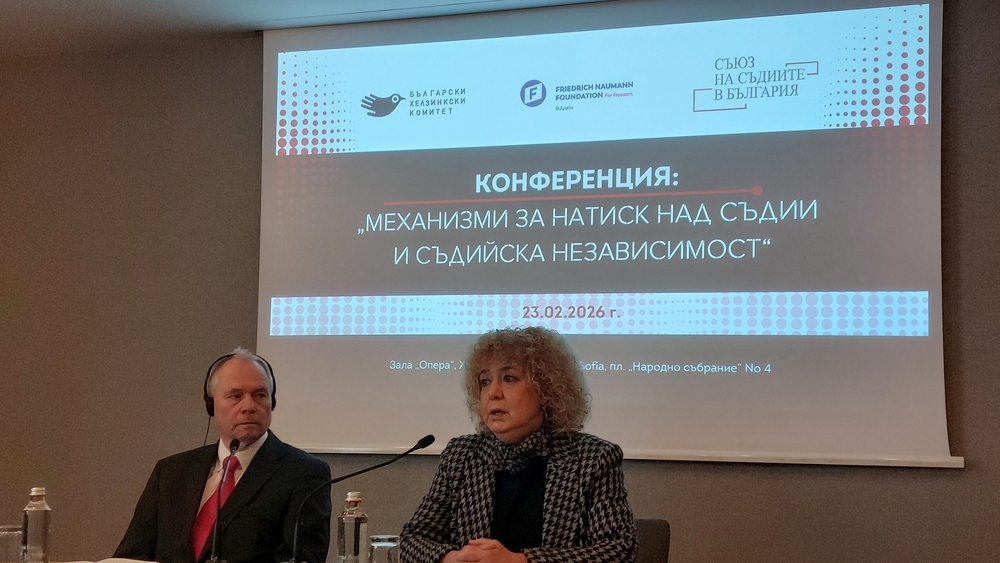
There are mechanisms of pressure within the judiciary that undermine justice and the rule of law. Countering them requires institutional measures, but also support for the resilience of magistrates. These are the conclusions of a conference on the “Mechanisms of Pressure on Judges and Judicial Independence” held in Sofia on Monday. It is organized by the Union of Judges in Bulgaria and the Bulgarian Helsinki Committee. During the forum, conclusions and data were presented regarding pressure on magistrates, including through the use of special surveillance means (SSM), as well as observations on institutional responses and effective protection mechanisms.
Commending the forum, Justice Minister Andrey Yankulov emphasized the need to support magistrates who are beginning to speak openly about pressure within the system.
In her remarks, Supreme Court of Cassation President Galina Zaharova focused on the intensifying public pressure on the courts, as well as the growing loss of mutual respect between the branches of power. “The failure to enforce court decisions is a grave scourge that destroys the rule of law,” Zaharova stressed.
Prof. Hans Petter Graver of the University of Oslo stressed that judicial independence is being attacked in a broader context of democratic decline, both in Europe and in the United States, and that judges have an active role in defending the rule of law. According to Prof. Graver, judges not only have the right to speak freely in defence of the rule of law, they have a duty to speak.
Judge Evgeni Georgiev of the Sofia City Court presented observations on specific cases of pressure and outlined typical sources. A particularly alarming signal is that the pressure is often exerted by administrative heads, the prosecution, or representatives of other institutions. In overcoming such pressure, judges have most often found support among colleagues, and less frequently from their administrative superiors.
Attorney Adela Katchaounova of the Bulgarian Helsinki Committee presented key data on the use of special surveillance means (SSM) against magistrates. Data covering a ten-year period show that every 17th magistrate in the country has been subjected to wiretapping, making magistrates 1,500 times more likely to be surveilled than ordinary citizens. A significant portion of the materials gathered through SSM do not lead to subsequent pre-trial proceedings. Procedural “loopholes” increase the risk of pressure: surveillance through SSM may be initiated without prior authorization in urgent cases, and the physical evidence collected may be stored indefinitely.
Judge Dayana Topalova of the Sofia City Court and Associate Professor Hristo Hristov from the Faculty of Law at Sofia University presented the systemic vulnerabilities that contribute to pressure within the system.
The event concluded with a discussion on the possibilities for strengthening judicial independence while at the same time preventing abuse of rights in the context of a compromised system.
A full recording of the event will soon be available on the Bulgarian Helsinki Committee’s YouTube page.
The report “Wiretapping Justice: Covert surveillance as a means of exerting pressure on judges, prosecutors, and investigators” is available on the Bulgarian Helsinki Committee’s website in Bulgarian and in English.
The summary report on cases of pressure against judges will be available on the website of the Union of Judges in Bulgaria.
/RD/
Additional

news.modal.image.header
news.modal.image.text
news.modal.download.header
news.modal.download.text
news.modal.header
news.modal.text