site.btaAntarctic Sound Probably Playing Important Role in Mixing of Cold and Warmer Water Masses, German Scientists Believe
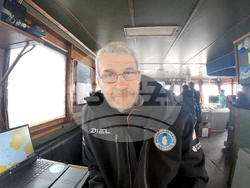
The Antarctic Sound has been studied a little, but it probably plays an important role in the exchange and mixing of cold and warmer water masses through tides and eddy currents. These are the initial conclusions from the research of two scientists from Germany, Emil Stanev and Michel Albinos, who are part of the 34th Bulgarian Antarctic expedition.
Their initial observations show an unexpected direction of movement, which could be crucial for the transport of cold water and, consequently, for the presence of krill and the food web in the Bransfield Strait area. They told BTA about their experiment in the Antarctic Sound, conducted over the last two days, what the initial data shows, and how the data will contribute to understanding the ecosystem in the area.
"There are currents in the Antarctic Sound that facilitate the exchange of water between these two areas. We are now taking advantage of the fact that the ship [Bulgarian naval research vessel RSV 421] has arrived at this point to organize a campaign to measure the currents in the passage. The currents are driven either by tides or by differences in density between the two parts: the Weddell Sea and the northern part of Bransfield Strait," explained Prof. Stanev, adding that the overall dynamics of these currents are not well known, as there have been very few measurements in this area. The exchange between the different water masses in the Antarctic Sound occurs through eddy currents, which are huge structures reaching sizes of tens and hundreds of kilometres.
"For now, there is insufficient understanding of submesoscale eddies (in the area), i.e. smaller than the rings and meanders of the Gulf Stream, with sizes ranging from hundreds of metres to several kilometres," said Prof. Stanev. "Our equipment can detect such features, with a scale of several tens of metres. We want to study the parameters that cannot be directly provided by the equipment. At the same time, we will measure the temperature and salinity in the deep layer up to 50 metres, or perhaps a little more. So that we can link the temperature and salinity anomalies," he added.
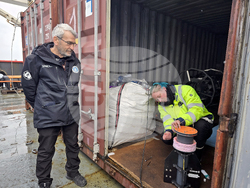
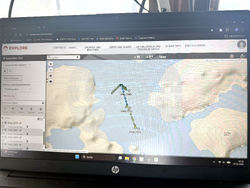
The experiment by the two scientists was carried out over the last three days on board the RSV 421 by releasing drifters - floating devices with GPS. The devices were retrieved from the water on the next day, and the first visible results of the project so far are that the currents are moving in the opposite direction to what was expected. Prof. Stanev and Albinos expected the drifters to be carried north, but within the first 24 hours they headed south.
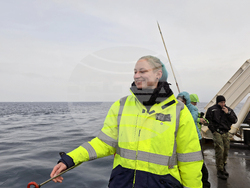
Albinos works at the Institute for Chemistry and Biology of the Marine Environment in Oldenburg, but she herself is involved in marine physics, more specifically physical oceanography. She explained to BTA that the main work on the project involves measuring the movement of currents, but the goal is to ultimately understand whether certain currents manage to reach the Bransfield Strait and bring the whales' main food source - krill - to them.
"There is a lot of krill in this area [Antarctica], which is important for the food chain, especially for whales, and krill likes this cold water. It is adapted to it. So, if there is a possibility for fresh, cold water to come from the Weddell Sea to the Bransfield Strait through the Antarctic Sound, then there is more krill, which is good for the ecosystem," Albinos explained, adding that the Antarctic Sound has not been well researched and it is still unclear whether it really is a passage for this water and, if so, how the water reaches the Bransfield Strait.
The released drifters have various sensors - for temperature, conductivity, temperature, and depth.
"Even as we were observing the drifters, it was clear that there were tides in the area. Tides mean that there is a wave that moves in one direction and then returns in the other, within a certain period of time. It appears that there are half-day tides. This means that once it enters the Antarctic Sound, the water moves back and forth all the time," Albinos explained. "This slows down the process of transporting this water mass to the Bransfield Strait. So I am going to do some calculations to see if there is any northward transport or not, and how long it probably takes," Albinos added.
She emphasized that this is important from an ecosystem perspective because if the water moves too slowly or mixes along the way in the Antarctic Sound and does not reach Bransfield Strait, then there will probably not be enough cold water for the krill population to thrive.
"The problem is that there is not only krill in the area, but also another type of zooplankton called salps. They are more attached to warmer water. And when they enter the krill habitat, it is not good for the food system because whales do not eat salps. It is not an invasive species, but it occupies the ecological niche of krill. So, if we understand whether there is a transfer of this water mass, we can be sure that krill is not only in the Weddell Sea, but also in the Bransfield Strait, which is larger and more accessible to whales," Albinos said.
The first level of processing the data collected in recent days includes preparing graphs, determining the temperature range, current speed, and direction of movement. The study also includes data from radar that measures sea surface roughness, greater surface circulation, and waves. The conclusions of the study conducted aboard the RSV 421 in recent days will not actually be finalized for several months, but they may prove crucial to understanding and researching the ecosystem in the region.
The Bulgarian naval research vessel Sv. Sv. Kiril i Metodii (RSV 421) departed for Antarctica from Varna (on the Black Sea) on November 7, 2025. After a month-long voyage across the Atlantic Ocean, the ship arrived at the Argentine naval base in Mar del Plata on December 13.
BTA has had a national press club on board the ship since 2022 and another on Livingston Island since February 2024. BTA Director General Kiril Valchev said they exist thanks to the generous support of RSV 421 and Bulgaria’s St Kliment Ohridski Base, which provide the necessary facilities. These two press clubs are added to the news agency’s other 41 national press clubs (33 in Bulgaria, seven abroad in neighbouring countries and in nations with large Bulgarian communities, and one mobile National Book Press Club).
The news items of BTA's special correspondents on RSV 421 and Antarctica are freely available in Bulgarian and English on the agency's website. They can be used free of charge by all media, with attribution to BTA. Valchev recalled that thanks to its correspondents, the news agency appears among the top results on Google when searching for the phrase “Antarctica correspondent”.
/DS/
Additional
news.modal.image.header
news.modal.image.text
news.modal.download.header
news.modal.download.text
news.modal.header
news.modal.text