site.btaA Country's Weight in ECB Depends on Meaningful Ideas, Says Former Bank of Portugal Governor
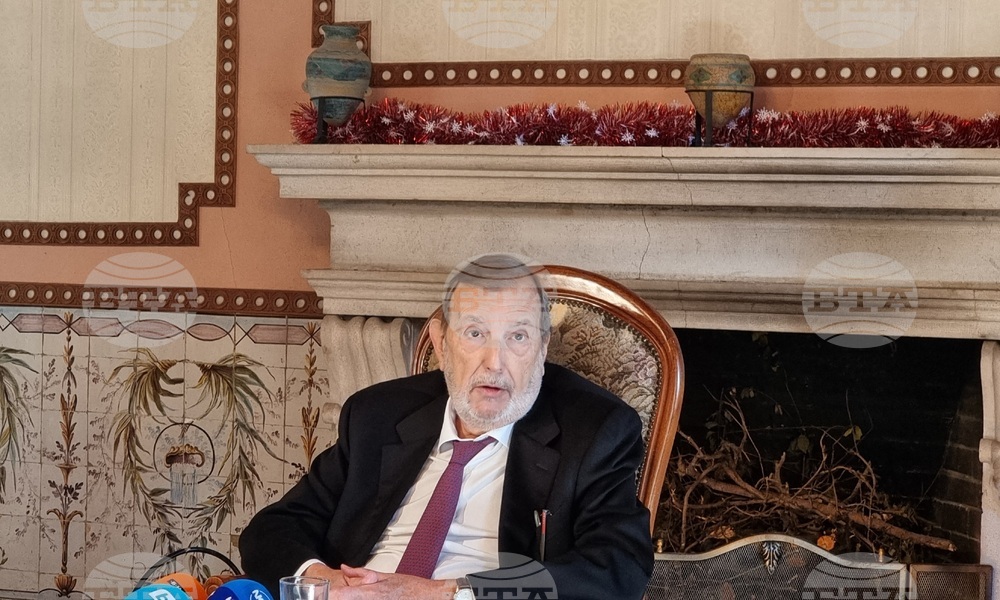
Every country has a voice in the European Central Bank (ECB), the weight of which depends on meaningful ideas in monetary policy, said Antonio de Sousa, former governor of the Bank of Portugal, in response to a question from BTA.
Speaking to Bulgarian journalists at the Embassy of Bulgaria in Lisbon, De Sousa shared his experience as governor of the Bank of Portugal from 1994 to 2000, a period that included the country’s adoption of the euro. Portugal was among the first 11 countries to introduce the single European currency, initially electronically in 1999, and then physically from 2002.
“When it came to Portugal, I had a voice that was not silenced until I was able to achieve at least something acceptable for us. Ultimately, it depends on your governor, because they can have more or less influence if they are able to assert their personality and ideas—not so much personality, but rather ideas that make sense from a scientific or monetary standpoint,” said De Sousa.
According to him, the euro made matters more predictable for his country, which had been strongly tied to financial markets. The biggest challenge had been stabilising the national currency—the Portuguese escudo—so that Portugal could be selected among the countries to adopt the single currency first. Support from Portugal’s main political parties for the euro was also crucial.
“We were in the worst position in terms of chances for participation and in fact were among the few that strictly met all the criteria,” he recalled.
He explained that establishing the Eurosystem meant building something entirely new from scratch. “We had meetings at least twice a month, which is no longer the case because now everything is organized and running normally. But at the threshold of the monetary union for the first countries, the situation involved a lot of work on something that no one really knew what it would look like.”
“That is why the euro was created financially on 1 January 1999, but you only saw it in your pockets on 1 January 2002. So those three years were, in a sense, a buffer to prepare everything fully, because the worst that could happen was to reach 2002 and have something not function,” said De Sousa.
He noted that there was no full consensus regarding the appearance of the currency, which is reflected in the national side of the coins. But for banknotes, if they were different for each country, people would not believe they had the same value—hence their uniformity.
Payment systems also needed to be standardized to avoid chaos, as did accounting procedures.
However, according to him, Bulgaria is in a very different position today, more than 25 years later. “You have the advantage that everything has already been done. Your central bank will know exactly what it needs to do,” he emphasized.
Beyond reaching agreement in the ECB on key structural issues, countries also had to explain as clearly as possible to their citizens what would happen and the consequences for daily life. The three-year period between 1999 and 2002 was not strictly necessary, as everything was ready by early 2001. “But we had already announced that it would be 2002, so we did not want to create even more confusion,” he said.
Portugal welcomed the euro physically at the start of 2002 with over 500 ATMs nationwide. About 1 percent were not working on the first day but were reprogrammed within a day or two. Conversion from escudos to euros was straightforward because the rate was 200 to 1—a round number. The adaptation period was six months, but after just three months, around 98 percent of old banknotes were already in banks’ vaults.
The economy continued largely unchanged for another two or three years, with a very strong housing sector. Interest rates were equally low, De Sousa recalled. It was estimated that rounding prices upwards for small cash purchases produced a one-off inflationary increase of around 0.2–0.3 percentage points.
No further impact was observed the following year. The euro gradually brought the country increased foreign investment and economic growth, driven by both housing and expanding tourism.
Having accumulated a large amount of external debt—“because it was cheap and easy”—Portugal today insists that it learned its lesson the hard way, emerging from the financial crisis with widespread wage reductions in both the public and private sectors, the former governor said.
“There is now broad agreement that we cannot have a 3 percent deficit. We must have a zero deficit. In fact, over the last four or five years, we have been around zero, usually even with a surplus,” he noted, adding that all major parties in the country share the view that public debt must be controlled.
The report follows a visit by Bulgarian journalists to Portugal, organized as part of the Bulgarian Foreign Ministry’s activities under the Action Plan for the implementation of the Communication Strategy on information and publicity regarding Bulgaria’s accession to the eurozone.
/VE/
news.modal.header
news.modal.text