site.bta20 Years Since the Death of Dissident Poet Peter Manolov
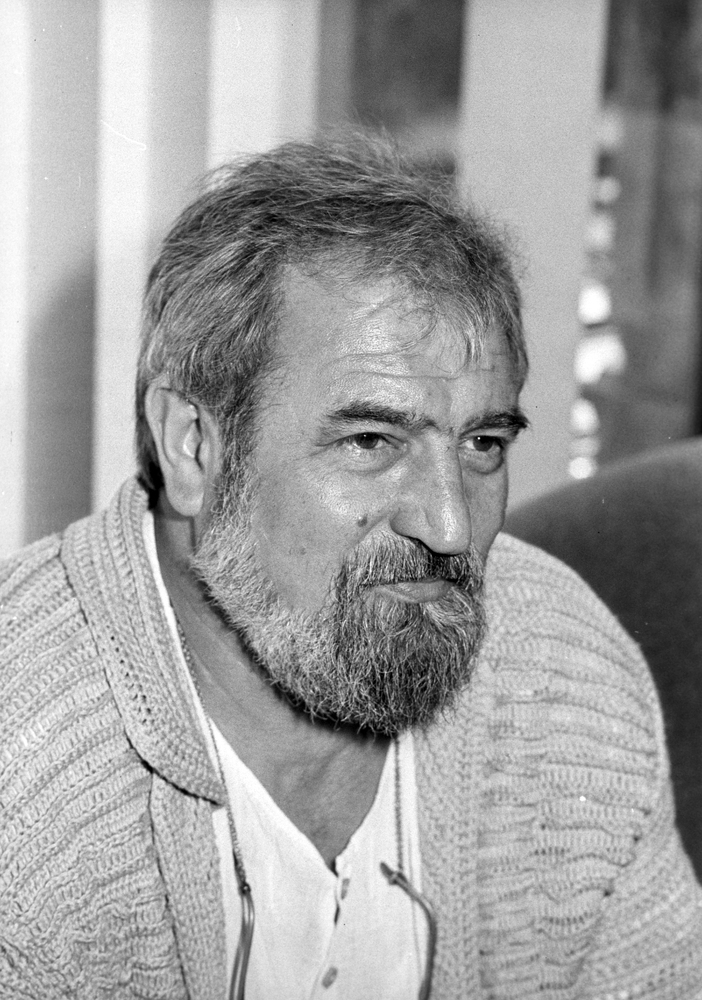
Peter Manolov, dissident poet and journalist, passed away 20 years ago on Saturday.
Born in the village of Sadovo near Kotel (Southeastern Bulgaria) in 1939, he studied in Sungurlare, attended a military school in Silistra, and graduated in pedagogy from Sofia University. He did odd jobs, including pupil supervisor, journalist at the Sofia Press Agency, and coastal meteorologist.
Reading his poems "Hello America" March 1987 and especially "A Hundred Patches" at Sofia University on May 26, 1987, the poet ushered in open public resistance to totalitarianism in Bulgaria.
On January 16, 1988, Manolov was among the founders of the Independent Society for the Protection of Human Rights in Bulgaria and became its secretary. On January 11, 1989 he was arrested, his home was searched, and documents, diaries, literary manuscripts and his typewriter were seized.
On the following day, in response to the seizure, Manolov went on hunger strike that lasted for 32 days. His protest was covered by Radio Free Europe, BBC and the global wire services. He received moral support from world celebrities like Kurt Vonnegut, Isaac Asimov, Allen Ginsberg, Norman Mailer, William Styron, and Bulgarian intellectuals Valeri Petrov, Radoi Ralin, Blaga Dimitrova, Georgi Mishev, Zhelyu Zhelev, Marko Ganchev, Ivan Kolarov, and Yordan Valchev. Publishers and literary agents in the US, the Frankfurt-based International Society for Human Rights, the Committee to Protect Journalists in the US, scholars, lawyers, public figures and members of the public at home and abroad all declared themselves in defence of the dissident.
On February 7, 1989, the party organ Rabotnichesko Delo carried an article titled "Who Champions Human Rights in Bulgaria and How". It referred to the members of the Independent Society as "rejects" and "scumbags". The attack on Manolov was particularly vitriolic. An open letter by Plovdiv-based writers in the same vein followed shortly.
The poet was interrogated daily at State Security. His family was persistently harassed by anonymous phone calls and death threats against his 15-year-old son.
On February 11, 1998, bowing to international pressure, the authorities were compelled to return the over 1,200 archive pages to Manolov. For the first time, the Communist Party suffered such an astounding loss in a highly publicized battle.
Later that month, the Communist Party Central Committee ordered a countrywide campaign of open party meetings for public condemnation of Manolov's poetry.
On May 20, 1989, he was extradited from Bulgaria to France with his entire family.
In exile, Manolov took part in discussions on free spirit and minority issues and contributed to the Continent journal, Radio France Internationale, BBC, Deutsche Welle, and the Paris branch of Amnesty International.
After the democratic changes, he returned to Bulgaria in 1991, where he shared in the setting up of the Podkrepa independent trade union (now Podkrepa Confederation of Labour). He was chief secretary of the Union of Bulgarian Writers (1991-1994) and managing director of the Narodna Kultura Publishing House (1997-2002).
His poems are collected in six books, published between 1980 and 2011. In November 2014, he was awarded the Order for Civil Merit, First Class.
Until his last breath, he remained a contrarious character, irritating others with his unusual sense of humour and sharp tongue. In his last interview in January 2015, he said: "If a poet does not earn his death, he is not a poet at all."
Peter Manolov died in Plovdiv (South Central Bulgaria) on February 7, 2006.
Following is a translation of a February 11, 1989 news item in BTA's Home News Desk Bulletin, covering the return of Manolov's archive and the end of his hunger strike:
"VINF 208 ATTEMPTED PRESSURE
Mass communication media in the West have recently circulated conflicting and often tendentiously untrue reports, comments and statements in connection with the hunger strike of Peter Manolov, a Bulgarian citizen from Plovdiv.
According to his own statements and his wife's assertions, Manolov went on a hunger strike because the investigative authorities had impounded his personal 'literary archive'.
As previously reported, acting on a warrant from the prosecution service, on January 11 this year [1989] written materials were seized from Peter Manolov's home which were necessary for the clarification of a number of facts and circumstances implicating Manolov and other persons in publicly prosecutable offences. A detailed inventory of the retained materials was drawn up, and it was signed by Manolov's wife. Clarifications were provided to him personally that, in accordance with the laws in force, the investigation may impound all materials or individual documents. Nevertheless, Peter Manolov declared a hunger strike, thus attempting to exert pressure and to foment a mood against the rightful actions of the investigative authorities.
It transpired today that, following a check carried out according to the laws, the competent authorities have handed the Manolov family, under benefit of inventory, the last portion of the archive as well, and namely the documents of the so-called Independent Society for the Protection of Human Rights.
On February 9 and 10, guided by humanitarian considerations and at the request of the Union of Bulgarian Writers, a highly qualified medical team of the Higher Medical Institute in Plovdiv carried out a thorough medical examination of Manolov. The commission, consisting of Assoc. Prof. Dr Andonova, head of the Fourth Internal Medicine Clinic, Assoc. Prof. Dr Stanchev of the Second Internal Medicine Clinic, and Dr Madzharova, Senior Assistant Professor at the Department of Psychiatry, established that Manolov's state of health gave no grounds for concern and that, for all intents and purposes, he was clinically healthy. A conversation was also held with Manolov and his wife. His medical condition and the risks associated with prolonged fasting were explained in detail. According to the medical commission, Manolov's condition does not require hospitalization, which he, by the way, categorically refused. In Manolov's own words, he has begun an intake of saline solutions and vitamins recommended by a district doctor of the Second City Polyclinic in Plovdiv, and today, in his own assessment, he felt better. (BTA) 16:30/MS"
/LG/
news.modal.header
news.modal.text