site.btaMarch 2, 2016: Ten Years since Passing of Veteran Journalist Petko Bocharov
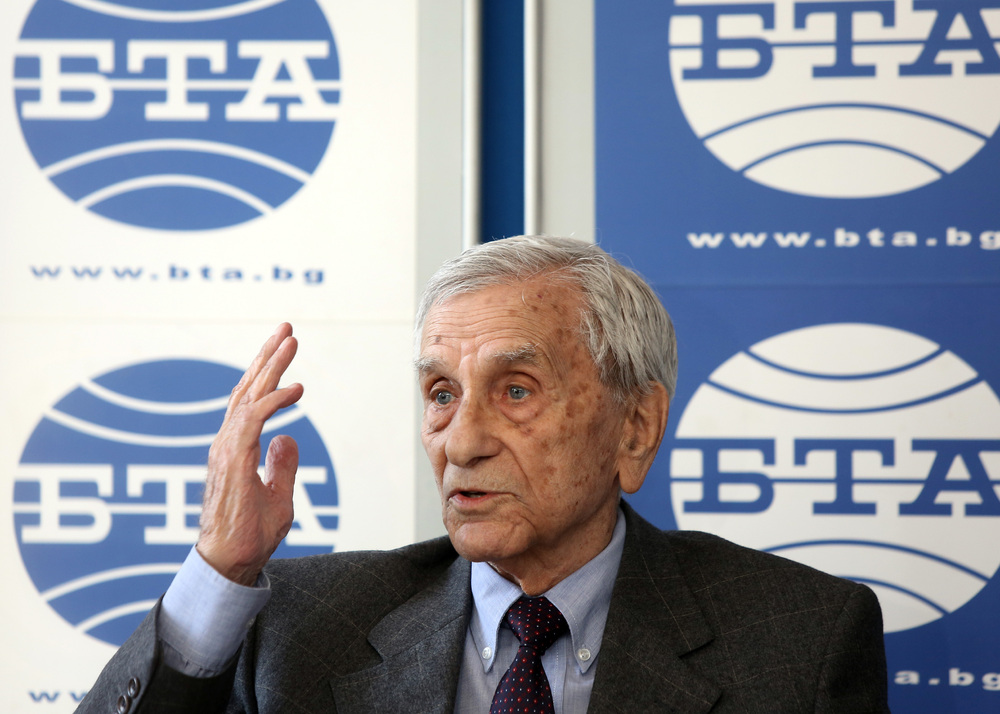
Veteran BTA staffer, TV personality and translator Petko Bocharov passed away ten years ago on Monday, on March 2, 2016. Aged 97, he was the oldest working journalist in Bulgaria.
Born in Sofia on February 19, 1919, Bocharov wanted to be a lawyer like his father or to teach law at the University. He graduated in law from Sofia University in 1945 and practised the legal profession in the capital city between 1945 and 1949.
In 1948 he was sentenced to one year imprisonment for bribing an investigator who handled his brother's case. Out of jail, he was disbarred for three years and worked as a reinforcing steel fixer between 1950 and 1952, advancing from apprentice to master.
His first position at BTA was editor and translator from English at the International News Desk Department. Later on, he headed the America and UN Sector and the Correspondents Sector at the same department, where he was ultimately promoted to deputy editor-in-chief.
In 1960, much to his dismay, he was sent on assignment to cover the Summer Olympics in Rome.
On January 20, 1962, he appeared on the main evening newscast of Bulgarian National Television (BNT) with a ground-breaking four-minute own comment.
In April 1962, after he was spotted on his way back home from a midnight Easter liturgy, he was "exiled" to Silistra (Northeastern Bulgaria) as BTA correspondent. The agency's newly appointed chief director Lozan Strelkov returned him to Sofia several months later.
In 1976, Bocharov was one of four experienced BTA international news analysts (along with Dimitri Ivanov, Stefan Tihchev and Stefan Kozhuharov) who took turns with ten-minute comments on current developments, broadcast live on national television straight from the agency's newsroom.
The old-timer retired in October 1983 after 31 years at BTA. He continued to work as a freelancer, covering domestic topics, too, with regular appearances on BNT's weekly political talk show Every Sunday (1981-1993). It was on that station's TV Eye Programme that he uttered his signature phrase "Right, but not quite" on February 23, 1992. He did not claim credit for inventing it, saying that he only used it in the right place. The daily newspapers that readily carried his contributions included Novinar, 24 Chasa, Trud, Novinar and Bulgarska Armiya.
In February 2008, the journalist was among the few public figures to admit to, and apologize for, his collaboration with the Communist-era State Security even before his affiliation was disclosed by the Secret Police Files Committee. According to declassified records, he was an agent for State Security Main Department Two (Counterintelligence) between 1946 and 1982.
His reminiscences and comments were published in book form as Pictures from Three Bulgarias (2010), Faces and Fates from Three Bulgarias (2010), Bombasts and Contrasts in Three Bulgarias (2011), and Our Via Dolorosa (2015).
Bocharov also translated fiction and non-fiction from English, including Carl Sandburg's Rootabaga Stories, Kurt Vonnegut's Cat's Cradle, and Stephen Carter's Civility: Manners, Morals and the Etiquette of Democracy. In 2011, the Bulgarian Translators' Union included Bocharov in the "Magnificent Six" of Bulgarian-English translation, together with Zheni Bozhilova, Dimitri Ivanov, Todor Valchev, Krastyan Dyankov, and Alfred Krispin.
In May 2014, the Bulgarian Culture Ministry awarded him its Golden Age Prize - Seal of King Simeon the Great. He also held the Golden Quill award of Classic FM (2012).
In a BTA podcast of April 2025, his BTA colleague Asen Agov listed him among the "grammar extremists" and "language fundamentalists" at the agency who taught him how to write properly, with brief and clear expressions.
The head of BTA's Cultural Communications Directorate, Assoc. Prof. Georgi Lozanov, pointed out at a celebration of Bocharov's 100th birth anniversary in January 2019 that "Bocharov viewed information as an immense human good that we are privileged to possess." In the media expert's words, the veteran combined the three crucial characteristics of a journalist from the classic information age: being true to the facts, having an opinion of their own, and separating facts from interpretation.
Following is an abridged English translation of an original news story by which BTA's Home News Desk marked Bocharov's 90th birthday in 2009:
"Petko Bocharov - Book - Jubilee
Petko Bocharov Still Driving on Licence of 1941 with Clean Traffic Offence Record
Sofia, February 18 (BTA) - Petko Bocharov continues to drive on a driving licence dating back to 1941, and his record of traffic offences is completely clean, BTA Director General Maxim Minchev said here on Wednesday at the launch of the book Petko Bocharov at 90? Not Quite, But Right!
The collection of commentaries from 1988 to 2009, published by Praven Svyat, is timed in with the nonagenarian's birthday. [. . .]
'The venue for the launch is BTA, as this is where Bocharov's professional career unfolded,' Minchev noted. Few journalists continue to write on current domestic and international issues at such a venerable age,' he pointed out.
An internet search [for a working journalist older than Bocharov] yielded negative results. 'This achievement could make it to the Guinness World Records,' said Valentin Izmirliev of Bulgarian National Radio. He highlighted the journalist's inexhaustible creative energy and courage, as his career spanned three historical periods: Bulgaria under the monarchy, communism, and post-totalitarianism.
[. . .]
The organizers of the celebration have nominated Bocharov for a state award and for the Sofia Badge of Honour. Pupils and teachers from the American College of Sofia, of which the jubilarian is an alumnus, presented him with a plaquette inscribed 'Petko Bocharov - Class of 1938'.
'BTA is my alma mater, my true university - this is where I have learnt the most,' the eminent journalist said, asked about his loyalty to the agency. 'Not a river, but an Amazon of information has passed before my eyes - from the five global wire services that pour it out around the clock,' Bocharov added.
In 1952, Bocharov joined BTA after a competitive selection precisely because he was 'the least unsuitable applicant', Minchev recalled. Bocharov had applied with little hope of success - given his bourgeois background, graduation from the American College, and so on - but after several months of waiting he received a favourable reply with this unconventional reasoning.
He was frequently invited to provide news and analysis of international events in almost all media outlets of the time. [. . .]
Over the years at BTA and to this day, he has appeared repeatedly on radio and television programmes and has published in major Sofia newspapers and magazines. [. . .]
In the 1990s he hosted his own regular current affairs commentaries on topics of his choice on Radio Free Europe and Deutsche Welle.
He now contributes most frequently to the Novinar daily and writes a weekly column titled 'Life in Three Bulgarias with Petko Bocharov' in the Bulgarian-language New York-based weekly Nedelnik. He is also a contributor to the online edition of Novoto Vreme and to the Praven Svyat magazine. /Penka Momchilova/"
/LG/
news.modal.header
news.modal.text