site.btaHistorical Sites in Giurgiu and Ruse Honoured As Part of 14 Centuries of Bulgaria in Europe Initiative
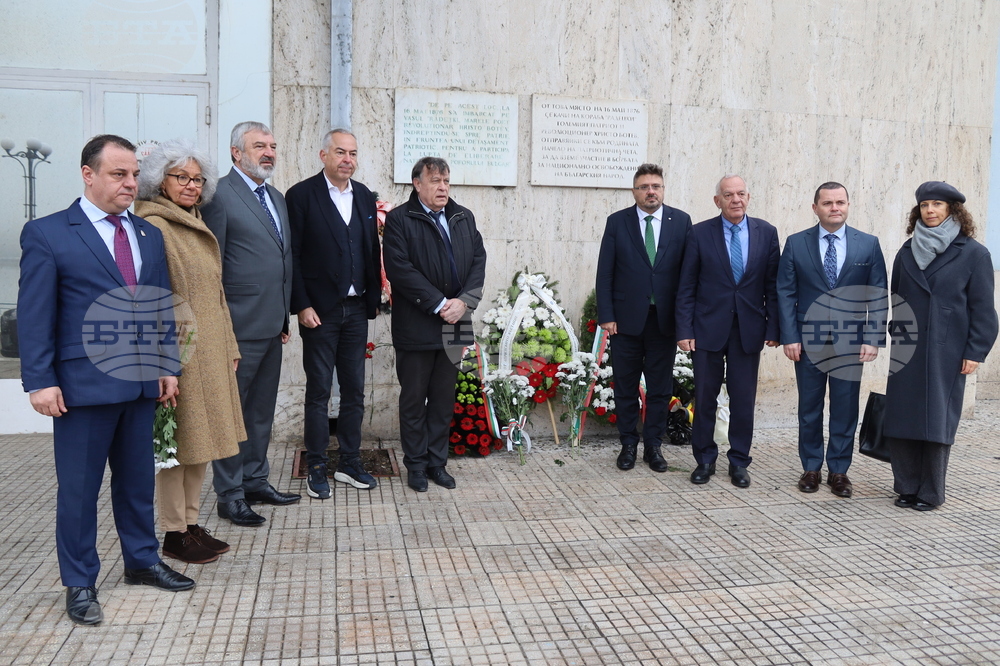
The sites where the Giurgiu Revolutionary Committee held its meetings, the Romanian port from which Hristo Botev’s detachment boarded the ship Radetzky, the Pantheon of National Revival Heroes and the tomb of Zahari Stoyanov in Ruse were honoured as part of the 14 Centuries of Bulgaria in Europe Initiative of the Bulgarian National Television (BNT), the Bulgarian News Agency (BTA), and Bulgarian National Radio (BNR).
The initiative will commemorate anniversaries in Bulgarian history that are significant for European history until 2032, the year of the 1400th anniversary of the establishment in 632 of Old Great Bulgaria, the first Bulgarian state in Europe.
“Here, on the hospitable Romanian soil, the newspaper Nova Bulgaria, founded by the great revolutionary and poet Hristo Botev, was published. Nearby was also the building where Bulgarian emigrants lived, who organized in 1876 the largest uprising for the liberation of Bulgaria,” reads the inscription in Bulgarian and Romanian on a plaque on the Vlad Tepes Street, near the market in Giurgiu.
Renovation works are underway at the site. Nevertheless, flowers were laid at the plaque by BTA Director General Kiril Valchev, Sofia University Rector Prof. Georgi Valchev, Ruse Mayor Pencho Milkov, Ruse Regional Governor Dragomir Draganov, journalist Boyko Vassilev, and Danubius Euroregion Association Executive Director Lili Gancheva.
At the site, Kiril Valchev read a quote from Zahari Stoyanov’s fifth chapter of the Memoirs of the Bulgarian Uprisings, dedicated to the emigrants in Giurgiu.
The delegation also visited the port in Giurgiu, where they were joined by Bulgarian Ambassador to Romania Radko Vlaykov, and Deputy Giurgiu Mayor Ionel Muscalu. Plaques in Bulgarian and Romanian mark the spot, noting that: “From this place, on May 16, 1876, the great patriot and revolutionary Hristo Botev boarded the ship Radetzky, setting off for the homeland at the head of a patriotic detachment to take part in the struggle for the national liberation of the Bulgarian people.” Wreaths and flowers were laid at the site.
The delegation also visited the Pantheon of the National Revival Heroes in Ruse. There it paid homage to memory of the 39 prominent Bulgarians reburied there, including Lyuben Karavelov, Stefan Karadzha, Panayot Hitov, Baba Tonka, Nikola Obretenov, Panayot Volov, Angel Kanchev, and others, as well as the 453 members of Botev’s detachment, the Chervenovod uprising detachment, the April Uprising, and volunteer units, whose names are inscribed inside. The delegation also visited the nearby tomb of Zahari Stoyanov.
As part of the 14 Centuries of Bulgaria in Europe initiative, a conference dedicated to the 150th anniversary of the 1876 April Uprising, and the December 1875 decision by the Giurgiu Revolutionary Committee to declare the uprising is held on Wednesday at the BTA National Press Club in Ruse.
The forum in the Danube city marks the beginning of discussions on the 150th anniversary of the April Uprising, which will also be organized next year at the Agency’s national press clubs in Veliko Tarnovo, Sliven, Vratsa, and Panagyurishte, which were centres of the four revolutionary districts during the 1876 April uprising.
/RY/
news.modal.header
news.modal.text