site.btaArchaeologists in Svishtov Discover Five Burial Structures, Fragment of Centurion's Tombstone
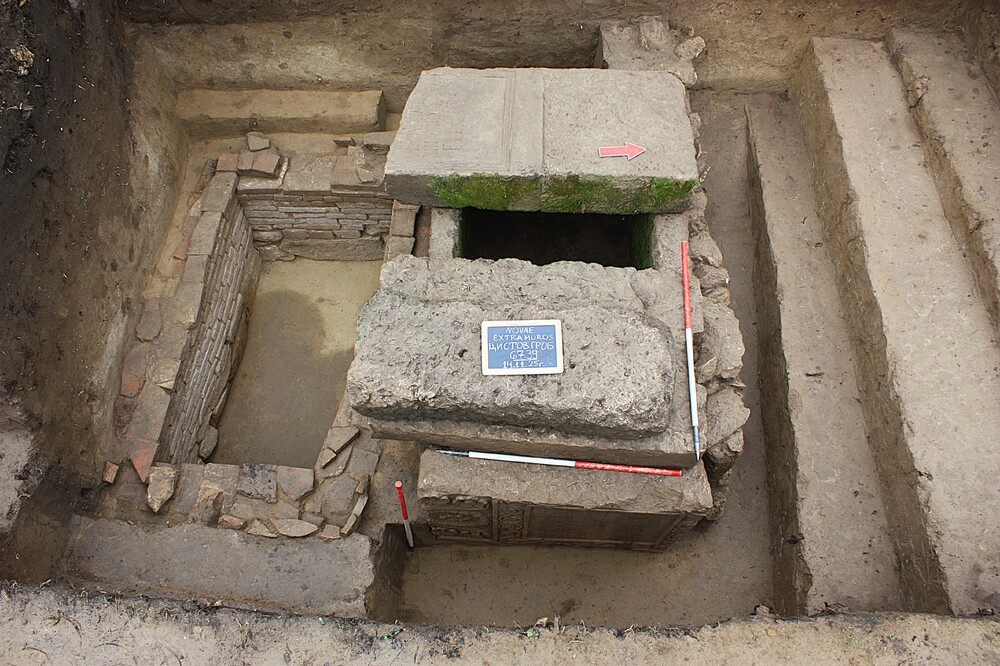
A fragment of the tombstone of a centurion of the Legio I Italica was uncovered during salvage excavations in the Western Necropolis of the Roman military camp of Novae near Svishtov, archaeologist Marin Marinov of the Svishtov Historical Museum said on Tuesday.
The rescue dig targeted a 2nd-3rd century necropolis after a local resident reported finding a tomb while uprooting a tree on his property in the town’s villa zone, Marinov said. The excavations are co-led by Dr Kalin Chakarov of the Regional History Museum in Veliko Tarnovo; Simeon Angelov, an archaeology graduate of Veliko Tarnovo University’s Faculty of History, also worked on site.
Archaeologists identified five burial structures: two cist graves formed of limestone slabs, a brick-and-stone-built grave, a simple burial pit and a stepped cremation pit, Marinov said. Four of the five were inhumation burials.
The partially preserved tombstone of centurion Gaius Valerius Verecundus was reused in one of the cist graves, together with other Latin-inscribed monuments reused in the structure, including the tombstone of Legio I Italica veteran Marcus Marius Patroclus from Iconium in Asia Minor. The second cist grave has an east wall built from the largely preserved tombstone of Gaius Alpinius Secundus, a native of Colonia Agrippina (modern-day Cologne, Germany). Another slab includes part of an epitaph of a veteran who served 25 years and died at 60, Marinov said.
Three of the tombstones are decorated with wreaths, ivy leaves and branches. The monument dedicated to Patroclus also depicts signa, a type of military insignia, Marinov said. All five graves appear to have been robbed in antiquity or in modern times; the few finds include a bone needle, a spindle fragment and two bronze fibulae.
The skeletal remains were found disturbed and will be examined by anthropologist Nadezhda Atanasova. Senior Assistant Professor Nikolay Sharankov of Sofia University is working on the Latin texts and will provide a full analysis, Marinov said.
/DS/
news.modal.header
news.modal.text