site.btaBulgarian Delegation Visits Antarctic Treaty Secretariat in Buenos Aires
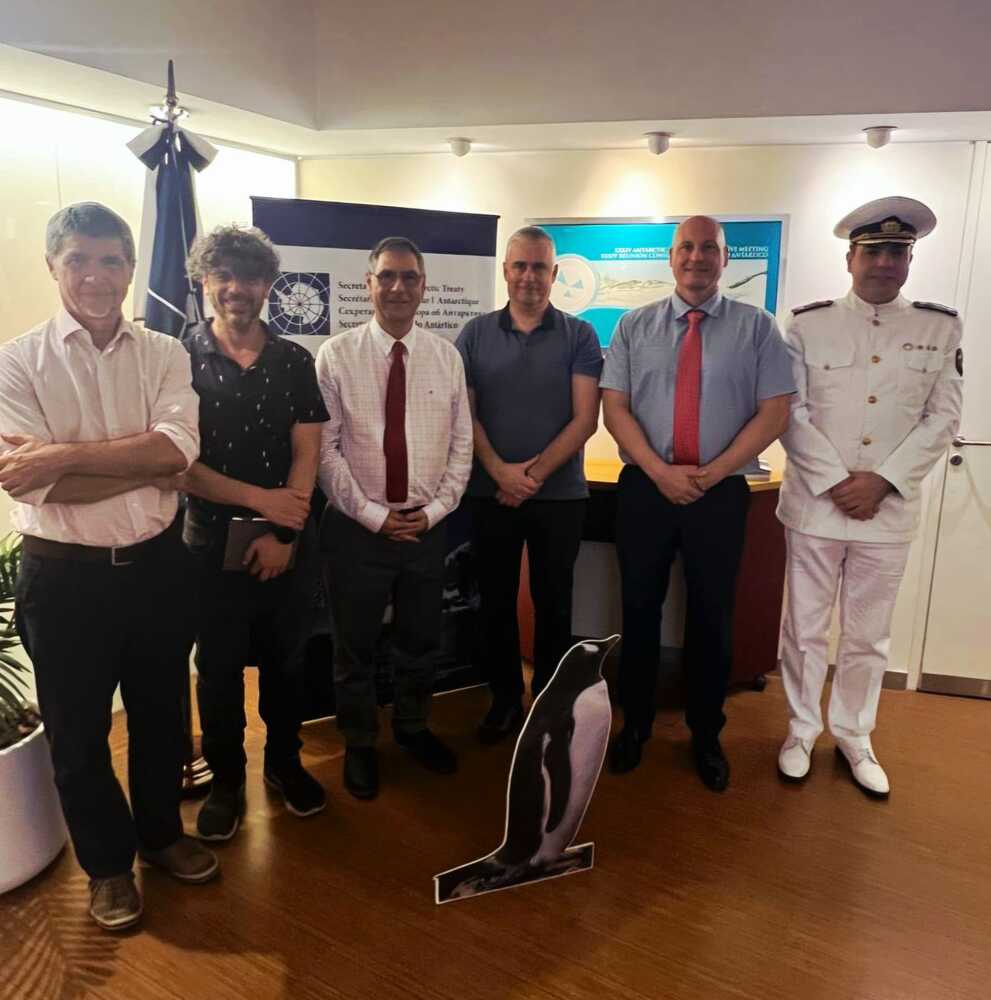
Representatives of the Bulgarian Antarctic Programme – Dragomir Mateev, Deputy Director of the National Centre for Polar Studies at Sofia University, and Captain 2nd Rank Nikolay Danailov, Head of the Staff Module and of the Research Vessels Unit at the Nikola Vaptsarov Naval Academy – together with Bulgaria’s Ambassador to Argentina Stoyan Mihaylov, visited the Antarctic Treaty Secretariat in Buenos Aires on February 9, the Bulgarian Antarctic Institute said.
During the visit, they held a working meeting with newly elected Executive Secretary Francisco Berguno of Chile and long-serving Secretariat officials Rodolfo Sanchez and Pablo Weinschenker.
The discussions focused on international cooperation within the framework of the Antarctic Treaty, as well as preparations for the upcoming Antarctic Treaty Consultative Meeting, which will be held in Hiroshima, Japan, in May. Issues related to sustainable development and governance of the continent within the Antarctic Treaty System were also addressed.
The Bulgarian representatives presented highlights of the ongoing 34th Bulgarian Antarctic Expedition, including new projects and initiatives. The 34th scientific expedition began its active phase in mid-November at Bulgaria’s Antarctic base St. Kliment Ohridski on Livingston Island. In the area of South Bay on Livingston Island, an international team of scientists, supported by the expedition’s logistics unit, is collecting samples under several research projects.
In June last year, the 47th Antarctic Treaty Consultative Meeting was held in Milan, where Bulgaria was represented by Prof. Christo Pimpirev, Dr. Rositsa Yaneva and Dragomir Mateev from the Bulgarian Antarctic Institute, as well as by representatives of the state administration.
The Antarctic Treaty was signed in Washington on December 1, 1959, with the aim of regulating international relations on the only continent without a native population – Antarctica. Initially signed by twelve countries whose scientists conducted active research during the International Geophysical Year (1957–1958), the Treaty entered into force in 1961. Many countries have since acceded to it, including Bulgaria.
The Antarctic Treaty System, comprising the Antarctic Treaty and related agreements, provides that the continent shall be used exclusively for peaceful purposes. Scientific research may be conducted freely, and results are exchanged among states. Military activities and nuclear tests are prohibited. Environmental protection is an obligation for all parties, and strong international cooperation is considered to be in the common interest.
The reports of BTA’s special correspondents from RSV 421 and from Antarctica are freely accessible in a special thematic section of the news agency’s website, entitled “Bulgaria-Antarctica BTA's Log,” in Bulgarian and English, and may be used freely by all media with attribution to BTA. According to BTA Director General Kiril Valchev, thanks to its special correspondents the agency appears among the first results in a Google search for the phrase “Antarctica correspondent”.
/RY/
news.modal.header
news.modal.text