site.btaMedia Review: February 9
HEADLINES
Monday’s news media are dominated by reports and speculation about the latest developments in the Petrohan murder case. All major print dailies report that the bodies of the three missing men - Petrohan Lodge owner Ivaylo Kalushev, 23-year-old Nikolay Zlatkov, and 15-year-old Alexander Makulev - were discovered in a camper located in a hard-to-reach area in northwestern Bulgaria on Sunday. Police say the three were killed inside the camper, where a weapon was also found. National Police Chief Zahari Vaskov is quoted as describing the crime as unprecedented in Bulgaria. Bulgarian National Television (BNT) reports that all working theories are being investigated, with the most likely scenario being that Kalushev killed Zlatkov and Makulev and then committed suicide.
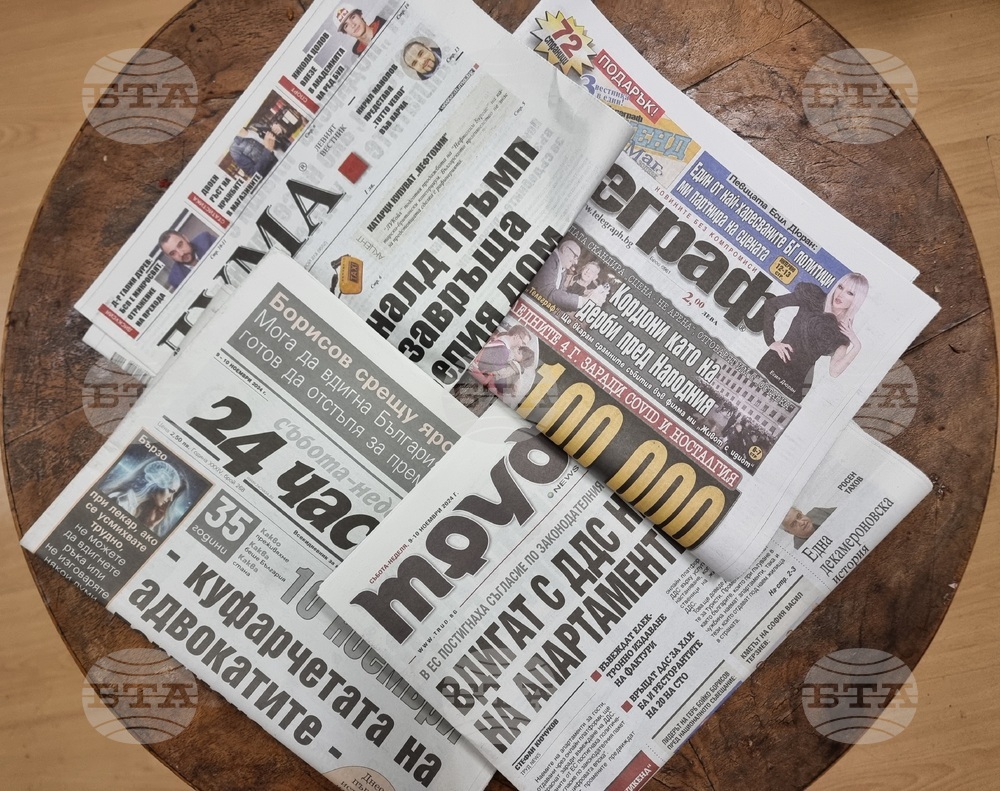
Telegraph leads with news of Bulgarian snowboarder Tervel Zamfirov winning a bronze medal in alpine snowboarding at the Milano Cortina Winter Olympics on Sunday. The daily notes that this is Bulgaria’s first Winter Olympics medal in 20 years, the first since Evgenia Radanova’s silver in short track speed skating in Turin. For the Bulgarian Ski Federation, this is its second Winter Olympics medal, following Ivan Lebanov’s bronze in the 30 km cross-country skiing event at 1980 Olympic Games in Lake Placid. Overall, this is Bulgaria’s seventh Winter Olympics medal. Trud and 24 Chasa also feature this story on their front pages.
Duma highlights the election of Krum Zarkov as leader of the Bulgarian Socialist Party (BSP) at the party’s 51st congress on Saturday. The story is covered by all major dailies.
Citing data from the National Social Security Institute, Trud reports that nearly every second pensioner in Bulgaria receives a minimum pension. The total number of pensioners stands at just over 2 million, with more than 937,000 people receiving the lowest pension of their respective category. Nearly 700,000 Bulgarians receive pensions below the poverty line. The data also show that the country grants more disability pensions than pensions based on length of service and age.
CRIME
Trud reports that the police’s main working theory regarding the Petrohan case is that Kalushev shot all five of his followers before taking his own life. A second scenario - an extended suicide - remains under consideration, although police say it is less likely. The daily recalls that on February 2, Ivaylo Ivanov (49), Decho Vasilev (45), and Plamen Statev (51) from the non-governmental organization National Agency for Control of Protected Areas, registered in 2022, were found shot dead near a lodge near the Petrohan Pass in the Western Balkan Mountains. That was when police efforts to locate Kalushev, the owner of the lodge, began.
Speaking on Nova TV’s morning programme, Ivan Ivanov, head of the psychiatry department at Levski Hospital and a forensic expert, said the events at the Petrohan lodge fit the definition of what is known as an extended melancholic suicide, a phenomenon associated with the most severe forms of depression. According to Ivanov, the most likely scenario in this case is murder followed by suicide. He believes the perpetrator was Kalushev, citing a letter addressed to Kalushev’s mother that was allegedly written by him some time before the bodies near the lodge were discovered. Ivanov also suggested that the other men may have been strongly influenced by Kalushev - whom he described as the group’s leader - which could explain why they offered no resistance. Ivanov was categorical that the case was unrelated to drug trafficking, score-settling, or sexual motives.
Trud reports testimony from a young man who alleged pedophilia on the part of Kalushev. The man, who now lives in a small town in the Sofia region, told investigators that he had been part of Kalushev’s group and, at the age of 15, lived with Kalushev and his friends in Mexico. He said he left the country after the attitude toward him began to change, as Kalushev began paying more attention to another minor - Nikolay Zlatkov, who was then 11 or 12 years old.
24 Chasa reports that one of the men killed near the Petrohan lodge, Ivaylo Ivanov, had represented Russia’s corporation Rosatom in its arbitration case against Bulgaria’s National Electricity Company (NEK) in Geneva. The case concluded in June 2016, when NEK was ordered to pay some EUR 600 million in compensation for equipment produced for the unrealized Belene nuclear power plant project. The paper adds that Ivanov later gave up his work as a lawyer and tax consultant to devote himself entirely to extreme sports and rangering alongside Kalushev. Ivanov was part of the management of the National Protected Areas Control Agency, the NGO with which the six victims in the Petrohan case were affiliated. The organization signed a framework agreement on environmental protection with the Environment Ministry in 2022.
Nova TV has an interview with Milena Malinova, a long-time friend of Ivaylo Ivanov, who dismissed the theories about sects and pedophilia as “complete nonsense.”
On the channel’s morning programme, criminologist Ivan Savov argued that the victims had been under the protection of criminal or political circles. He questioned who had stood behind Kalushev and his activities for so many years, noting that it remains unclear what the group had been doing at the lodge over the past four years. “According to information from my sources, reports were filed against the victims. They operated in symbiosis with criminal circles and were allowed to do whatever they wanted because they helped someone carry out shady activities. That is my assumption,” Savov said.
Mariyan Sabev, a senior security analyst at the Center for the Study of Democracy, told Bulgarian National Radio (BNR) that instead of presenting facts, the Interior Ministry had reinforced insinuations, which he described as extremely dangerous at this stage of the investigation.
Also on BNR, Toma Belev, deputy minister of the environment in 2022, called for international investigators to be invited to take part in the probe, citing widespread public mistrust in how the institutions are handling the case.
*
Telegraph reports that its own online check found Bulgarian euro coins being sold on websites for precious metals and stones to foreign collectors at double the domestic price. The starter pack of euro coins of all denominations available in Bulgaria is being sold at prices up to three and a half times higher.
POLITICS
Speaking on BNT’s morning programme, MEP Tsvetelina Penkova said that ”the BSP is embarking on a path of renewal and reflection aimed at restoring the party’s significance and rightful place in Bulgarian society and politics.” She noted that Krum Zarkov has long enjoyed strong support within the BSP. “We are the most democratic party, where decisions are taken by collective bodies. The choice was a natural one. He is the person who should have led the BSP,” Penkova said. According to her, Zarkov’s election is a clear sign that the left is urgently needed in Bulgarian society and politics, adding that his positions have always been moral, principled, and expert.
Political analysts Hristo Panchugov and Strahil Deliyski also commented on the issue on BNT. Panchugov said that Zarkov’s election was effectively the only viable option, as it allows the party to project a message of organizational and ideological renewal. Had the BSP retained its old leadership, it would have been a complete failure in the upcoming elections, he argued.
Trud publishes an interview with Prof. Antoaneta Hristova, who says it would be most logical for Andrey Gurov, Bulgarian National Bank Deputy Governor and former Continue the Change (CC) floor leader, to serve as caretaker prime minister. ”The battle for fair elections will be very tough. No single person can be a guarantor of this process. There is no such thing as an ‘equally distant’ politician,” Hristova notes. She adds that CC and Gurov are currently not ”on the same track,” arguing that CC is trying to cling to Gurov in order to gain political dividends. Taking a question about the peculiarity of the Bulgarian political spectrum, Hristova says that Continue the Change-Democratic Bulgaria (CC-DB) is not a democratic right-wing political entity. “Society is desperate after a prolonged period of uncertainty and poor decisions. When society is desperate, it looks for a savior, and CC–DB betrayed hopes,” she adds.
Sociologist Boryana Dimitrova from Alpha Research told BNR that April 19 is a possible date for early parliamentary elections. She said the future caretaker prime minister would have about a week to form a cabinet, making the timeline feasible. According to Dimitrova, the President is likely to opt for a more compromise figure as caretaker prime minister, rather than a highly prominent representative of either political camp. She also argued that GERB has suffered significant damage from its close public association with Delyan Peevski and his Movement for Rights and Freedoms – New Beginning. “I do not think that trying to attach Peevski to CC–DB will bring the expected results, but [GERB leader Boyko] Borissov is clearly trying to distance himself from Peevski,” she said. Dimitrova added that under its new leadership the BSP has a chance to return to the political game, but warned that the party also faces serious challenges ahead.
ECONOMY
24 Chasa writes that although Bulgaria has the lowest minimum wage in the EU, Bulgarians have higher purchasing power than residents of the Czech Republic, Estonia, and Latvia. Since January, the minimum wage has stood at EUR 620.20, yet Bulgarians can afford goods and services that cost the average European EUR 1,039. The data come from Eurostat’s first recalculation of minimum-wage purchasing power in the EU for the year.
*
Duma reports that the Association of Bulgarian Tour Operators and Travel Agents has expressed serious concern over the expanding grey sector in tourism and the growing number of unregulated practices. Trud sums up the problem by noting that tourist trips are being organized without any guarantee that they will actually take place. The association is urging institutions to introduce effective oversight and legislative changes.
*
24 Chasa publishes an interview with Alexander Kolyachev, acting chair of the Commission for Consumer Protection, who says that since the beginning of February the Commission has carried out 288 inspections and issued seven violation reports. Fines totalling EUR 15,000 have been imposed on stores that raised the prices of multiple products. Violations have also been found at winter resorts, with some establishments facing closure. Most complaints concern the service sector, particularly price hikes at gyms and sports centers, Kolyachev notes.
DATA SECURITY
Telegraph quotes information technology and data storage and analysis expert Nikola Tulechki, who warns that more than 100,000 video cameras in Bulgaria are connected to the internet, many of them completely vulnerable to hacking. According to Tulechki, attackers can easily download footage or even watch live streams. His comments come amid revelations that videos from Bulgarian beauty salons and a gynecological examination room have appeared on global pornographic websites. Tulechki adds that most homeowners, clinics, offices, and security firms install the cheapest Chinese-made cameras on the market, costing EUR 10–20, which are particularly easy to hack.
/IV/
news.modal.header
news.modal.text