site.btaMonitoring Glacier Melting Important for UAE as Coastal Country, Says Scientist Ahmed Al Kaabi
In an interview with BTA, United Arab Emirates (UAE) meteorologist Ahmed Al Kaabi, member of Bulgaria’s 34th Antarctic Expedition, said that monitoring the rate of glacier melting is important for the UAE as a coastal country. “The UAE is a small country located on the Arabian Peninsula and surrounded by two bodies of water, the Gulf of Oman and the Arabian Gulf. It is very important to have an understanding of the rate at which ice is melting and how this will affect the country in the future,” he said.
Al Kaabi works at the National Center of Meteorology in Abu Dhabi and heads the Meteorology and Geophysics Section.
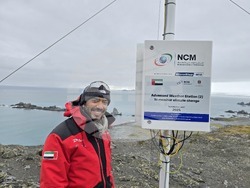
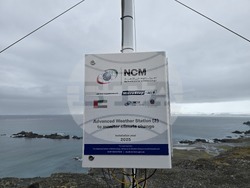
“The UAE is part of the Earth, and when there is a global initiative, the UAE is committed to being part of solving global problems. That is why, as scientists, we have installed two scientific stations and will deploy more scientific instruments in Antarctica to help better cover this gap, which will allow us to apply these skills and data to better understand the environment,” he explained.
The project of Al Kaabi and his colleague Badr Al Ameri started in 2025, and this year they are installing new stations – a meteorological station and a tide gauge. Their goal is to collect ground-based observations of various meteorological and seismological parameters over a longer period of time. From the first meteorological station installed last year, the scientist already has data covering 365 days.
“After some time for data analysis and filtering, the data will be assimilated into numerical weather prediction models to improve the local forecast for the Livingston Island area. This will happen through the global models used by the World Meteorological Organization. We feed the data into models such as the Global Forecast System and the local Weather Research and Forecasting model to improve forecasts for the area,” Al Kaabi said.
The data are transmitted every hour from Antarctica to data centres in the UAE, specifically to the National Center of Meteorology. They are then carefully analyzed and used to fill gaps in forecasting for the Livingston Island area. “The UAE laboratory began as a collaboration between the National Center of Meteorology within the UAE Polar Program and the Bulgarian Antarctic Institute, in order to establish our first laboratory on the territory of the Bulgarian Antarctic base,” Al Kaabi said. “We are very happy that it was completed this year, and it will be used to store sensors, as a workspace for scientists to prepare their equipment, maintain it and improve it in a comfortable working environment.”
He added that cooperation between scientists from the UAE and the Bulgarian Antarctic base is made possible thanks to the Bulgarian Antarctic Institute, and in particular the head of the Bulgarian Antarctic expeditions, Prof. Christo Pimpirev, and the Deputy Director of the National Centre for Polar Studies at Sofia University, Dragomir Mateev. They invited the UAE to begin sending its scientists to Antarctica and to use the Bulgarian Antarctic base to launch its first scientific mission and research programme.
“In Arab culture, we have a saying that goes: those who do not like climbing mountains will never reach the summit. Deciding to come to Antarctica and spend time installing scientific projects, then collecting data and returning with highly valuable information from one of the most remote areas on Earth sounds very difficult, but at the same time it is very beautiful and optimistic that young people have the chance to do something not only for themselves, but for the world and for the next generation,” Al Kaabi said.
The Bulgarian naval research vessel Sv. Sv. Kiril i Metodii (RSV 421) departed for Antarctica from Varna (on the Black Sea) on November 7, 2025. After a month-long voyage across the Atlantic Ocean, the ship arrived at the Argentine naval base in Mar del Plata on December 13.
BTA has had a national press club on board the ship since 2022 and another on Livingston Island since February 2024. These are added to the news agency’s other 41 national press clubs (33 in Bulgaria, seven abroad in neighbouring countries and in nations with large Bulgarian communities, and one mobile National Book Press Club). BTA's Director General Kiril Valchev announced ahead of the fourth voyage to Antarctica on November 7, 2025 that the national news agency would send a special correspondent in January-February 2026.
He said the press clubs exist thanks to the generous support of RSV 421 and Bulgaria’s St Kliment Ohridski Base, which provide the necessary facilities.
The news items of BTA's special correspondents on RSV 421 and Antarctica are freely available in Bulgarian and English on the agency's website. They can be used free of charge by all media, with attribution to BTA. Valchev recalled that thanks to its correspondents, the news agency appears among the top results on Google when searching for the phrase “Antarctica correspondent”.
/NF/
Additional


news.modal.image.header
news.modal.image.text
news.modal.download.header
news.modal.download.text
news.modal.header
news.modal.text