site.btaMacroeconomic, Financial, Tax Stability Main Priorities for Businesses in 2026, Industry Leaders Say
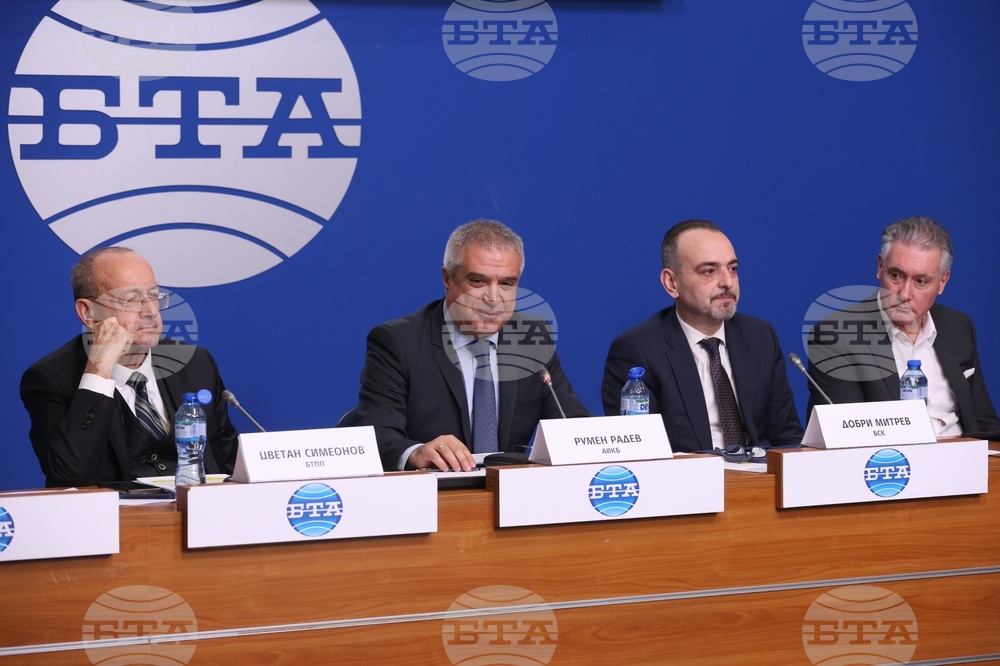
The Association of Bulgarian Employers' Organizations (ABEO) has identified macroeconomic, financial and tax stability as its main priority this year. Dobri Mitrev, Chair of the Board of the Bulgarian Industrial Association (BIA) and ABEO's rotating chair for 2026, announced this at a BTA-hosted news conference in Sofia on Thursday.
According to Mitrev, the business focus in 2026 is no different from previous years: economic stability and accelerated growth. "Unfortunately, political instability prevents us from achieving all these things at the pace we would like, and from having a prosperous economy, industry and wealthier Bulgarian citizens," said Mitrev.
He identified the preservation and application of market economy principles as a new priority for the association. "It is important to us that the State adheres to fiscal rules. Budget implementation data show a significant increase in tax revenues. This means that we have a good tax and social security model. However, attempts to change this in the 2026 draft budget, as well as plans to increase taxes and social security contributions, have prompted people to take to the streets in protest," Mitrev said.
One of the ABEO's priorities is to remove Bulgaria from the Financial Action Task Force's so-called grey list for money laundering. "Bulgaria is the only European Union country on this list, which has a serious impact on its image and the operating environment for investors in our country," Mitrev noted.
Rumen Radev, Chair of the Management Board of the Bulgarian Industrial Capital Association (BICA), presented the ABEO's priorities in terms of the business environment and the economy. These include maintaining the existing tax model and tax and social security burden and reducing the share of GDP redistributed through the state budget. "Over the past ten years, there has been a steady increase in tax and social security revenues, as well as in the share of redistribution through the state budget. That is why we reacted so sharply when the discussion on the first draft of the 2026 budget began. This type of trend is not positive for the country," he said.
The BICA's programme for this year also includes promoting investment in the real manufacturing and extractive sectors, introducing real programme budgeting, linking the public sector to measurable goals and results, and increasing the efficiency of the public sector by reducing administrative structures and the number of people employed in them.
Kiril Domuschiev, Chair of the Management Board of the Confederation of Employers and Industrialists in Bulgaria, pointed out that businesses in Bulgaria pay some of the highest electricity prices in Europe. According to him, this results in a loss of competitiveness, as well as higher prices for services and products, which affects society as a whole. "Prices in Europe are also high, mainly due to the war in Ukraine, but the price in Bulgaria last year was EUR 107 on the Bulgarian Independent Energy Exchange. Prices are slightly higher only in Italy, Romania and Hungary. It [the electricity price in Bulgaria] is by 20% higher than in Germany, 70% higher than in France and Spain, and five to six-fold higher than in Scandinavia," he said.
The ABEO insists on a guaranteed compensation mechanism for high electricity prices, adoption of a mechanism and procedures for signing long-term contracts for energy-intensive enterprises and to activate the operational work of the Green Deal Advisory Board to achieve a balanced and structured approach to forming national policies on the green transition, and to recalibrate the Green Deal.
Tsvetan Simeonov, the Chair of the Board of Directors of the Bulgarian Chamber of Commerce and Industry (BCCI), presented the employers' priorities in education and the labour market. These include aligning secondary and higher education with the needs of the labour market and introducing specific quality indicators for education. The ABEO insists on the development and expansion of vocational training to prepare qualified personnel, through partnerships between the education system and businesses that are in line with the needs of the economy.
Other priorities include improving the digital skills of the population, including businesses and workers, promoting the digitization of the economy; and providing an environment for the use of artificial intelligence. There is also a focus on improving financial literacy, particularly among students and young adults.
/TM/
Additional





news.modal.image.header
news.modal.image.text
news.modal.download.header
news.modal.download.text
news.modal.header
news.modal.text