site.btaMaria Tsantsarova's Dismissal Prompts Regulator's Scrutiny and Calls for Stronger Safeguards for Journalists

The lawyers of the Council for Electronic Media (CEM) will examine the case of the dismissal of journalist Maria Tsantsarova from bTV and whether it involves a breach of the Radio and Television Act (RTA). The decision was made on Thursday by CEM members after a lengthy discussion. They also decided to organize a meeting with the Association of Bulgarian Radio and Television Broadcasters (ABBRO).
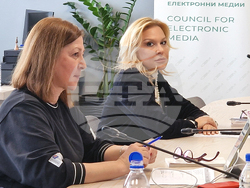
The first item on the agenda of the regulator’s first meeting of 2026 concerned freedom of expression, journalists’ rights and adherence to journalistic ethics. The discussion was prompted by Tsantsarova's removal from the airwaves of bTV towards the close of 2025.
On December 22, bTV announced that it had decided to part ways with Maria Tsantsarova, one of its best-known personalities, a co-host of the channel’s morning show. The broadcaster cited multiple reasons for her dismissal, including alleged on-air political bias, her accusations against her immediate superior of exerting editorial pressure, and extending an interview in a way that disrupted the broadcast schedule. Tensions between the bTV leadership and Tsantsarova escalated after, on the day of large-scale anti-government protest on December 10, the journalist placed in front of her a mug with the message "Time to make real change." The mug appeared in the frame several times during the broadcast. Tsantsarova's removal sparked protests. The Association of European Journalists-Bulgaria said her dismissal was due to heavy-handed political pressure and stressed that Bulgaria must comply with the European Media Freedom Act, which protects media outlets from political interference.
During Thursday's CEM meeting, one of the regulator's members, Gabriela Naplatanova, said: "For me this is a serious shock in one of the most watched television channels, and conclusions ought to be drawn within the media itself, of which I was also part for 22 years." She added: "I am surprised at what led the media to sacrifice one of its most popular and recognizable presenters, and a symbol of sharp political commentary: Maria Tsantsarova."
According to Naplatanova, reactions have been predictably polarized because "as a prominent journalist, Maria Tsantsarova took positions on air and gained many supporters but also many detractors who organized numerous attacks and smear campaigns on social media over the past year. If a journalist does not seek the truth and does not provoke public reactions with their work, then their work serves no purpose."
Naplatanova recalled that many journalists had been removed in the past. "This process does not concern only one person and only one media outlet. It concerns the entire media environment, and has done so for a long time," she said.
She stressed that CEM should not intervene directly in this case because the editorial staff of the media outlet is free to determine its staffing decisions and editorial policy. The newly adopted Media Freedom Act strictly prohibits interference by CEM in this respect, she noted. "A categorical action on our part in this case would be perceived as pressure," Naplatanova added.
She proposed that CEM meet with the Association of Bulgarian Radio and Television Broadcasters (ABBRO) to clarify how such decisions are taken in editorial offices. Her proposal was accepted by CEM.
Other CEM members also took the floor. Kadrinka Kadrinova said that "the media environment in Bulgaria has long been ailing; the reasons are many and should be the subject of serious analysis, because the state of the media environment is the most visible indicator by which one can judge the state of democracy in society."
"For decades there have been abuses of journalistic labour through humiliatingly low pay as a widespread practice," Kadrinova said. "I firmly believe it is the legislator’s duty for journalism finally to acquire the status of an activity of public significance, even one of strategic importance for the foundations of democracy," she added.
Prolet Velkova described Tsantsarova's dismissal from bTV as "extremely drastic". In her words, this concerns "a striking journalist with an exceptionally large audience, one of the few remaining journalists who work in depth, examine the facts, look for the connections between them, allow themselves to think critically and insist on answers to uncomfortable questions."
Velkova said that two of the media outlet’s arguments for dismissing Tsantsarova contravene provisions of the Radio and Television Act. These are the presenter’s on-air appearance "with a branded mug bearing a message clearly associated with an ongoing political campaign" and "Maria Tsantsarova having allowed herself on air to make numerous comments accusing her direct superior of influencing the editorial content."
According to Velkova, the branded mug did not carry a political message linked to a party but to civic protests against corruption and lawlessness in the country. "Stripping a journalist of the right to express positions, especially ones clearly in the public interest, is for me a breach of Article 10 of the Radio and Television Act," she said, noting that it states "the guarantee of the right to free expression of opinion."
With regard to the argument that the journalist had allowed herself to make comments accusing her direct superior, Velkova cited Article 11(3) of the Radio and Television Act: "Public criticism of media service providers by those working for them is not disloyalty to the employer."
Velkova proposed that CEM instruct its lawyers to examine this case, analyze it and assess whether there has been a breach of the Radio and Television Act. Her proposal was accepted by her colleagues.
Simona Veleva, the CEM chair, emphasized that the regulator cannot and should not interfere in the editorial independence of the media and has no powers over their staffing decisions. "That is indisputable. At the same time, it is our duty to monitor compliance with the principles of transparency, predictability and professional standards in the work of media service providers, especially when it concerns leading journalists with public trust," Veleva said.
"For me, a very bad sign and an extremely poor impression was the warming-up for this removal through speculative articles in tabloid media along various lines linked to her working rhythm, which was an extremely unhygienic approach. That is why I consider it important for CEM to state its expectations that the media inform the public in a responsible and clear manner when decisions of high public sensitivity are taken," the CEM chair said regarding Tsantsarova’s removal.
/MR/
Additional


news.modal.image.header
news.modal.image.text
news.modal.download.header
news.modal.download.text
news.modal.header
news.modal.text