site.btaMedia Review: December 23
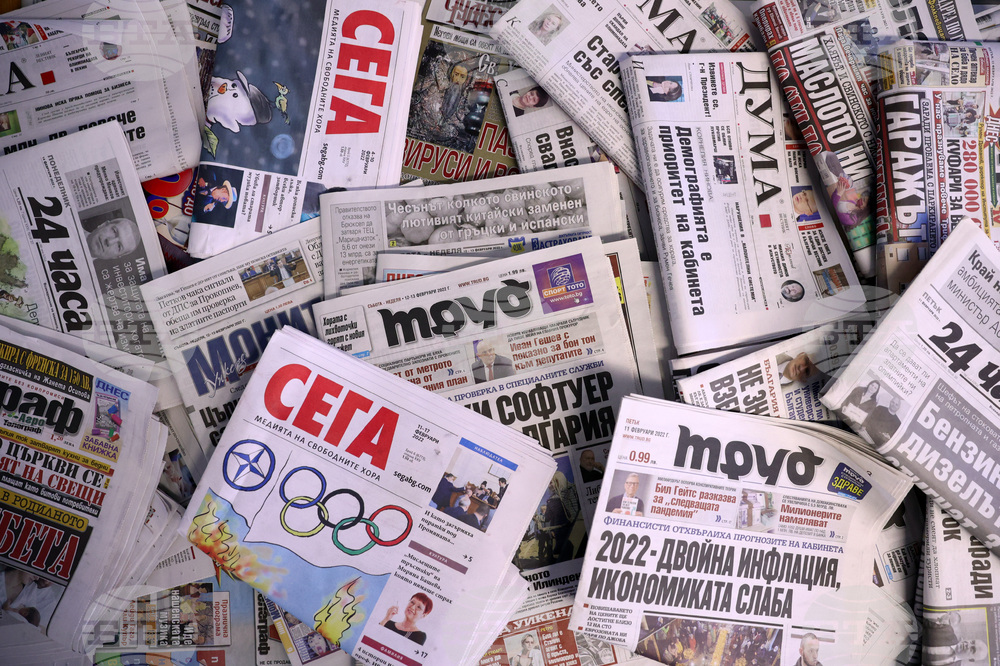
POLITICS
In an interview with the Bulgarian National Radio, political scientist and journalist Emiliya Milcheva on the political situation in the country. She said that the protests which brought hundreds of thousands of people onto the streets not only in Sofia but also in other cities, as well as in several European capitals, were triggered by the state budget bill but were in fact the result of accumulated public tension. According to her, the crowds included many people who were not merely voters or supporters of a single political force. Among the reasons driving people to protest, Milcheva listed the lack of justice on the roads, the state of the healthcare system, the arrogant behaviour of the ruling political elite and “many other issues”. She also pointed to the discontent among young people as a significant factor, noting that they “certainly want a different future, one that is not shaped by such analogue politicians”.
***
All media outlets quote BTA’s Tuesday interview with Bulgarian National Bank Governor Dimitar Radev. While the title in BTA is different, the other media outlets put the highlight on his words regarding the caretaker prime minister position: “Absolutely not [when asked if he would accept it, if it is offered to him]. The independence of the Central Bank is a fundamental principle. Calling it into question would undermine trust not only in the BNB, but in the entire institutional system, especially at a moment of historic change of the monetary regime.”
ECONOMY
One of the leading news topics on Tuesday covered the water prices set by the Energy and Water Regulatory Commission for the country for the coming month. From a 14% increase to a 12% decrease – this was the range outlined by Bulgarian National Radio. Most media outlets highlighted the price increases in their headlines, as they affect a larger number of regions. The Ministry of Regional Development responded with a statement saying that the water and sewerage companies within its system would not raise prices in order “to ensure the necessary transitional period for smoother adaptation following the adoption of the euro as the country’s official currency”. 24 Chasa writes that this includes “almost all water utilities in Bulgaria, with the exception of the one in Sofia, as it is operated by the French company Veolia” – in the capital, the price will rise by 12%.
***
Bulgarian National Television’s (BNT) morning show featured an interview with Podkrepa Confederation of Labour President Dimitar Manolov. He argued that there had been better options for addressing the state budget for next year than entering 2026 with a so-called extension budget. “After version 1.0 of the budget, which was criticized by everyone, we produced budget 2.0, which in many respects was far better,” he said, adding that the current decision “is not development, but stagnation and survival”. According to him, the funds earmarked for the public media – BNT, BTA and BNR – have fallen back to previous levels. Manolov warned that municipalities would also be seriously affected, as they would be left without investment opportunities for a long period of time.
Also on BNT’s morning show, National Association of Municipalities Executive Director Silvia Georgieva said that the adoption of an extension budget “always creates difficulties”. “Each month we will receive exactly the same amount of money as in the corresponding month of the previous year. Education, healthcare and social services will certainly continue to function normally. Municipalities will make every effort to ensure this,” she said. Georgieva believes that projects under the Recovery and Resilience Plan will be at risk in this situation. “At the moment, municipalities are implementing projects worth around EUR 2 billion under the Recovery and Resilience Plan, many of them at an advanced stage. There is no clarity for them, there are no precise texts in the extension budget, and this is why there is the greatest uncertainty about how payments will proceed.”
***
Bulgarian National Radio quotes an Agence France-Presse report by Rosen Bosev, which highlights concerns among people in small settlements in Bulgaria about the introduction of the euro. “In villages, three factors accumulate: an older population, lower levels of education and financial literacy, and payments made predominantly in cash,” said Alpha Research sociologist Boryana Dimitrova, who has been studying attitudes towards the euro for a year. Food price inflation has further intensified concerns among Bulgarians. “We have to acknowledge that the increase in prices has not been insignificant,” the sociologist told AFP. Food prices in November rose by 5% year on year, according to the National Statistical Institute – more than twice the euro area average.
***
Trud features an article on the property market in Bulgaria. According to its survey, buyers on the residential property market in Sofia continue to favour larger homes suitable for family living. The average size of purchased dwellings stands at around 115 square metres, with two- and three-room apartments accounting for roughly 80% of all transactions. Interest in houses in and around the capital has increased significantly, with transactions nearly doubling year on year, driven by demand for more space and proximity to nature. Most buyers are aged between 30 and 49 and make purchasing decisions quickly. A substantial share rely on mortgage financing, often covering a large proportion of the purchase price. On the secondary market in Sofia, the main motivation for sellers is capital gain, followed by the intention to purchase another property, while sales due to financial necessity remain limited. In Varna, the average size of purchased properties is smaller, at approximately 105 square metres. Two-room apartments remain the most popular, largely for investment purposes, although overall average space is increasing due to higher demand for houses and larger homes. The buyer profile in Varna largely mirrors that in Sofia, with mortgage-backed purchases accounting for more than one-third of transactions.
CULTURE
Sega.bg writes how long-standing criticism over the allocation of funds by the National Culture Fund “has received confirmation from within the institution itself”, as it quotes minutes from a December 11 meeting of the Fund’s Management Board. The discussion concerned financing for small cultural projects in 2025 and revealed serious objections from several board members regarding the work of the evaluation committee and flawed assessment rules. Despite expressed concerns over unequal treatment of projects, insufficient justification of scores and tight assessment deadlines, the board ultimately approved the funding after a second vote, citing the risk of losing allocated programme funds. The approval was described by some members as a compromise taken under pressure, with acknowledgements that similar decisions had been made in the past. Further controversy arose later in the meeting when additional projects were approved despite objections that there were no clear grounds for their selection, the article reads.
***
OffNews.bg quotes a petition by Bulgarian scholars and intellectuals opposing an initiative to mark in 2032 the 1,400th anniversary of the founding of the Bulgarian state under the slogan “14 Centuries of Bulgaria in Europe”. “The impression arises that this is yet another manifestation of a long-standing addiction to pompous celebrations of round anniversaries, albeit more ambitious and in any case more comical than those produced over the past century and a half,” the signatories of the open letter note. “Experience so far shows that inflated celebrations of artificially designated occasions fuel hollow, jingoistic patriotism, alienate and estrange critically minded people, and provoke annoyance and irony. They only reinforce retrograde and authoritarian tendencies, social sclerosis, disorientation and stagnation,” the letter reads.
WORLD
bTV’s morning show aired an interview with former deputy foreign minister Milen Keremedchiev on international political developments over the past year and expectations for the coming one. “We can describe 2025 as the year of unfulfilled hopes. With [US President] Donald Trump’s return to the White House, we indeed saw a reawakening of US foreign policy, which had been drifting during Joe Biden’s term. This sharp surge and maximum activation did not lead to lasting results. The Trump administration’s claim of eight resolved conflicts proved exaggerated. The only conflict that was actually resolved was between Armenia and Azerbaijan,” he said. “We saw the situation in Gaza – the 20-point plan stalled at the second point. Hamas has not laid down its arms and hostilities may resume. There is also no convergence of positions on Ukraine. President Vladimir Putin has said he expects 2026 to be a year of military action. Ukraine marked a year with the lowest level of funding from its partners,” Keremedchiev explained. “The United States does hold all possible cards to exert pressure on Russia. The ban on trade in Russian oil products had a strong impact in both India and China. We are also seeing a decline in consumption of Russian oil. From here on, how far the US and Trump will want to increase pressure on Putin is simply a presidential decision. However, we see hesitation in his policy. Every meeting between the Russian and US negotiating teams leads Trump to adopt a far more hesitant position,” he noted.
/MR/
news.modal.header
news.modal.text