site.btaExperts Call for Stronger Rules to Protect Children Online
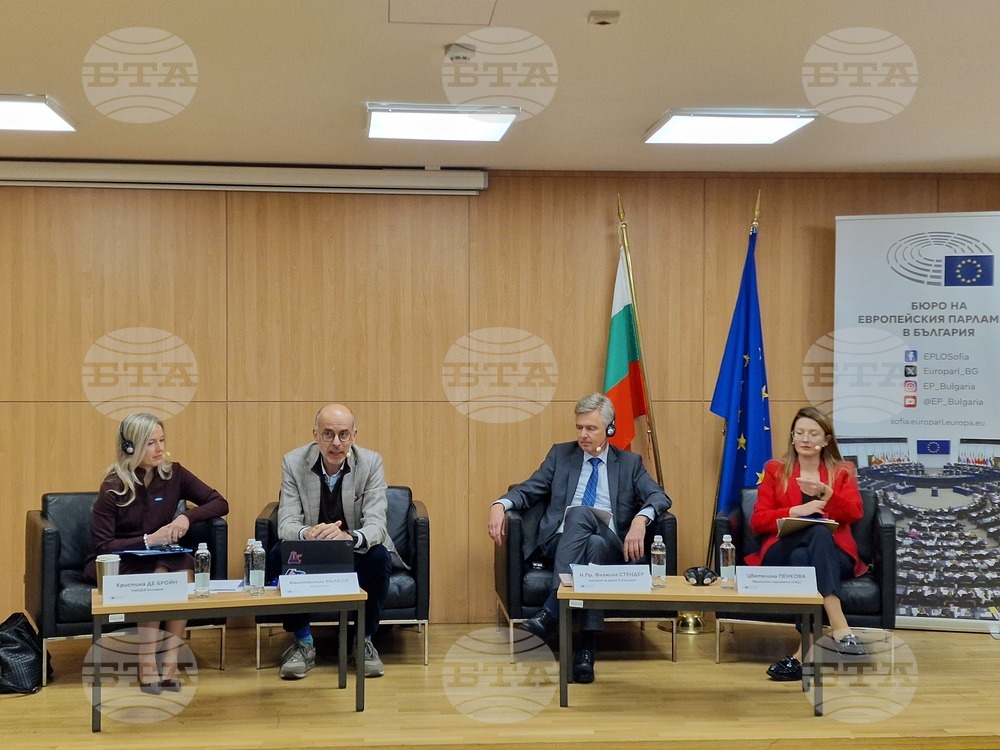
Experts at European and national level on Friday voiced support for stronger regulation and age-verification mechanisms to protect children online during a discussion titled Risks on the Internet: Protecting Young People and Children Online. The event was organized by the European Parliament (EP) Office in Bulgaria in partnership with the Bulgarian Safer Internet Centre.
The forum brought together representatives of European institutions, journalists and specialists at the House of Europe in Sofia to discuss EU legislation related to the online safety of minors and the necessary national-level measures in this field. The Head of the EP Office in Bulgaria Teodor Stoychev opened the event, which was moderated by journalist Konstantin Valkov.
The first panel featured Danish Ambassador to Bulgaria Flemming Stender, UNICEF Representative in Bulgaria Christina de Bruin, Members of the European Parliament Tsvetelina Penkova and Ivaylo Valchev, as well as Katie Rigg from the European Commission’s Directorate-General for Communications Networks, Content and Technology (DG CONNECT).
Valkov noted that it takes around 45 seconds for a child to become engaged in a high-risk online conversation.
Ambassador Stender said Denmark had recently suspended the use of mobile phones in schools. About 94% of young people have social-media profiles after the age of 14, he added, stressing that while major platforms profit from children spending more time online, parents play a key role in ensuring their safety.
De Bruin said it was important to consider the full spectrum of children’s rights related to internet use, noting that responsibility for their safety is shared by society at large.
Penkova said Europe needs uniform rules to ensure online protection for minors, as the current fragmented environment does not provide sufficient safeguards. While age-related restrictions place responsibility on parents, platforms themselves must be regulated, she noted. She argued for flexible measures that would allow limited, but not banned, access to the internet, adding that age 13 to 16 could be an appropriate threshold. She also said the European Commission is developing an application prototype designed to verify age without requiring personal data disclosure.
Speaking online, Valchev said Europe is, for the first time, discussing voluntary limitations on children’s online access. He noted the difficulty of sanctioning platforms and algorithm developers, as responsibility ultimately shifts to the state. Also appearing online, Rigg said new measures are being drafted to address algorithm-related risks to minors.
In the second panel, focused on Bulgaria, Deputy Education and Science Minister Emilia Lazarova said digital competence is integrated into all school curricula and will become a leading priority under upcoming changes.
As children grow, responsibility increasingly rests with parents, Deputy Justice Minister Mihaela Mechkunova said, adding that the state must provide a legal framework that supports them.
State Agency for Child Protection expert Tsvetelin Kanev said key challenges include insufficient awareness of online risks and limited opportunities for children and parents to consult specialists. Effective change, he said, is impossible without dialogue among children, parents and institutions.
Representatives of the Bulgarian Safer Internet Centre psychologist Yana Aleksieva, Executive Director of the Parents Association, and Georgi Elenkov, Director of Child Policies at the National Network for Children presented the Centre’s work. They reported a record number of alerts in 2024 concerning online violence against children: 1,749,747. Of these cases, 99% involved girls and 1% boys. They noted that one in seven children in Bulgaria reports having been a victim of sexual harassment online.
/RY/
news.modal.header
news.modal.text