site.btaA Life Shaped by Migration: The Filmmaking Journey of Sisters Marina Grozdanova and Biliana Grozdanova
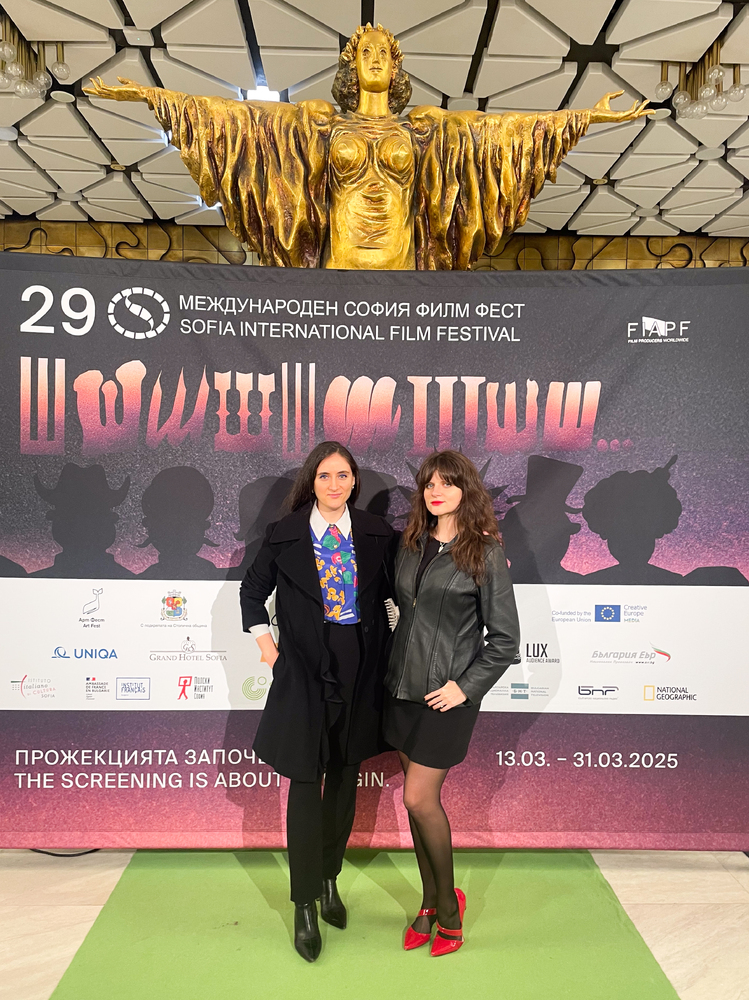
The Bulgarian sisters Biliana and Marina Grozdanova share a journey as immigrant filmmakers based in the United States. Over the past 25 years they have lived, studied, and worked across several countries. They left Bulgaria with their family in the early 1990s, living in Australia and Canada before settling in the US in 2000.
They began their creative careers in documentary filmmaking, focusing on music-related stories. Their first feature documentary, The Last Kamikazis of Heavy Metal, followed their friend Igor Galijasevic and explored the immigrant experience through heavy metal culture. Their latest and most successful project is Eastern Western, a hybrid narrative-western film inspired by immigration, identity, and frontier landscapes. It has screened at more than a dozen festivals.
The idea for Eastern Western stems from their desire to tell a “coming to America” story rooted in immigrant realities. The film blends documentary techniques with fiction, casting Igor and his son to portray a deeply authentic 1880s immigrant narrative set in Montana.
Their next project, New Dawn Rising, a neo-western set on the Blackfeet Reservation in Montana, is currently in development with state support.
Below is the full text of the interview with the sisters Biliana (BG) and Marina (MG):
Tell us more about your move to the United States. What prompted this decision, and how long have you been there?
BG: We left Bulgaria at a very young age in the early 90s. Our parents wanted to raise us in a climate different from the one that was taking place during those years. We didn’t move to the US right away. Our journey led us to Australia first, then Canada, and eventually the United States in 2000. We established a homebase with our parents in Atlanta, then moved to Chicago, New Orleans and now New York.
MG: Overall as a homebase, we’ve been in America for 25 years. But our academic paths did take us to even more places: I completed my cinema studies in Canada and France; Biliana studied film in Spain. I worked and did research in Japan and China for a few years. We’ve always been open to new opportunities and consider ourselves global citizens.
BG: As part of this most recent chapter, we decided that we had to reunite in New York and take a leap of faith in the American film industry.
Do you keep in touch with other Bulgarians living abroad?
BG: We try to! Honestly we fell into the Bosnian community first during our time in Chicago, and through our friendship with Igor Galijasevic, who is now the protagonist of our first feature film.
MG: I find it interesting that when you don’t seek each other out, you find each other in more interesting ways. While at graduate school for film in Montreal, I met so many female Bulgarian filmmakers. It was great.
Tell us more about your creative journey. Which are your most successful projects?
BG: We started in the documentary space, creating a number of music-focused projects. Igor was actually the protagonist of our first feature documentary too. We met during the Chicago years, when going to rock shows was how we would spend almost every weekend. Igor led the heavy metal band Hessler, and eventually we started documenting their creative journey and tours across America. The film is called The Last Kamikazis of Heavy Metal, and more than a music documentary, it became an exploration of being an immigrant and pursuing your dreams in America.
Kamikazis was the first film to take us to 10+ film festivals, but distribution was hard, it’s still hard. The answer to your question also depends on how we measure success. Creatively, I have felt very successful in being able to collaborate with my sister, I feel fortunate to be working in the artistic space, and I feel we are on the verge of our most successful project right now with Eastern Western. Making a fiction feature on your own, with extremely limited funds, is challenging to say the least. But we went for it and now are in the limbo between having invested all of our blood, sweat and tears, the end of our theatrical run, and the prospects of what streaming might bring us as far as exposure and financial return. It’s a marathon and not a sprint. The western genre seems to be having a comeback in the States right now, so we are hopeful.
MG: The documentary genre actually allowed us to become filmmakers and learn the tools we needed to unlock our creativity. At the beginning of our career, it was about what story was within our grasp, what characters, what locations. This type of filmmaking allowed us to make Eastern Western, which is very much a narrative world created with documentary techniques. I would say Eastern Western is definitely our most successful project. We’ve premiered at 12+ festivals in the U.S. and internationally. We played in AMC theaters this past December, and now we are headed to digital. We are really hopeful for the future life of this film.
Is there a specific place — a country, city, or something else — that inspires your creativity?
BG: Our creativity is very location-based. Specifically with Eastern Western, a lot of the segments of the story were inspired directly by Montana, the wild locations, or what we could imagine doing with these locations, the people that could have lived there, seen the same sunsets and traversed the same vistas. You think about all the people that came before you, your ancestors, and their paths. All those paths are linked to geographies, and sometimes the imagination naturally starts to brew there. Related to this, we have stories we want to tell all over the world, including of course, Bulgaria.
MG: Location definitely inspires. I lived in Japan for a while and that inspired me incredibly. I want to go back and make a film there one day. I am also very interested in the peripheries, the outskirts, the frontiers. This means I like to envision stories outside of major cities or central hubs or obvious places. The frontier lands of our world – and Eastern Western is set in one of those frontier lands – hold so much potential for storytelling.
How did the idea for the western Eastern Western come about?
BG: We always knew we wanted to tell a “coming to America” story. We have many ideas and feelings about what it means to be an immigrant today, what it means to feel removed from your place of origin, what home means… And Eastern Western was born in this space.
MG: We wanted to work with what was familiar to us: documentary techniques and characters who could develop the story with us. Igor Galijasevic, our lead protagonist, left Bosnia in the 1990s and moved to the States as a young boy. Although we have different origin stories and paths to America, there are a lot of shared sensibilities and hardships. In a sense, we fused our stories and set them 150 years in the past. We cast Igor and his real life son, to reimagine what the realities of those days were, striving for a very authentic depiction.
BG: Growing up in Western Canada, the Northamerican West has always been very nostalgic to us. We also grew up watching 90’s Westerns. Placing this story in the Western genre was a natural move for us. I had also recently worked on a film in Montana where I met a lot of great people and resources who could support our production: cowboys, ranchers, land owners, film crew. We discovered a great grant program in the state as well, the stars aligned, and we went for it.
Is there a difference in how Eastern Western is received by American and Bulgarian audiences, especially after its screening at the Sofia Film Fest?
BG: You know, when we first set out to make this movie, we weren’t exactly sure if we were making a European film or an American film. It’s a western set in the traditional space of the western genre - Montana, the wilderness, prairies and ghost towns - but it is half in a “foreign” language, and led by an Eastern European immigrant. So we weren’t sure how either sides of the ocean would receive or react to the story, but not so accidentally, I believe we told a universal tale. From our film festival experiences, we were able to touch and emotionally connect with both audiences. When making a movie, you never expect to make your audience cry, you can only wish you might achieve human connection, and when you feel that, it’s very rewarding.
MG: Bulgarians, Bosnians, and other Eastern Europeans (both in the US and in Bulgaria) saw a journey within Eastern Western that they definitely recognized. Many of the Bulgarian audience members who saw the film at Sofia Film Fest have family members abroad, and are part of the immigration story in that respect. The Bosnians and Bulgarians who saw the film at the Chicago premiere, they definitely understood that this story is very relevant today.
How did American viewers react to Eastern Western during the screenings in the different cities?
MG: I think each “side” of the East/West narrative will find different things that are relevant to their history, their experience, their knowledge. Some American audiences were not really aware of Eastern European immigrants in the story of the American West. This made them think about the origin of these immigrants, what made them come here, and what was taking place in East Europe in the late 1880s. Some were humbled, I would say, when they realized the interconnectedness of our stories. When the film reveals that American horses were sent to Europe, to reach the lands where Igor was from, it amazed some viewers how this family story could represent such a full-circle narrative of our humanity. We traveled with the film as much as we could, and these are some of the in-person impressions we’ve collected.
What’s next for Eastern Western after the screening at the Consulate General of Bulgaria in New York this February — are more festivals coming up?
BG: We are very excited to announce that the film will be available on demand starting February of this year. We also have some community and university screenings coming up in the States. However, we are always looking for special screening opportunities and especially distribution in Bulgaria. So if anyone reading this is interested in bringing a screening to Bulgaria, any town, any movie theater, we would absolutely welcome this. One of our favorite things along this filmmaking journey has been screening in unexpected towns in old, historic movie theaters. We would love it if the film could tour Bulgaria.
Where will the next screenings take place?
MG: We have more in-person screenings coming up in February and March: we’re screening at the Consulate of Bulgaria in New York, in Charlottesville, VA, and in New Orleans, LA. We also have two more screenings in Chicago: one at the University of Chicago, my alma mater, and another at the Bulgarica - Bulgarian Cultural Center in North Chicago on March 14 and 15. The Bulgarians in the US have really embraced the film and we are extremely happy.
The story is rooted in immigration and the journey toward a new beginning. What message would you like viewers to take away from the film?
MG: The new beginnings of immigration bring opportunity, but they also come hand-in-hand with hardship and sacrifice. Immigration journeys, as everyone who has experienced one will understand, can be very hard and painful for families. So, I would like viewers to really understand the sacrifice that so many families around the world have to make, especially for their children’s future, and try to empathize and understand why they undertake these journeys.
BG: This is a film about family, identity, kindness, human connection, connection to home, and a longing for finding that home. The film takes an unexpected turn towards the end, and specifically those final moments I hope open a portal of imagination for the viewer that stays with them after the lights come up.
Are you already working on your next project? Maybe you want to share something about it?
BG: Yes, we are working on getting our next feature off the ground! We’re excited to share that we’ve received support from the State of Montana for the production of New Dawn Rising, a neo-western action starring Walter Running Crane Jr. We met Walter on the set of Eastern Western, where he has a secondary but very significant role in our narrative. We stayed in touch and developed a story that will take place in his hometown of Browning, MT, on the Blackfeet Reservation. We are still fundraising and aiming to film this year.
What are your ambitions for establishing yourselves in the American film industry as a Bulgarian directing duo?
MG: I think siblings, especially sisters, are an interesting dynamic that is uncommon in the film industry in the US, and at large for that matter. At every film discussion, we get asked a question about what it’s like to direct with your sister. We love it, we embrace it, and ultimately, two heads are better than one. This dynamic hasn’t changed since we started our company, El Jinete Films, in 2015. Specifically as a Bulgarian directing sister duo, I hope we can find a way to stand out with our films, both the ones we want to make here in America and abroad.
/NF/
news.modal.header
news.modal.text