Sofia Economic Forum VI
![Participants in Panel Dedicated to Bulgaria's Euro Area Membership Describe Euro Adoption as Strategic Success Opening New Opportunities]()
![Participants in Panel Dedicated to Bulgaria's Euro Area Membership Describe Euro Adoption as Strategic Success Opening New Opportunities]() Sofia Economic Forum VI panel dedicated to Bulgaria's eurozone membership. In the photo (from left to right): Senior Research Fellow at the Institute for Market Economics Petar Ganev, Deputy Minister of Finance Metodi Metodiev, Deputy Governor of the Croatian National Bank Sandra Svaljek, Vice-President of the European Investment Bank (2019-2023) Lilyana Pavlova, and Iliya Lingorski, Member of the Governing Council of the Bulgarian National Bank, Sofia, January 27, 2026 (BTA Photo/Hristo Kassabov)
Sofia Economic Forum VI panel dedicated to Bulgaria's eurozone membership. In the photo (from left to right): Senior Research Fellow at the Institute for Market Economics Petar Ganev, Deputy Minister of Finance Metodi Metodiev, Deputy Governor of the Croatian National Bank Sandra Svaljek, Vice-President of the European Investment Bank (2019-2023) Lilyana Pavlova, and Iliya Lingorski, Member of the Governing Council of the Bulgarian National Bank, Sofia, January 27, 2026 (BTA Photo/Hristo Kassabov)
site.btaParticipants in Panel Dedicated to Bulgaria's Euro Area Membership Describe Euro Adoption as Strategic Success Opening New Opportunities
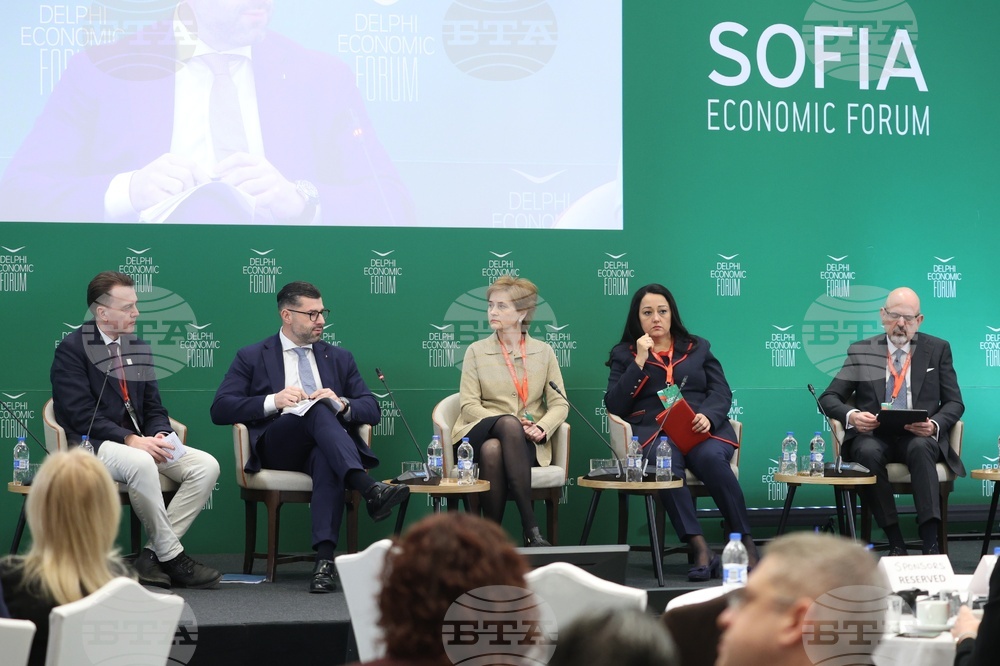
The shared view of participants in a panel dedicated to Bulgaria’s euro area membership, part of the Sofia Economic Forum VI, held on Tuesday at the Sofia Balkan Palace hotel in the capital, was that membership in the euro area is a success of strategic importance for Bulgaria that opens up a wide range of opportunities.
Sandra Svaljek, Deputy Governor of the Croatian National Bank, congratulated Bulgaria on joining the euro area, noting that the smooth technical transition is proof of institutional maturity.
Drawing on Croatia’s three years of experience as a euro area member, she said it can be concluded that euro adoption has been a major success for the country, with the single European currency delivering all the benefits that had been expected before accession.
Svaljek pointed out that the euro has brought positive effects such as an improved credit rating, lower borrowing costs, and a stronger position in the eyes of foreign investors.
According to her, critics of the euro often argue that it has led to price increases in Croatia, but when the euro area’s contribution to inflation is calculated, it turns out to be negligible, around 0.2 to 0.4 percentage points.
"The euro has brought us everything we expected from it," she said.
Lilyana Pavlova, former Vice President of the European Investment Bank, said Bulgaria’s euro area membership came at the right moment, as deeper European integration represents a form of protection in a rapidly changing world. In her words, the euro area offers many opportunities and advantages, but it does not work miracles on its own. Access to cheaper financing is a good prerequisite for development, she added, provided it is used to boost productivity rather than consumption alone.
"Without strong institutions and without stable, long-term political decision-making, we will not be able to fully harness all the opportunities and benefits that come with euro area membership," Pavlova said.
Iliya Lingorski, member of the Governing Council of the Bulgarian National Bank, noted that after years without an active national monetary policy due to the currency board, Bulgaria is now, following euro adoption, part of the decision-making process on monetary policy for one of the world’s two largest currencies and the largest currency bloc.
Commenting on the withdrawal of lev banknotes and coins from circulation, Lingorski highlighted an interesting fact: the Bulgarian National Bank expects around half of the one-stotinka coins never to be returned. He recalled the latest central bank data showing that 67% of lev cash has already been withdrawn from circulation, with expectations that over 90% will eventually be withdrawn as a result of the transition from lev to euro.
The value of euro banknotes and coins in circulation has already surpassed that of lev cash, Lingorski added, with just over BGN 10 billion and EUR 5.3 billion currently in circulation.
According to him, the private sector is the true hero of Bulgaria’s path to the euro area, as institutions merely provide the framework. In his view, the country’s economic development and growth under euro area membership will depend precisely on the dynamism of the private sector.
/RY/
news.modal.header
news.modal.text