BTA interview
![Euro Has Been Key to Attracting Investment, Eliminating Currency Risk in Slovakia - Central Bank Chief Economist]()
![Euro Has Been Key to Attracting Investment, Eliminating Currency Risk in Slovakia - Central Bank Chief Economist]() Michal Horvаth (right), Chief Economist and Executive Director for Monetary Policy and Market Operations at the National Bank of Slovakia
Michal Horvаth (right), Chief Economist and Executive Director for Monetary Policy and Market Operations at the National Bank of Slovakia
site.btaEuro Has Been Key to Attracting Investment, Eliminating Currency Risk in Slovakia - Central Bank Chief Economist
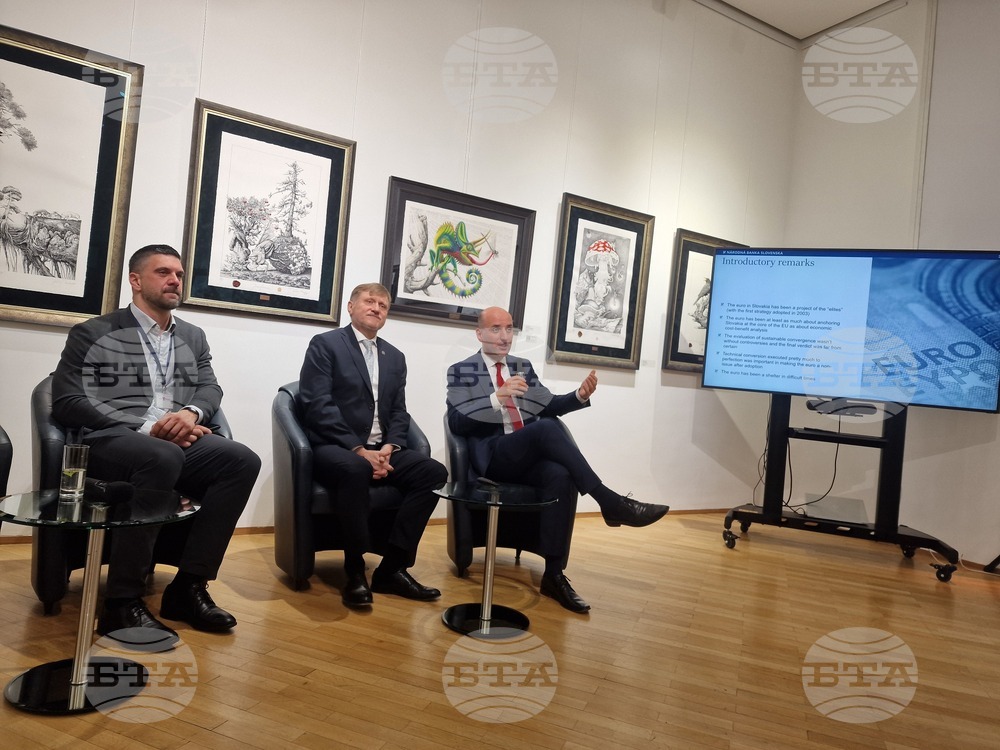
Interviewed by BTA, Michal Horvаth, Chief Economist and Executive Director for Monetary Policy and Market Operations at the National Bank of Slovakia, said the introduction of the euro as Slovakia's official currency was an important step in attracting foreign investment and eliminated uncertainty around exchange-rate fluctuations.
Horvath noted that a decade of deep reforms preceded the adoption of the euro. Slovakia has been part of the eurozone since January 1, 2009, having started the process of joining the currency area in 2004. The country's first strategy for entering the monetary union was drawn up in 2003 by the second government of prime minister Mikulas Dzurinda, under which Slovakia joined the Exchange Rate Mechanism (ERM II) in 2005. Dzurinda's government fell in 2006 after parliamentary elections were won by Robert Fico's Direction - Social Democracy party. Fico then completed the process of euro adoption, during which Horvath served as adviser to the finance minister.
The euro was an important element, a piece of the puzzle that turned Slovakia into an attractive investment destination, Horvath said. Adopting the euro followed a decade of deep reforms in the country, part of the preparation for EU accession [in 2004]. Reforms were carried out in areas including the tax system, pension system and labour legislation, he recalled.
At the adoption of the euro, 1 euro was equivalent to 30.1260 Slovak koruna (SKK). Prior to that, the Slovak currency experienced significant fluctuations, trading around SKK 38 to the euro in 2005 and gradually strengthening to just under SKK 35 to the euro in 2006, after Fico publicly expressed support for euro adoption.
"The euro was the final step that effectively eliminated currency uncertainty. Expectations were that it would bring additional investment and boost foreign trade, as this is the economic model on which Slovakia's prosperity has been based," Michal Horvath noted.
Asked about the main challenges his country faced in joining the eurozone, he explained that meeting the convergence criteria was not an easy task for Slovakia.
Even before the adoption of the euro, the main challenge was convincing European institutions that the country was ready, that the economy was prepared, and that everything would be fine after joining the eurozone, Horvath said. After joining, there were practical issues to be resolved. It was a major logistical project for the central bank.
For businesses, adopting the euro meant a series of relatively minor operational adjustments: updating software, changing receipts and displaying dual prices. These were largely practical issues. Overall, companies looked forward to the opportunities the euro would bring, while households were perhaps a little apprehensive, as in many other countries, Horvath said.
To address public concerns, a major information campaign targeted groups, including households, businesses and the financial sector, to explain the practical implications of the euro and counter common fears, such as price increases. Considerable effort was made to enhance pricing transparency before and after adoption and to ensure the technical transition proceeded smoothly, he added.
Asked about difficulties for individuals and businesses in the first months after adopting the euro, Horvath said there were none. In fact, everything went better than expected. At the time, the European Commission was producing regular reports on the euro's introduction. After a while, these reports became very dull, because there were no problems to address. Everything went very smoothly, he recalled.
He noted that Slovakia joined the eurozone as Europe and the world were entering a period of crisis during the 2008-2009 global financial downturn. Interest rates were influenced by many factors. Real incomes fell, households faced great insecurity, and investment in the economy, including in housing construction, was very low. All these factors overshadowed any concerns people may have had, such as potential market bubbles, which ultimately did not materialize.
In conclusion, Horvath described Slovakia's entry in the eurozone as a success. The population supports the euro with great enthusiasm, Slovaks are among the most enthusiastic about the euro in the entire eurozone, the central bank's Chief Economist said. He added that the functioning of the euro has been entirely smooth from the moment it was introduced in Slovakia. The economy faces many challenges, but none of them are directly related to the euro; they stem from other factors connected to the country's current economic situation.
/DD/
news.modal.header
news.modal.text