site.btaDecember 1, 1972: Interkosmos 8 Satellite Is Launched, Carrying First Bulgarian Equipment to Measure Ionospheric Plasma Parameters
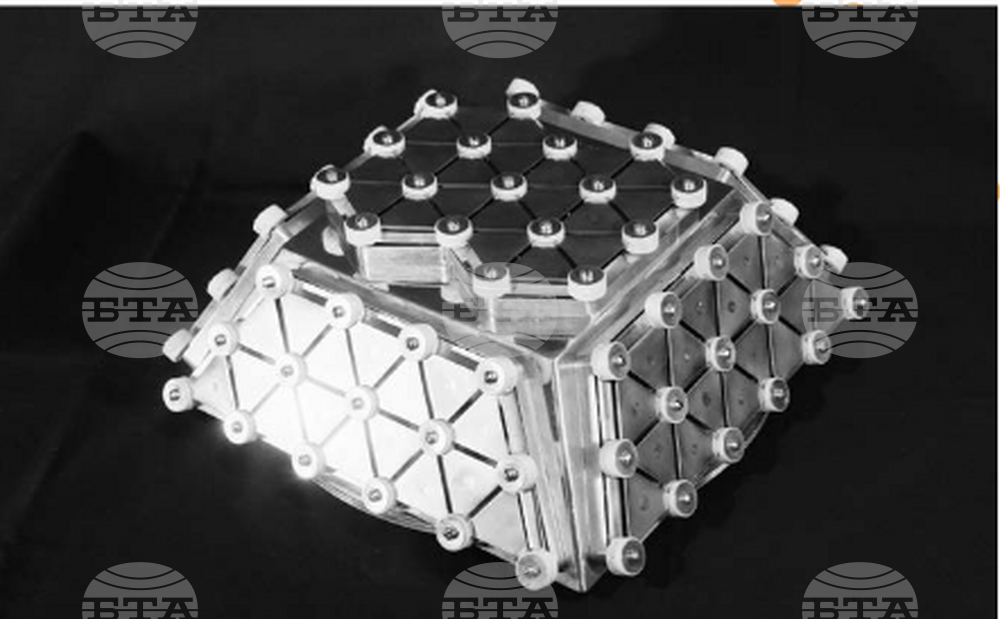
On December 1, 1972, the Interkosmos 8 satellite is orbited, carrying Bulgarian equipment to measure ionospheric plasma parameters.
According to Assoc. Prof. Tanya Ivanova, PhD, a scientist at the Space Research and Technology Institute of the Bulgarian Academy of Sciences (BAS), the first scientific unit for organized space research in Bulgaria, Space Physics Group (SPG), was established on November 1, 1969, under the Presidium of BAS and was headed by Acad. Lyubomir Krastanov, Director of the Geophysical Institute at BAS. The actual founder of the SPG was Acad. Kiril Serafimov. Among the first employees appointed to the group were Tanya Ivanova and Maria Petrunova, electrical engineers who had just graduated from the Technical University of Sofia and were assigned to BAS.
Engineer Stefan Chapkunov was recruited from the Nuclear Centre of BAS to lead the small team through a competition for a research associate position. Specialists Georgi Sokolov, Georgi Karamishov and Slavka Leseva were entrusted with the technical implementation. Despite their young age, the specialists were entrusted designing the first Bulgarian space device and laying the foundations for space instrumentation in Bulgaria. The choice of scientific field was crucial. The ionosphere was one of the most extensively studied parts of near space and Bulgarian scientists had conducted research through ionospheric stations and observatories in Bulgaria.
The first Bulgarian space instrument, called P1, was designed to measure the parameters of the ionospheric plasma directly around the Interkosmos 8 satellite. The P1 device electronics were primarily composed of Bulgarian components: MOS integrated circuits from Blagoevgrad, resistors from Aytos, capacitors from Kyustendil and wires from Sevlievo.
The P1 was launched on December 1, 1972, on board the Interkosmos 8 satellite, part of the Soviet Interkosmos programme that aimed to foster cooperation between the Warsaw Pact countries in the field of space research. In recognition of this achievement, the members of the SPG received gold and silver medals from BAS Chair Acad. Nikola Bonev.
Following the launch of P1, many other Bulgarian instruments designed to directly investigate the ionosphere and upper atmosphere were developed. The P2 and P3 instruments were also combined and flew aboard the Interkosmos 12 and 14 satellites. In 1974, the SPG became the Central Laboratory for Space Research (CLSR). In 1979, Bulgaria's first cosmonaut, Georgi Ivanov, went into space aboard the Soyuz 33 spacecraft.
The following is how the Bulgarian News Agency's English Service covered this event:
"Interkosmos 8 was launched yesterday in the USSR. This mission marked the first time Bulgarian equipment was sent into space. The equipment, which includes ion traps, Langmuir probes, and their electronic
modules, was entirely designed and manufactured in Bulgaria," corresponding member of the International Academy of Cosmonautics, Kiril Serafimov told BTA on December 2.
The apparatus, composed of power sources, DC amplifiers, and electronic control units, provides data on the electron and ion densities and their corresponding temperatures in the surrounding space, utilizing semiconductor-based instrumentation. It utilizes innovative methods for stabilization and calibration of measurement results. The instruments were developed by the Space Physics unit at BAS, using exclusively Bulgarian materials and components. Bulgaria has significantly contributed to the Interkosmos programme to date, through ionospheric, heliophysical, and optical observations from the Earth's surface. Lyubomir Krastanov has led Bulgarian specialists and collaborated with researchers from other socialist countries to develop space instruments and launch previous Interkosmos satellites.
These experts have proficiently processed and scientifically analyzed data from the Interkosmos 2 and Interkosmos 4 satellites, along with various missions from the Soviet Kosmos 261, Kosmos 348, and Kosmos 381 programmes. The launch of Interkosmos 8 has elevated Bulgaria's science, technology, and industry, placing the country at the forefront of space research.
/RY/

news.modal.header
news.modal.text