site.btaScientists and Logisticians Present Highlights from Latest Bulgarian Antarctic Expedition
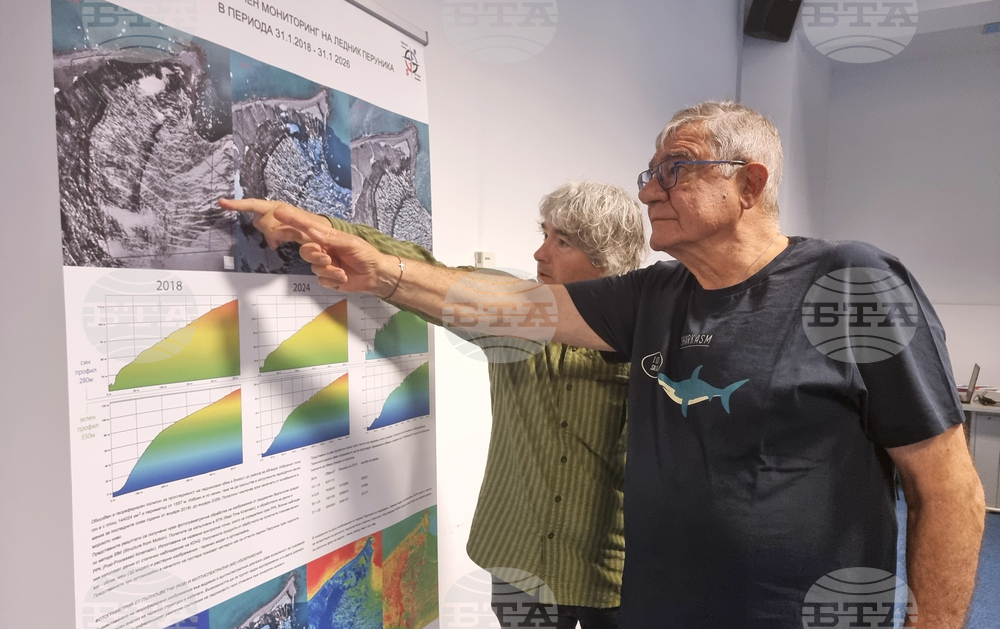
A reporting camp of the 34th Bulgarian Antarctic Expedition was held in the Bulgarian Black Sea resort of Aheloy on Saturday. The expedition was conducted between November 2025 and March 2026 with the logistical support of the Bulgarian naval research vessel Sv. Sv. Kiril i Metodii (RSV 421). As usual, the annual mission was based at the Bulgarian Antarctic Base on Livingston Island.
The 34th Expedition was the most successful and the largest to date, said Christo Pimpirev during the reporting camp. Pimpirev is President of the Bulgarian Antarctic Institute and leader of the country's annual expeditions to the icy continent. He described the expedition members as "a very good blend of scientists and sailors". He highlighted the cooperation of Bulgarian polar researchers with international partners.
The ship's Commanding Officer Radko Muevski said at the camp that RSV 421 travelled more than 20,000 nautical miles during the expedition and the crew worked for 56 days straight. The crew traditionally assisted scientists in collecting seabed samples as well as field research, and they studied ocean currents, he added. The vessel also assisted foreign scientists. Muevski highlighted cooperation with the Turkish Antarctic program, as well as collaboration with researchers from Argentina, Chile, and Spain. For the first time on this voyage, RSV 421 reached the Antarctic mainland, he noted.
Kamen Nedkov, the Commander of the Bulgarian Antarctic Base on Livingston Island, said that what started years ago as a single cargo trailer has now grown into what can be called a Bulgarian town in Antarctica. "This year, in partnership with the United Arab Emirates, we built a new facility for housing a meteorological and seismic laboratory," Nedkov said. The sewage network is now fully completed, and all buildings have been supplied with water. Wastewater is processed through a treatment plant, he said.
Seismologist Gergana Georgieva, who teaches at Sofia University, said during the gathering in Aheloy that glaciers are truly disappearing, and they are quite a complex system. According to Georgieva, studies have been conducted in the accumulation zone of the Balkan Glacier on Livingston Island, which have revealed its movement. As a result of global warming, movement in the upper section has decreased.
Petar Sapundzhiev, an engineer and creator of an automated system that monitors the Huntress Glacier on Livingston Island, spoke about the electronic and communication installations used during the expedition.
Physicist and engineer Oleg Vasilev underlined the importance of mapping Livingston Island, Emona Bay, and False Bay. Mapping work was also discussed by engineer Kiril Velkovski, who focused on underwater measurements.
Cultural manager Martina Stefanova presented the findings of a study examining the knowledge, attitudes, and behaviours of Antarctic expedition members regarding sustainable development and environmental protection. According to Stefanova, the results confirm that people working in Antarctica can serve as an example of a responsible attitude toward the planet and its sustainable future.
Borislava Margaritova, an ichthyologist of the WWF conservation organization, said that heavy metals accumulate in the highest concentrations in the scales of fish. Compared to data collected 15–20 years ago, only copper and manganese are currently present in higher concentrations, while the other metals are at lower levels, she said.
Health risks for participants in polar expeditions were also discussed at the meeting in Aheloy. Razvigor Darlenski, a dermatologist, focused specifically on the project to study skin adaptation in cold climates. Clinical toxicologist Daniela Petrova reported that a metagenome of lactobacilli discovered in Antarctic ice can benefit human health through food and pharmaceuticals.
Snezhana Rusinova, senior research associate at the Institute of Microbiology with the Bulgarian Academy of Sciences (BAS), noted that during the 34th Expedition, scientists collected samples from many more locations than originally planned, relying on the Bulgarian research vessel for this purpose. Simona Georgieva from the BAS Institute of Biodiversity and Ecosystem Research spoke about the study of parasites in Antarctica. According to her, the project is important because polar ecosystems have low biodiversity, which makes them vulnerable.
Ivaylo Nachev of the Technical University of Sofia said that this expedition involved collaboration with Czech scientists in conducting observations of solar activity and the Earth’s magnetic field.
BTA Director General Kiril Valchev said that the national news agency remains the most important source of information on Bulgarian scientific research in Antarctica. BTA published 753 news reports in Bulgarian and 640 in English covering the last four Bulgarian Antarctic expeditions. It also put out 4,039 photos and 217 videos on the topic during that period. "These are significant statistics that demonstrate the scale of the work involved in covering Bulgaria’s presence in Antarctica," he stated.
/VE/

Additional


news.modal.image.header
news.modal.image.text
news.modal.download.header
news.modal.download.text
news.modal.header
news.modal.text