Antarctic expedition reporting camp
![Participants in 34th Bulgarian Antarctic Expedition Present Research at Reporting Camp in Aheloy]()
![Participants in 34th Bulgarian Antarctic Expedition Present Research at Reporting Camp in Aheloy]() Assoc. Prof. Gergana Georgieva, seismologist and lecturer at the Faculty of Physics of the St Kliment Ohridski University of Sofia, presents a study on glaciers, Aheloy, on the Black Sea, June 6, 2026 (BTA Photo/Mira Bezus)
Assoc. Prof. Gergana Georgieva, seismologist and lecturer at the Faculty of Physics of the St Kliment Ohridski University of Sofia, presents a study on glaciers, Aheloy, on the Black Sea, June 6, 2026 (BTA Photo/Mira Bezus)
![Ахелой - полярници - отчетен лагер]()
![Ахелой - полярници - отчетен лагер]()
![Ахелой - полярници - отчетен лагер]()
![Ахелой - полярници - отчетен лагер]()
![Ахелой - полярници - отчетен лагер]()
site.btaParticipants in 34th Bulgarian Antarctic Expedition Present Research at Reporting Camp in Aheloy
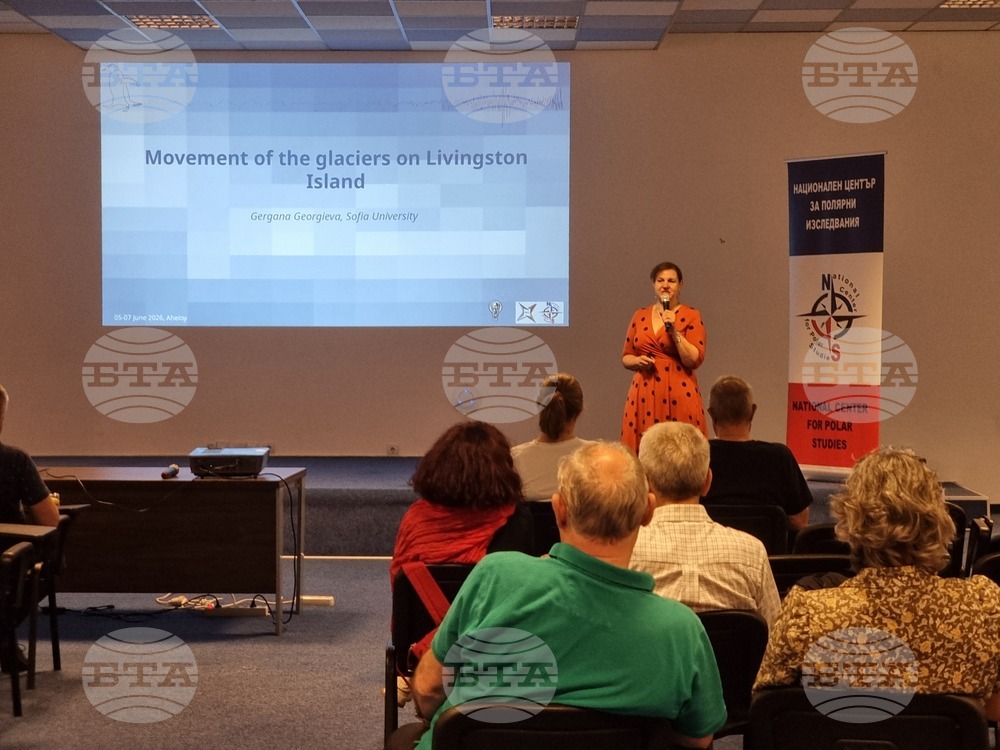
At a reporting camp here on Saturday, participants in the 34th Bulgarian Antarctic Expedition presented their research on glacier movement, mapping and conservation of Antarctica.
Assoc. Prof. Gergana Georgieva, seismologist and lecturer at the Faculty of Physics of the St Kliment Ohridski University of Sofia, said glaciers are truly disappearing, and they are quite a complex system.
Studies have been conducted in the accumulation zone of the Balkan Glacier, which have revealed its movement. As a result of global warming, movement in the upper section has decreased. Tidal and gravitational forces also play a role, but the causes are generally quite complex, the seismologist summarized. Measurements were also taken on the Contell Glacier, using a drone to survey inaccessible areas, she added.
Dr. Petar Sapundzhiev, an engineer and creator of an automated system that monitors the Huntress Glacier on Livingston Island, spoke about the electronic and communication installations used during the expedition. It collects visual data showing how the glacier is changing - whether it is melting, moving, or accumulating new ice mass. He is also working on communication systems that provide real-time access to this data. Sapundzhiev also presented the sensor-based monitoring system, which measures and transmits its data once a day. Eight devices have been experimentally installed around the Bulgarian polar base to receive the data, he added.
Physicist and engineer Oleg Vasilev spoke about the importance of mapping Livingston Island, Emona Bay, and False Bay. The aircraft flew over 1,200 km during the mapping phase of the expedition. According to him, the data from the study is important for planning the work of Bulgarian polar researchers. “During a single flight, I try to collect not only data specifically for mapping, but also information on glaciers and penguin colonies,” Vasilev added.
Engineer Kiril Velkovski said that this season, efforts were focused on completing the mapping of the South Bay and False Bay, referring to the underwater measurements during the 34th Bulgarian Antarctic Expedition. According to him, orthophoto imaging provides valuable data for ships on how to navigate around underwater obstacles.
Assoc. Prof. Marina Stefanova presented the results of a study conducted among participants in Bulgarian Antarctic expeditions. The study focuses on the concept of the “good steward of the planet” and examines the knowledge, attitudes, and behaviors of Antarctic expedition members regarding sustainable development and environmental protection. The survey, in which 81 polar explorers participated, reveals a high level of awareness regarding global environmental challenges and a well-established attitude toward the need to care for shared natural resources. According to Stefanova, the results confirm that people working in Antarctica can serve as an example of a responsible attitude toward the planet and its sustainable future.
Dr. Borislava Margaritova, an ichthyologist of the WWF conservation organization, said that heavy metals accumulate in the highest concentrations in the scales of fish. She presented the research project she is working on with a team of researchers, noting that the data is preliminary and the research will continue. Experts are collecting data on the concentration of seven heavy metals. According to Dr. Margaritova, funding has been secured to process 30 specimens, from which samples have been taken from the liver, muscles, and scales. Preliminary data show that zinc has the highest concentration, followed by manganese and copper. Compared to data collected 15–20 years ago, only copper and manganese are currently present in higher concentrations, while the other metals are at lower levels, she added. In her words, it is too early to draw conclusions about whether human activity is affecting the inhabitants of the waters around Livingston Island. According to Margaritova, samples must first be taken from other regions of the Antarctic continent, and then many of the questions will be answered.
Health risks for participants in polar expeditions were also discussed at the meeting in Aheloy. Prof. Razvigor Darlenski, a dermatologist, focused specifically on the project to study skin adaptation in cold climates. According to him, changes in the skin become visible during longer stays - at least 1.5 to 2 months. At that point, local bacteria multiply and dominate the skin’s microflora. Prof. Darlenski clarified that these bacteria are unique to these regions and are entirely different from the skin contamination caused by exhaust fumes in large cities. He added that the initial results of the project, which will continue next year, have already been published. According to him, the research is being followed with interest throughout Europe.
The first Antarctic yeasts have already been isolated, said Dr. Snezhana Rusinova, senior research associate at the Institute of Microbiology with the Bulgarian Academy of Sciences (BAS). She explained that during the 34th expedition, scientists collected samples from many more locations than originally planned, relying on the Bulgarian research vessel for this purpose. They searched for endemic yeasts on various islands, and the first results are already available. Rusinova explained that the main goal of the project she is working on is to select good producers from which to obtain biopolymer molecules for use in new medicines.
Assoc. Prof. Simona Georgieva from the Institute of Biodiversity and Ecosystem Research with BAS spoke about the study of parasites in Antarctica. According to her, the project is important because polar ecosystems have low biodiversity, which makes them vulnerable. The scientists conducted fieldwork around the Bulgarian base, along the coast, and in other areas. They collected samples of mollusks, invertebrates, and fish near leopard seals and penguins. The preliminary data indicate the presence of various parasites, added Georgieva. According to her, some of them pose a risk to humans, especially if they consume improperly processed fish meat. The project is a two-year initiative, and a wider variety of hosts will be studied during the next expedition, Georgieva noted.
Chief Assistant Ivaylo Nachev of the Technical University of Sofia said that this expedition involved collaboration with Czech scientists in conducting observations of solar activity and the Earth’s magnetic field. He specified that the scientists used a new method for data processing, and data from this project has already been published. Nachev also said that he managed to establish nearly 14,000 connections with amateur radio operators.
/DS/
Additional


news.modal.image.header
news.modal.image.text
news.modal.download.header
news.modal.download.text
news.modal.header
news.modal.text