site.btaMedia Review: February 18
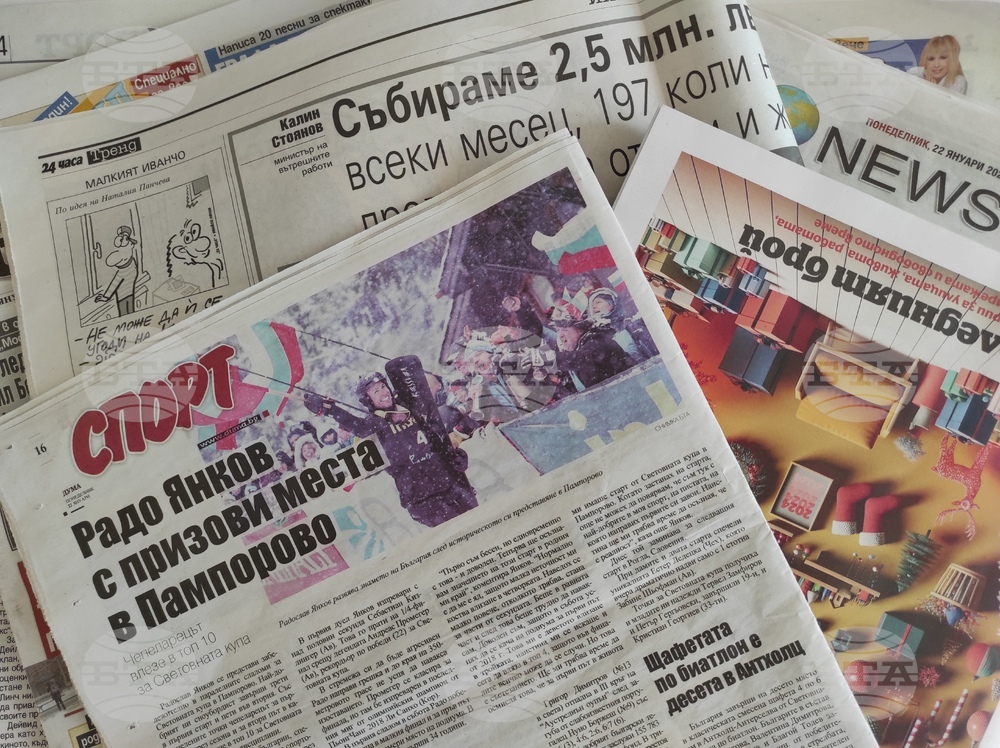
Economic news, the latest developments in the Petrohan criminal case, and the caretaker government's lineup dominate Wednesday's news media.
POLITICS
On bTV's morning show, Anton Kutev commented on former president Rumen Radev's upcoming political project. Kutev, former caretaker government spokesperson, said he believes that the project could bring about change: "I believe that this project can change Bulgaria. I have no doubt that Radev will win the election one way or another and will form a government one way or another. Not only can he change Bulgaria, he has no other choice," Kutev said. The topic was also discussed by political scientist Ruzha Smilova, sociologist Andrey Raychev, and analyst and former energy minister Miroslav Sevlievski. They agreed that the current polls give Radev great results in the elections, but it is still to early to say whether he would have enough MP seats to govern on his own. If he needs a coalition parther, that would probably be Continue the Change - Democratic Bulgaria (CC-DB).
On Nova TV's morning show, journalist Rouzha Raycheva commented that the new caretaker government sounds to be filled with people linked to CC-DB, which is logical given the expected coalition with former president Radev after the elections. According to her, MRF - New Beginning leader Delyan Peevski is trying to figure out who the people around Radev are and is gathering compromising information to deliver a blow. GERB leader Boyko Borissov, on the other hand, is waiting to see how things develop with the caretaker cabinet. Political scientist Prof. Rossen Stoyanov believes that the hypotheses with names of ministers leaked to the media speak of a "hotchpotch" cabinet. "There are so many impossible names inside that cannot coexist and make state decisions, so many opposing people," he commented. If there is a coalition between Radev and CC, Democratic Bulgaria would not participate, Stoyanov said. Political scientist Milen Lyubenov said that it is too early to talk about future coalitions. "The caretaker government simply needs to guide the country through the elections and reassure citizens. People with administrative and political experience will join the caretaker cabinet. Some of the [caretaker ministers] mentioned do not surprise me," he noted.
A hypothetical political formation led by President Radev would receive 33.3% support if parliamentary elections were held today, according to a Myara poll presented by sociologist Parvan Simeonov on Nova TV. The results are calculated based on those who are determined to vote and show that GERB-UDF remains the second force with 18.9%, followed by CC-DB with 12.7%.
***
Duma reports on its front page about the latest developments in the Petrohan case investigation [a high-profile criminal case in which five men and a 15-year-old boy met a violent death between February 2 and 8, their bodies found in two remote mountain locations in Northwestern Bulgaria with weapons on site; the deceased were associated with a non-governmental conservation group called National Protected Areas Control Agency (NPACA)]. The daily writes that a right-wing NGO – the Anti-Corruption Fund foundation - exerted pressure on the Interior Ministry to prevent an investigation into the NPACA head, against which alerts had been submitted for pedophilia. The pressure is evidenced by a letter to the Interior Minister of August 2024, circulated by the Glasove website; in the letter, the Fund requests information on whether there have been alerts against the NPACA and warns of a “risk of abuse and institutional harassment.” The letter also recalls that the NPACA has a framework agreement with the Environment and Water Ministry, signed on February 8, 2022 when Borislav Sandov was minister; Sandov himself has admitted to having visited the Petrohan Lodge several times [one of the two locations where bodies were found on February 2]. According to the daily’s sources, at the time of the letter’s receipt, the Interior Ministry regarded it as an attempt at political cover-up of the NPACA.
Mediapool.bg presents a report by the Inspectorate Directorate published on the Interior Ministry's website, according to which the Ministry has received four reports concerning the NPACA's activities and persons associated with it. The first report was filed on February 2, 2022 by people claiming they were threatened in the area of the Petrohan Lodge by five men who introduced themselves as Petrohan patrol rangers. The second alert came from Rositsa Karamfilova-Blagova, environment minister at the time, who referred to the Interior Ministry the 2022 framework agreement between her ministry and the NPACA over discrepancies in the drafting of the document, as well as suspicions of unlawful exercise of control functions by the NGO in protected areas. The third alert was from the grandparents of an 8-year-old child, who they believed was at risk as he was transferred from a public to a private school in 2023, was living in the Petrohan Lodge with people presenting themselves as rangers, and was showing behavioural changes. The fourth alert, received by the General Directorate for Combating Organized Crime in early 2022, was verbal information about a religious group led by NPACA head Ivaylo Kalushev, who is alleged to have committed acts of sexual abuse against minors.
On Bulgarian National Television's (BNT) morning show, CC leader Assen Vassilev said the Petrohan case is not damaging to his party because it has become clear that this case is entirely problematic due to the State Agency for National Security (SANS), which protected it, and the General Directorate for Combating Organized Crime (GDCOC) under the leadership of Kalin Stoyanov, which also protected it. They, together with the Ministry of Interior and the prosecution service, were entirely under the control of GERB and MRF - New Beginning during the period in question. According to Vassilev, these institutions had known about what was happening in Ivaylo Kalushev's group for two years, but did not stop it. "Even the investigation has been terminated. The Ministry of Interior's claims that they had an investigation but lost the file and therefore stopped the investigation, are absurd. Attempts are being made to pin something on CC in the most disgusting way, and every time this happens on the eve of elections."
Vazrazhdane leader Kostadin Kostadinov told BNT that the Petrohan case should be examined at all levels of government, because there are clearly serious gaps in the work of both the Interior Ministry and the prosecution service. "When society falls into total nihilism and denies everything and everyone, this is the best breeding ground for all kinds of fraudsters," Kostadinov said. He believes that there is a political cover-up surrounding the case. For him, the Petrohan crime is sinister - murder and suicide - but the motive remains unclear.
***
Trud has an interview with journalist and international analyst Ognyan Daskarev, who comments on whether US President Donald Trump’s Board of Peace might replace the UN and where this international organization has failed in its 80 years of existence. According to Daskarev, Trump is overly preoccupied with foreign policy, but in nine months' time there will be extremely important mid-term elections in the US where he could lose the House of Representatives. He does not think Bulgaria made a mistake by joining the Board of Peace, even though this is constantly being claimed, because the United States is Bulgaria's main strategic ally. The UN failed in Gaza, Ukraine, and Iran. The analyst goes on to talk about Trump’s foreign policy toward Greenland, Ukraine, and Russia.
Capital.bg has an interview with UN General Assembly President Annalena Baerbock, who says that the United Nations is not perfect as no institution is. Over the decades, there has been too much bureaucracy and also too much overlap between different agencies doing similar work. But that is why the UN, thanks in particular to Secretary-General Antonio Guterres, launched a reform programme some time ago called UN80 - to reform the United Nations to make it more effective in the 21st century, she explained. In her words, we have seen that these reform debates have been misused by some to degrade or even attack the UN as such. However, no other institution would have the authority of the United Nations to bring together 193 member states, so diverse, no one would have the authority to make decisions on peace and security, she argued. According to her, it is clear that the use and abuse of the veto in the Security Council is not only a huge problem for peace and security, but also for the UN's authority. That is why she has appointed two experts to look into reforming the Security Council. But one has to be realistic - when the five permanent members have to agree on this reform, it is not an easy process, she added.
ECONOMY
24 Chasa’s front-page story reads that buying government bonds yields twice the profit of a deposit. If you have EUR 5,000 and invest them in three-year government securities, you will win EUR 175 in the first year already and up to EUR 544 in the third year, the daily writes. The government bonds will be released in post offices and on an e-platform by end-2026.
***
24 Chasa has an analysis by Open Society chief economist Georgi Angelov, who argues that the high prices of repairmen and hair stylists are a symptom that the Bulgarian economy is overheating. Though National Statistical Institute data show a lower inflation rate now – which was expected given the high number of administrative decisions last year that increased price levels and international trade factors keeping inflation low in January, the prices in the services sectors remain high, particularly for entertainment, hotels and restaurants, education, and personal care. In that sector, the Institute reports a 5.1% price hike year on year, or seven-fold more than the appreciation of non-food products, and the inflation levels vary significantly from one service to another. That is understandable as the services that have become more expensive are not affected by international trade but by labour costs, particularly by the rising minimum wage and workforce shortage. Still, the appreciation of certain services is too great to be explained by these factors, meaning another factor is at play – increased demand. That is yet another indicator that Bulgaria’s economy is overheating: an accelerated rise in demand, a record-low unemployment rate, a boom of lending, an appreciation of real estate, a sharp rise in imports and trade deficit, and a significant appreciation of services. When much more money enters the economy than it can handle, it overheats, leading to inflation pressure, the expert explains. He advises a new state budget that would cool current expenditure and bank loans but preserve investment in the economy.
***
Telegraph has a front-page story about rising prices in Bulgaria. According to the daily, the introduction of the euro in Bulgaria has led to very expensive vegetables. An inside-page article draws attention to the shard decrease in industrial production, which Eurostat data show was the third lowest production in the EU in December 2025.
Assoc. Prof. Ognyan Boyukliev from the Economic Research Institute at the Bulgarian Academy of Sciences commented for Bulgarian National Radio that the euro's introduction has hardly had any effect on food prices in Bulgaria. On Tuesday, Vladimir Ivanov, head of the Coordination Centre for the Introduction of the Euro, reported that over the past week, the small consumer basket had increased by EUR 1, reaching EUR 58, but Boyukliev noted that this data is based on wholesale trade. Consumers do not fill said basked at commodity exchanges and markets, he underscored. According to him, 75% of Bulgarians shop at chain stores. "We need to focus on traditional, high-quality food, but that is not what we are doing. The markets are mainly filled with imported goods, with very few local products," he went on to say. Seasonal price increases do occur, but the most important indicator is imports - what is imported and how, he believes. There needs to be a detailed analysis, but such is missing in Bulgaria, he argued.
Segabg.com reports that another factory producing components for the automotive industry is closing down in Bulgaria. Germany’s MD Electronics in Vratsa (Northeastern Bulgaria) has begun a process of mass layoffs due to the worsening situation in Europe’s automobile industry, according to local media outlet Vratsa Today. Over 570 people work there. Another manufacturer of cable sets for the automotive industry, SE Bordnetze Bulgaria, announced in December 2025 that it is closing down its plant in Karnobat (on the Black Sea), where 800 people are employed. A year ago, the same fate befell the company's plant in Mezdra (Northwestern Bulgaria), which employed 950 workers. This was also explained as a "global strategic restructuring" of the company due to "changing cost parametres in the region."
***
Trud’s front-page article reads that a possible explanation for the high electricity bills in January is low voltage. There have been alerts about bills by 124% higher than a month earlier. Electricity operators are also warning of higher bills in February due to increased consumption. In Northeastern Bulgaria, the operator says February bills are higher by 10.74% month-on-month for some clients, as the average consumption increased by 11.08% from January 2026. Compared to February 2025, the electricity bills went up by 25% on average.
***
24 Chasa has an interview with Economic and Social Council head Zornitsa Roussinova, who says that it is the regular cabinet who must propose a new budget; the caretaker one must ensure the functioning of the State with the current budget [the 2025 state budget extended until March 2026]. Asked if that puts the Swiss rule for pensions’ calculations at risk, she says the Swiss rule is guaranteed by the Social Insurance Code. Any changes to the pension system must be preceded by analysis and broad public debate, she argues. With multi-fund pensions, pensions can become more adequate and higher, she adds. Today, when there is talk again of a two-speed EU, Bulgaria’s membership in the eurozone is a guarantee that the country will remain competitive, Rusinova argues.
***
Telegraph has an interview with engineer Martin Yanev, a railway expert, who comments on possible chaos for passengers once private companies start operating on the national railway network. On February 11, outgoing Deputy Minister of Transport and Communications Grozdan Karadjov signed 12-year contracts with the selected contractors under the procedure for awarding passenger rail transport services, meaning that for the first time in Bulgaria there will be more than one railway operator providing passenger services. According to Yanev, the model remains such that it is more profitable for the carrier to have empty coaches. Even with new trains, there is no guarantee that travel will become faster and cleaner, he warns.
/DS/
news.modal.header
news.modal.text