Wrap-up
![AmChams Regional Economic Summit in Sofia Focuses on Regional Cooperation, Energy Security, Innovation]()
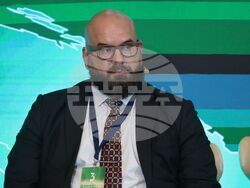
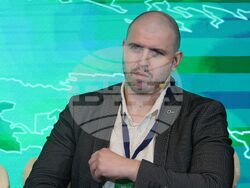
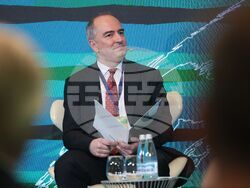
![AmChams Regional Economic Summit in Sofia Focuses on Regional Cooperation, Energy Security, Innovation]() 3rd AmChams Regional Economic Summit, ARES 2026, June 25, 2026 (BTA Photo/Vladimir Shokov)
3rd AmChams Regional Economic Summit, ARES 2026, June 25, 2026 (BTA Photo/Vladimir Shokov)
![Трета Регионална икономическа конференция на Американските търговски камари - Пленарна сесия: Енергийна сигурност и устойчивост]()
![Трета Регионална икономическа конференция на Американските търговски камари - Пленарна сесия: Енергийна сигурност и устойчивост]()
![Трета Регионална икономическа конференция на Американските търговски камари - Пленарна сесия: Енергийна сигурност и устойчивост]()
![Трета Регионална икономическа конференция на Американските търговски камари - Пленарна сесия: Енергийна сигурност и устойчивост]()
![Трета Регионална икономическа конференция на Американските търговски камари - Пленарна сесия: Енергийна сигурност и устойчивост]()
![Трета Регионална икономическа конференция на Американските търговски камари - Пленарна сесия: Енергийна сигурност и устойчивост]()
![Трета Регионална икономическа конференция на Американските търговски камари - Пленарна сесия: Енергийна сигурност и устойчивост]()
![Трета Регионална икономическа конференция на Американските търговски камари - Пленарна сесия: Енергийна сигурност и устойчивост]()
![Трета Регионална икономическа конференция на Американските търговски камари - Пленарна сесия: Енергийна сигурност и устойчивост]()
site.btaUPDATED AmChams Regional Economic Summit in Sofia Focuses on Regional Cooperation, Energy Security, Innovation
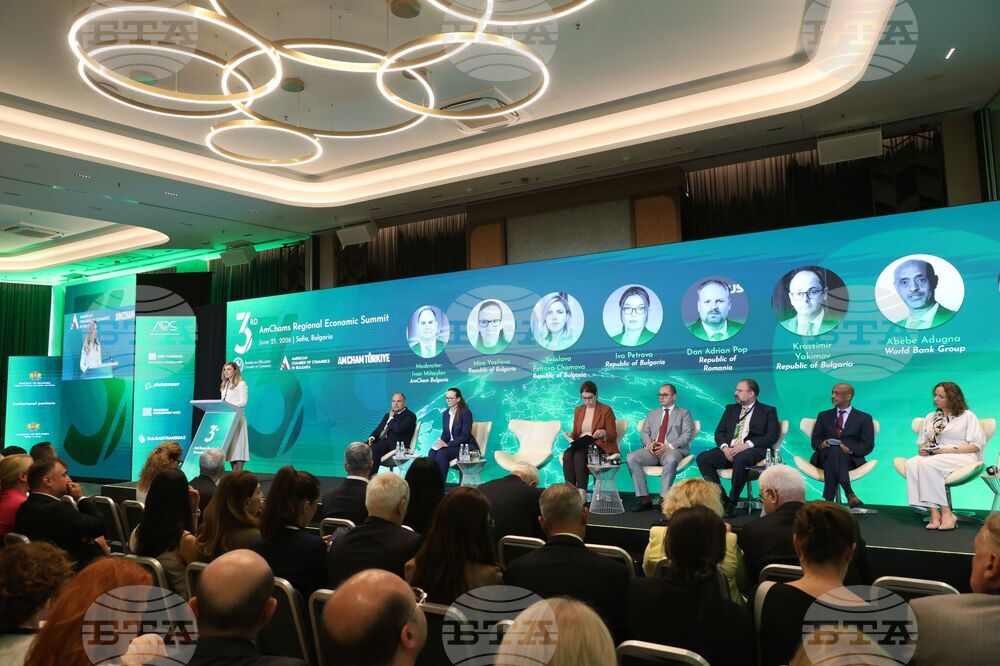
Regional cooperation, energy connectivity, innovation, investment and sustainable economic growth were at the centre of discussions during the 3rd AmChams Regional Economic Summit (ARES 2026), held in Sofia on Thursday. The event, hosted by the American Chamber of Commerce in Bulgaria in partnership with the American Chambers of Commerce in Greece and Turkiye, brought together more than 300 business leaders, policymakers and financial institutions from 15 countries across Southeast Europe, Central Asia and the Caucasus. BTA is a media partner of the forum.
Opening the conference, newly elected President of the American Chamber of Commerce in Bulgaria Tommy Ver Elst stressed that stronger regional cooperation and a shared commitment to sustainable development are essential for building a positive economic future. He said economic prosperity cannot be achieved by individual countries acting alone and emphasized the need for closer cooperation to foster innovation, investment and connectivity.
American Chamber of Commerce in Bulgaria CEO Ivan Mihaylov highlighted the importance of financial institutions in supporting cross-border projects and regional development. He noted that representatives of the Black Sea Trade and Development Bank, the European Bank for Reconstruction and Development, the World Bank Group and the Bulgarian Development Bank were participating in the forum to discuss financing opportunities for strategic regional projects.
Foreign Minister Velislava Petrova said Bulgaria has the potential to establish itself as a regional energy hub and a significant player in the development of artificial intelligence in Europe. She noted that the country's geographic location makes it a natural bridge between Europe, the Middle East and Asia and pointed to ongoing efforts to expand energy connectivity and attract strategic investments. Petrova also highlighted Bulgaria's role in the European AI ecosystem, including its hosting of one of Europe's AI gigafactories, and reaffirmed the government's priorities of improving the investment climate and advancing the country's accession to the Organisation for Economic Co-operation and Development.
Energy Minister Iva Petrova emphasized that economic development increasingly depends on cooperation between countries. She identified energy security as a key priority and underlined the strategic importance of regional infrastructure projects, particularly the Vertical Gas Corridor. According to her, modern infrastructure and energy connectivity not only strengthen security of supply but also serve as drivers of economic growth and regional integration.
Deputy Economy, Investment and Industry Minister Krasimir Yakimov described Bulgaria as a strategic investment destination rather than a peripheral market. He cited the country's geographic position, skilled workforce and competitive industrial zones as key advantages and said the government is focusing on attracting high-tech, high-value-added investments. Yakimov stressed that Bulgaria aims to become a regional technological and industrial hub through political stability, strategic vision and active support for investors.
Deputy Innovation and Digital Transformation Minister Mira Yossifova called for stronger regional cooperation and joint deployment of technologies. She described collaboration as a strategy that can transform national advantages into regional strength and argued that connectivity among markets, supply chains, talent and technologies is the region's greatest shared asset. Yossifova highlighted Bulgaria's research centres, startup ecosystem, experience in microelectronics and participation in the Artemis Accords as foundations for future growth.
World Bank Group Regional Director for Prosperity in Western and Central Africa Abebe Adugna warned that the global economy is entering a period of slower growth, persistent inflation and limited fiscal space. He said the World Bank expects global economic growth to reach around 2.5% in 2026, one of the lowest levels since the COVID-19 pandemic. Adugna noted that Southeast European countries have made significant progress in economic convergence with the European Union over the past two decades, but argued that future growth will increasingly depend on innovation, technology adoption and productivity gains.
Romania's Secretary of State at the Ministry of Economy, Digitalization, Entrepreneurship and Tourism Dan Adrian Pop said Southeast Europe is experiencing a period of economic transformation that creates new opportunities for the region. He stressed the need to move from competitiveness based on low costs to competitiveness based on added value through digitalization, innovation and energy security. Pop highlighted the importance of regional cooperation, noting that trade between Bulgaria and Romania has nearly tripled over the past decade.
American-Hellenic Chamber of Commerce President John Saracakis said no country can build prosperity in isolation amid growing economic uncertainty and shifting supply chains. He argued that the region possesses the entrepreneurship, innovation and human resources needed to succeed but must work more closely together to unlock its full potential.
AmCham Turkiye Chair Emre Karter identified energy, logistics, infrastructure, investment and digital transformation as the key factors that will determine the region's future competitiveness and sustainability. He said the summit provides an important platform for building partnerships between businesses, institutions and investors and expressed confidence that it would help generate new ideas and regional cooperation initiatives.
Bulgarian Development Bank Supervisory Board Chair Delyana Ivanova stressed that development banks play a critical role in ensuring that capital reaches businesses, entrepreneurs and strategic projects. She said global changes in supply chains, digital transformation and investments in energy security create significant opportunities for the region but require appropriate financial mechanisms.
Regional Development and Public Works Minister Ivan Shishkov presented the Government's plans to address quickly this country's lag in the development of North-South transport infrastructure by means of a design and construction programme and active attraction of private capital and partnerships. He discussed key infrastructure projects that will be prioritized, including a motorway between Ruse and Makaza, the Black Sea Motorway, the unfinished Struma Motorway, and the projected Rila Motorway. Shishkov expressed readiness for a change of the design and investment model for the bulk of large infrastructure projects implemented so far, which relies mainly on the central-government budget or EU funds, is a problem.
Antonio Nuñez, Lead Transport Specialist in charge of Eastern Europe at the World Bank, said that rebuilding Ukraine's transport sector will cost USD 100 billion over ten years.
Mehmet Sami Kalic, Vice President, Europe Regional Manager, and Turkiye Country Manager at Turner International, argued that deficient expertise, undeveloped regulatory regimes and inadequate pre-planning rather than the lack of financing pose the greatest challenge to the implementation of such projects.
Bulgarian Development Bank Management Board member and Executive Director Tsanko Arabadzhiev said that the Bulgarian Development Bank can be turned into a tool to mobilize the sizable uninvested capital in the banking system, which is estimated at approximately EUR 100 billion, as well as some EUR 30 billion in the pension funds.
Neslihan Arbar Aybar, Country Director, Hill International, Inc., argued that the different legislations and infrastructure systems require a strong political will for cooperation, and the weakest link often determines the success of the entire project.
Elina Markaryan, Public Affairs and Communications Director of Coca-Cola Hellenic Botting Company Armenia, who joined the discussion via video link, presented the Trump Route for International Peace and Prosperity Project as an example of strategic partnership between the US and Armenia that targets turning Armenia into a hub of regional trade.
Atanas Papazov, Director, Global Business Development, World Transport Overseas, pointed out that the lack of predictability in world economic development forces companies to seek unconventional solutions and a new approach to risk management.
Adrian Marius Calangiu, Craiova Engine Plant Manager, Ford Otosan, argued that regulations should reckon with the role of key suppliers and the EU's strategic partners including Britain and Turkey.
Aurubis Managing Director and CEO Rakan Rahbani listed as priorities recycling and recovery of inputs from end-of-life products and better alignment of EU and national legislation.
Titan Usje CEO Konstantinos Nikolaou said that the transition to low carbon production is an opportunity to boost competitiveness by investing in innovations, applying circular economy principles, and improving effectiveness.
Assoc. Prof. Nikolay Krushkov, Director of Corporate Communications at Bella Bulgaria, sees wars, tariff barriers, and compliance with regulatory requirements as key challenges to the food processing industry.
Dennitsa Dimitrova, Managing Partner, Kambourov & Partners - Tax Consulting, said that the quality of the business environment, the predictability of regulations and overall costs of labour and social security matter more than the low tax rate in Bulgaria.
Anton Karlov, Chief Legal and Government Affairs Officer, EMEA-APAC, Molson Coors, pointed out that after the start of the war in Ukraine his company focused on a more reliable data analysis and inflation risk management, which increased its resilience against the jolts that followed.
Stoyan Stoyanov, Senior Director of Manufacturing Operations, Intuitive, discussed the significance of rigorous quality and safety requirements in the medical products sector.
International Finance Corporation Senior Investment Officer Nicola Saporiti said that public-private partnerships can be successful when the government and private operators bring complementary strengths in water supply, transport, telecommunications, and other infrastructure. In nuclear power plants, wastewater treatment facilities, airports and other strategic infrastructure, public-private partnerships enable the mobilization of private capital and shift a significant portion of project risk, traditionally borne by the public sector, to a private-sector operator with the necessary expertise.
Participants throughout the forum agreed that deeper regional cooperation, stronger connectivity, energy security, innovation and access to financing will be crucial for enhancing the competitiveness of Southeast Europe and attracting future investment.
/NF/
Additional



news.modal.image.header
news.modal.image.text
news.modal.download.header
news.modal.download.text
news.modal.header
news.modal.text