site.btaMedia Review: January 12
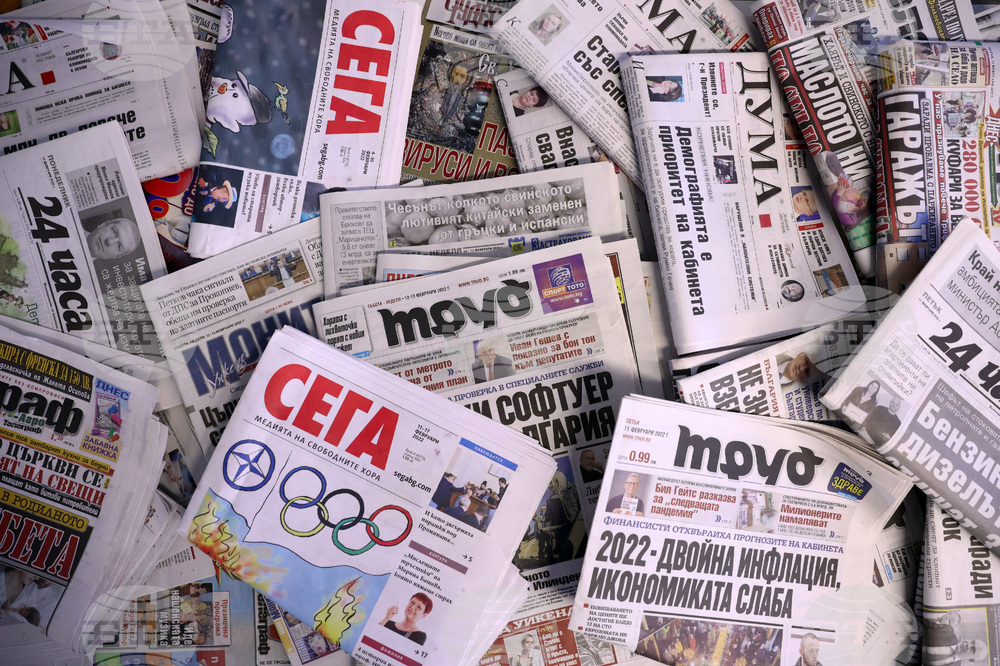
POLITICS
bTV: GERB leader Boyko Borissov said the outgoing coalition government achieved historic results, including Bulgaria’s accession to Schengen and the eurozone and the absorption of nearly BGN 5 billion in EU funds. Speaking on Facebook, he described the cabinet as “good but very quiet” and said it successfully implemented tough decisions despite opposition from left-wing coalition partners.
Borissov highlighted that since GERB’s founding, Bulgaria’s GDP has nearly quadrupled, exports rose 40%, and major investments, including Europe’s largest arms manufacturer, arrived in the country. He also claimed the party strengthened partnerships with the U.S., UK, and EU and prevented illegal migration. Borissov said GERB leaves government “with its head held high” and intends to continue pursuing a clear programme in the upcoming elections.
***
NOVA TV: Outgoing Prime Minister Rosen Zhelyazkov returned to the President the mandate of GERB-UDF to form a government, further steering the country towards early elections. The development was discussed on NOVA TV by social anthropologist Haralan Aleksandrov and journalist Stoyana Georgieva.
After returning the mandate, Zhelyazkov took stock of his government’s performance and, together with President Rumen Radev, called for higher voter turnout. GERB-UDF said the resignation was submitted to avoid further division and to move towards stability and democratic development.
Aleksandrov said it would be highly risky for anyone to attempt to form a cabinet, noting that the prevailing public mood favours new elections. He added that resignation alone is insufficient, as divisions are already entrenched, warning of a dangerous social charge linked to expectations of a possible political project by President Radev, which could fuel radicalisation and demands for revenge among parts of society.
Georgieva said elections are a logical way out of the crisis, with the key question being whether Radev will enter the race with his own political project. She stressed that if the President decides to do so, it should happen before the formation of a caretaker government to avoid a conflict of interest. According to her, the elections will take place in a highly mobilised public environment marked by growing dissatisfaction with the status quo and a sense of injustice, while real power over key institutions remains unchanged.
Journalists Yuri Velev and Georgi Marchev also commented on future political partnerships. Marchev said that amid major international developments such as Bulgaria’s entry into the eurozone and Schengen, the country’s internal political situation takes on new significance. Despite internal political disputes, Bulgaria is becoming an increasingly important part of a free Europe at a time of historic decisions, he said.
Velev predicted a highly dynamic political year, saying Bulgarians will certainly face at least two elections – parliamentary and presidential – with the possibility of another snap parliamentary elections. He warned that the campaign is likely to be fierce and expressed hope it would not become overly aggressive and dominated by smear tactics.
According to Marchev, there is no time for President Radev to form a party, as the registration procedure is lengthy and could not be completed by the end of March. He added that if Radev had intended to establish a party, he would already have done so.
***
24 Chasa quotes GERB MP Delyan Dobrev as telling Bulgarian National Radio (BNR) that if President Rumen Radev were to enter the political arena with his own party led by himself, the composition of the National Assembly would change and there might then be a greater chance of forming a government.
Dobrev stressed that it would be necessary to see the platform of such a party in order to determine whether there could be common policies with it or not.
“If there is no new player on the political scene, the elections will reproduce what we have already seen the last six or seven times. The parties and their mutual intolerance will be the same. If that happens, in my opinion, a government will not be formed after the upcoming elections and there will be new elections – probably in the autumn,” the MP said.
GERB will immediately return the government-forming mandate in order to save time and allow elections to be held more quickly, the he underscored.
According to Dobrev, the Zhelyazkov cabinet has achieved noticeable successes and the coalition arrangement functioned well.
“The biggest success is the country’s entry into the eurozone.”
Preliminary data show that the deficit for 2025 is within 3%, which he described as a miracle, said Dobrev, who chairs the Parliamentary Budget and Finance Committee.
“The extended budget is an obstacle because incomes could not be increased as planned in the two versions of the 2026 budget, but on the other hand it helps because it guarantees that the budget will not collapse in this unstable political environment.”
He stressed that GERB will not support the proposal by MRF - New Beginning for a law regulating price mark-ups.
Doborev said his problem with MRF - New Beginning is that they position themselves as a left-wing party, while GERB is a right-wing party, adding that this would cause a collision in the future.
The Election Code should not be revised before the elections, the GERB MP added.
Dobrev warned that without a united right-wing presidential candidate, who is equidistant from everyone, Vazrazhdane leader Kostadin Kostadinov could end up being elected president in the upcoming presidential elections “and this is no joke”.
Continue the Change – Democratic Bulgaria are behaving arrogantly and do not want such talks. If the right-wing fails to produce a candidate who can become president, the responsibility will be theirs, he said.
***
Duma quotes Senior officials of the Bulgarian Socialist Party (BSP) as having expressed reservations about convening a party congress at this stage, arguing that the party needs calm and focus ahead of the upcoming elections.
Speaking on Nova News, Valeri Zhablyanov, a member of the BSP National Council, said that the reasons for the party’s current condition do not stem from the past year alone and stressed that the BSP needs “calm, sober judgment and positive energy, not a congress”. According to him, the election of a new leader is not merely a vote but a complex process that cannot be carried out hastily within a few weeks. He noted that the Congress still has to decide whether to terminate the mandate of current party leader Atanas Zafirov and whether to proceed with the election of a new leadership at all.
Zhablyanov said he would personally support Zafirov, arguing that over the past year he has largely succeeded in consolidating left-wing forces in Bulgaria and that the BSP leadership has demonstrated a new approach to governance. He added that BSP–OL has shown in the current government that it can address concrete issues facing the country. He also warned that the party must stop undermining itself through internal confrontations.
A similar position was voiced by Alexander Simov, also a member of the BSP National Council, in an interview on Bulgarian National Television (BNT). According to Simov, the debate has never been about whether a congress should be held, but about its timing. He argued that it would be more appropriate to hold a congress after the elections, allowing the party to assess its electoral performance and outline its future tasks in a calmer environment.
Simov said the BSP currently needs to focus primarily on election preparation, warning that a congress could disperse the party’s efforts and reignite internal disputes. He described the recent meeting of the National Council as paradoxical, noting that it unanimously adopted a positive assessment of BSP’s participation in government before deciding to convene a congress to elect a new leader.
Simov also highlighted the party’s performance in government, pointing out that of the 100 policy measures included in BSP’s election programme, 36 have been implemented in less than a year. According to him, a party with 19 MPs and the status of fifth political force managing to fulfil 36% of its programme in 11 months should be considered a success, rather than focusing on internal divisions.
BULGARIAN EMBASSY – SKOPJE – VANDALISM
Bulgarian National TV (BNT): A window of the Bulgarian Embassy in Skopje was broken in an act of vandalism carried out Sunday by an unidentified perpetrator, Bulgaria’s Ambassador to the Republic of North Macedonia, Zhelyazko Radukov, told BNT. An investigation has been launched.
According to Radukov, the Bulgarian side is in contact with the competent authorities in North Macedonia, who have assured that they are working on the case. Footage from the Embassy’s security cameras has been provided to investigators. North Macedonia’s Ministry of Foreign Affairs condemned the incident in an official statement on the social network X, describing it as a violation of the Vienna Convention on Diplomatic Relations.
There is currently no official information on whether the perpetrator has been identified or detained. Radukov said he had no data on the stage of the investigation but expressed confidence that it was ongoing.
The Ambassador stressed that the incident was not isolated but part of a series of acts targeting Bulgarian institutions and citizens in North Macedonia. He attributed this to the continued anti-Bulgarian narrative in the public space and the lack of effective punishment for such acts.
“This impunity creates a sense that such actions are acceptable. There is no prevention – on the contrary, people feel free to show antagonism,” Radukov said.
He warned of an escalation from vandalism against cultural sites to physical attacks on members of the Bulgarian community, noting that an attack on a diplomatic mission represents a qualitatively different act and crosses an important line.
Radukov said Bulgaria’s response had been “adequate and measured”, with additional security measures taken around the Embassy. He added that the key question is whether the authorities in Skopje are prepared to genuinely work towards good-neighbourly relations, warning that the lack of effective action against hate crimes, combined with the prosecution of Bulgarian activists for their views, only deepens the problem.
WORLD
Britain has begun discussions with its European allies on the possible deployment of a NATO-led contingent in Greenland, The Telegraph reports, citing its sources. According to the publication, the plans, which are at an early stage, could include the deployment of British troops, ships and aircraft to protect the island.
The talks are taking place against the backdrop of recent statements by U.S. President Donald Trump, who has repeatedly spoken about the need to establish American control over Greenland, citing threats from Russia and China. European countries hope that strengthening their military presence in the Arctic will help persuade Trump to abandon his plan to take control of the strategically important region.
As The Telegraph notes, the U.S. president could present the European plan as a victory for American taxpayers, arguing that Europe is assuming a greater share of the costs of Atlantic security.
British government sources told The Telegraph that Prime Minister Keir Starmer takes the threats from Russia and China in the Arctic “extremely seriously” and agrees that action is necessary. “We share President Trump’s view that Russia’s growing aggression in the High North must be contained and that Euro-Atlantic security must be strengthened,” one of the sources said.
The idea was discussed at a NATO meeting in Brussels on January 8. Allies instructed NATO’s European Command to examine possible measures. The operation could involve a full-scale troop deployment or a combination of exercises, intelligence sharing, force build-up and redistribution of defence spending.
Any future mission would likely take place under NATO auspices, with British officials confirming to the newspaper that the country’s armed forces are preparing to expand their role in Arctic security.
At the same time, according to The Telegraph, the European Union is developing plans for sanctions against U.S. companies (including Meta, Google, Microsoft, X, as well as banks and financial institutions) should Trump reject the proposal to deploy NATO forces.
Meanwhile, the Daily Mail claims that Trump has ordered the development of a plan for a possible invasion of Greenland.
According to the tabloid, the idea is being actively promoted by “hawks” within the U.S. president’s inner circle, led by political adviser Stephen Miller, inspired by what they describe as a successful operation in Venezuela. The plan, however, is facing resistance from senior military officials, who consider it “insane and illegal”.
According to the newspaper’s sources, the generals are trying to distract Trump with other major military operations, such as intercepting Russia’s shadow fleet or striking Iran.
***
Capital: Protests against the rule of Ayatollah Ali Khamenei and Iran’s theocratic regime intensified on Saturday after security forces failed to suppress them despite aggressive intervention. The country has been under a media and information blackout since Thursday following a nationwide internet shutdown. Limited contact with the outside world has been possible via Starlink satellite internet, but IranWire reports that the military is attempting to jam the service.
Information from Iran remains fragmentary and comes mainly from major Western media. The BBC reports that hundreds of people have been killed so far. Late on Saturday, the broadcaster cited hospital sources in Tehran saying medical facilities are overcrowded with wounded and dead protesters, some of whom were shot with live ammunition. Images and videos reaching the outside world show burning cars and buildings. According to the BBC, eyewitness accounts and verified footage indicate that the government response is becoming increasingly aggressive.
Iran’s Prosecutor General Mohammad Movahedi-Azad has warned that protesters will be tried as “enemies of God”, a charge under Iranian law that can carry the death penalty.
The protests began over high inflation but quickly evolved into anti-government demonstrations. The authorities say economic protests are legitimate but reject any attempt to overthrow the regime. Supreme Leader Khamenei claims the unrest serves U.S. interests. U.S. President Donald Trump has voiced support for the protesters and has said military intervention in Iran remains possible.
Reuters reports that U.S. Secretary of State Marco Rubio has discussed such a scenario with Israeli Prime Minister Benjamin Netanyahu. Although Iran has seen protest waves before, the current unrest is widely viewed as the most serious challenge yet to the regime established after the 1979 Islamic Revolution. Reza Pahlavi, son of the last Shah of Iran, has urged protesters to seize control of major cities.
***
Bulgarian National Radio: The situation in Iran is unprecedented, with protests spreading across all provinces, Arabist Prof. Vladimir Chukov said in an interview with BNR. He added that the regime is highly experienced in repression and terror compared to other parts of the world.
According to Chukov, the former shah’s son has emerged clearly as a leader, addressing specific social groups in a targeted appeal. He described the situation as “more or less a civil war” and said Iran can no longer continue to exist in its current form.
Chukov noted that a change of Supreme Leader Ali Khamenei has been discussed for years, describing him as a figure of the past who cannot represent Iran’s future. He also said that so-called reformists cannot be an alternative to conservatives identified with Khamenei.
The Arabist warned that if the mullahs feel they are losing power, they could strike Israel as an external enemy. He predicted that the United States would avoid massive strikes, focusing instead on elements repressing protesters and avoiding direct military escalation.
According to Chukov, Iran’s nuclear programme has been set back by decades, but its ballistic missile capability remains more dangerous and continues to develop. He concluded that geopolitical layers in the region are shifting and being rearranged.
/MY/
news.modal.header
news.modal.text