BTA interview
![Director Yordan Mihaylovski: Immersive Exhibition about Antarctica Could Inspire Children to Take Up Science]()
![Director Yordan Mihaylovski: Immersive Exhibition about Antarctica Could Inspire Children to Take Up Science]() Director Yordan Mihaylovski on Livingston Island, February 15, 2026 (BTA Photo/Simona-Alex Mihaleva)
Director Yordan Mihaylovski on Livingston Island, February 15, 2026 (BTA Photo/Simona-Alex Mihaleva)
![Антарктида - Йордан Михайловски - режисьор]()
![Антарктида - Йордан Михайловски - режисьор]()
![Антарктида - Йордан Михайловски - режисьор]()
![Антарктида - Йордан Михайловски - режисьор]()
site.btaDirector Yordan Mihaylovski: Immersive Exhibition about Antarctica Could Inspire Children to Take Up Science
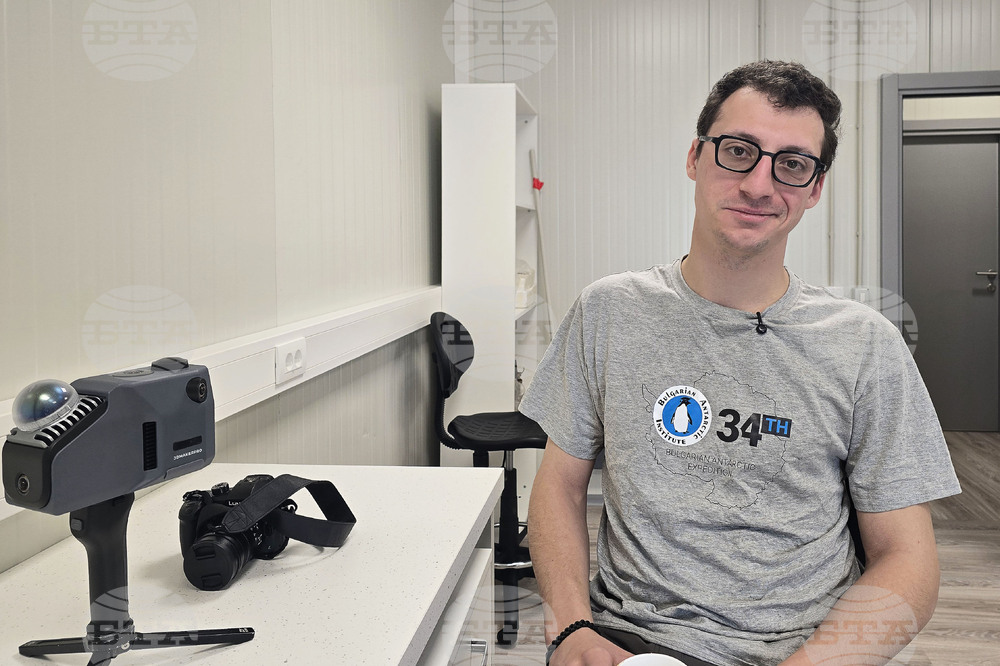
An immersive exhibition about Antarctica can inspire curiosity in children and a desire to engage in science, director Yordan Mihaylovski said in an interview with BTA.
Mihaylovski is a director, screenwriter, and producer, and this year he is part of the 34th Bulgarian Antarctic expedition. He is here with a project to create an immersive exhibition that can be viewed with virtual reality glasses and recreates the feeling of being in Antarctica.
In an interview with BTA, Mihaylovski said that the idea of presenting and "bringing closer" the Bulgarian Antarctic expeditions to the people arose at the Createch seminar in China in 2025, which is aimed at integrating new technologies into the creation of cultural products. That was when he started thinking about immersive exhibitions. His goal was for the first exhibition to be dedicated to the Bulgarian pride - the Liberation from Ottoman rule, sporting successes, or scientific achievements. That was how he settled on Antarctica and the scientific contribution of Bulgarian Antarctic explorers to Bulgarian pride.
"I wanted to rely on and take advantage of Bulgarians' sense of belonging to their homeland, their country, their community, etc., as well as their pride in our history and successes. (...) We already have several expeditions [to Antarctica], we have our own land, we have created infrastructure, and we are expanding both the Bulgarian and the global scientific community with the discoveries made here," he explained.
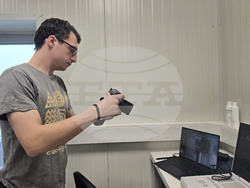
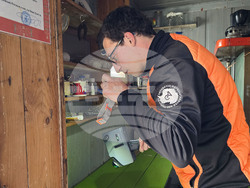
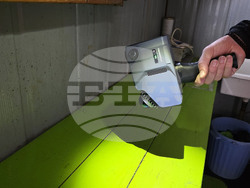
His job is to scan the interior of the Bulgarian Antarctic base, including the new laboratory, chapel, museum, and scenes from everyday life. "By 'scan,' I mean using a device that captures light, photons from surfaces. It can be used for interiors and creates a three-dimensional model of the volume of a given space. Then I take high-quality photos with a camera - 4K, 6K, i.e., with good resolution - so that the texture and colour of the object I am scanning are captured," Mihaylovski noted.
The scanner has four cameras that cover almost 180 degrees, so that there is something to superimpose the high-quality photos on. This material is not visible to the viewer, but is used to mark points on the surface of objects. The high-quality images are then superimposed from different angles to achieve photorealism. The final stage is shooting with a 360-degree camera.
"The final product will be an exhibition to be presented at SCAR - a conference for scientific polar researchers. It will be in Sofia in 2028. This is an international conference, the largest in the world, held every two years. (...) My goal is to present the project there. I do not know exactly what it will look like, but I imagine it like this: I will place a large container in front of the National Palace of Culture, giving it an industrial feel, and people will go inside with VR glasses and walk around the laboratory, the beach, the glacier, the ship, to see the path to here," he explained. He also plans to include stories from the journey to Antarctica, focusing on key historical moments such as the construction of the Bulgarian Antarctic base and the first voyage of the Bulgarian naval research ship Sv. Sv. Kiril i Metodii.
The director envisions the exhibition's development after its presentation in 2028. "Depending on how it develops, I would place it in natural history museums. Or, if the container option works in practice, the container itself could be used, because we can keep the temperature inside from getting too low and make it even more engaging. I would place it in regional cities, in the centre - a traveling exhibition," he explained. "In other words, apart from art, it is more of an archive and social information."
The project will be implemented during the 34th and 35th Bulgarian Antarctic expeditions.
"This year, it would be nice to do something smaller, something like a prototype, using only VR glasses, and visit some natural history museums. That way, I will see how people react and be able to adapt to them," Mihaylovski noted, adding that at this stage he has already talked to various museums in Blagoevgrad, Veliko Tarnovo, Burgas, and Sofia about presenting the exhibition.
He also said that if funding is available, he would expand the project after the immersive exhibition is presented for the first time. "I would like to go to 0 degrees on the continent, that is, to the South Pole itself, to take a picture there because it is spectacular. Rather, to show what 'zero degrees' looks like - to add something that attracts people: 'Come and see.' And when they come [to the exhibition] because of 'zero degrees', they will learn more about the positive effects and the years of work that have gone into making the base as useful as it is," he explained.
He hopes the exhibition will achieve two goals: to have a positive impact on raising more funds for the expedition and to spark curiosity in children and students. "I hope the exhibition will have such a positive effect: that young students will be inspired and start getting involved in science," he concluded.
The Bulgarian naval research vessel Sv. Sv. Kiril i Metodii (RSV 421) departed for Antarctica from Varna (on the Black Sea) on November 7, 2025. After a month-long voyage across the Atlantic Ocean, the ship arrived at the Argentine naval base in Mar del Plata on December 13.
BTA has had a national press club on board the ship since 2022 and another on Livingston Island since February 2024. BTA Director General Kiril Valchev said they exist thanks to the generous support of RSV 421 and Bulgaria’s St Kliment Ohridski Base, which provide the necessary facilities. These two press clubs are added to the news agency’s other 41 national press clubs (33 in Bulgaria, seven abroad in neighbouring countries and in nations with large Bulgarian communities, and one mobile National Book Press Club).
The news items of BTA's special correspondents on RSV 421 and Antarctica are freely available in Bulgarian and English on the agency's website. They can be used free of charge by all media, with attribution to BTA. Valchev recalled that thanks to its correspondents, the news agency appears among the top results on Google when searching for the phrase “Antarctica correspondent”.
/DS/

Additional
news.modal.image.header
news.modal.image.text
news.modal.download.header
news.modal.download.text
news.modal.header
news.modal.text