site.btaAntarctica's Geological Advances Matter Because We Still Know Little, Says Geologist Stoyan Georgiev
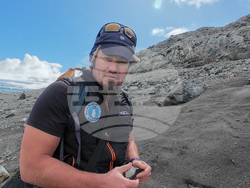
Assoc. Prof. Stoyan Georgiev from the Geological Institute of the Bulgarian Academy of Sciences (BAS) is taking part in two Antarctic expeditions this year. He is a member of the 34th Bulgarian Antarctic Expedition as well as the 10th Turkish expedition to Horseshoe Island. He has joined a team of geologists who will sail to the island, which lies beyond the Antarctic Circle.
"Scientific achievements can be shared, and we know that in this part of Antarctica they are rather scarce," the geologist commented.
Assoc. Prof. Georgiev specializes in the study of volcanoes. He told BTA that the scientific objective of the expedition is to identify magmatic sources on Horseshoe Island in relation to the displacement and sliding of tectonic plates during various periods of the Earth's development.
"The main goal of the expedition will be the study of magmatic rocks associated with Jurassic and Cretaceous subduction, as well as the related processes up to the present day, including ore formations associated with basic magmas and gabbro (a dark, coarse-grained intrusive igneous rock - editor's note). One of the key tasks will be to establish the link between this magmatism and ore formation in the region," Assoc. Prof. Georgiev said. In most cases the hot aqueous solutions that lead to the formation of metallic mineral resources are linked to a magmatic source.
At its core, this year's geological work on Horseshoe Island will focus on identifying the prerequisites for the formation of mineral resources.
"Overall, we are more interested in the processes that led to the formation of mineral resources and the types of deposits, rather than their size. But it is certainly known that Antarctica has a significant number of deposits, due to the fact that it was connected to South America, which has some of the world's largest deposits," Georgiev added.
This is not the scientist's first expedition to Antarctica. On his first visit to the Ice Continent, his work focused mainly on Livingston Island, home to Bulgaria's St Kliment Ohridski Base. At that time, he studied rocks and processes related to magmatism and tectonic matters.
This year's project on the study of magmatism and mineral resources on Horseshoe Island largely complements the project previously carried out on Livingston Island.
"A great deal of information will be generated, which we will try to present in a more popular-science format as well. Of course, the most significant contributions will be in the scientific domain, which, although somewhat difficult for most people to understand, is of extremely great importance for understanding the geological processes in the region. This will allow correlations with different parts of the Antarctic Peninsula, as well as with the South Shetland Islands, where Livingston Island is located. There are similar types of rocks and similar types of hydrothermal systems that can be compared, which is of great value," Georgiev explained.
He stressed that cooperation between the Bulgarian and Turkish Antarctic programmes is very important, as it provides greater opportunities for both countries to study the southernmost continent.
"We have had very good cooperation with the Turkish expedition and with our colleagues from Turkiye almost since the very beginning of their programme, which started well after ours," the geologist noted. "In most cases we provide them with logistical support, and they in turn assist us in various respects. As you know, in Antarctica and in this region people make a point of supporting one another. In many cases Turkish colleagues have worked at our base, and some of our colleagues have also taken part in their expeditions."
He explained that, unlike the Bulgarian Antarctic Expedition, which has scientists in Antarctica for almost the entire austral summer period from November to mid-March, the Turkish programme plans an expedition lasting only one month, usually in February, when the weather is at its best. Their expedition is carried out mainly by ship, as is planned again this year.
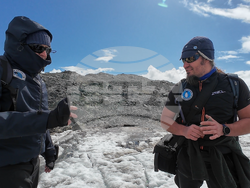
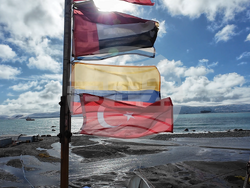
On its way to Horseshoe Island on Sunday, the 10th Turkish Antarctic Expedition paid an official visit to the Bulgarian naval research vessel Sv. Sv. Kiril i Metodii (RSV 421) and to the Bulgarian Antarctic Base on Livingston Island. Participants from the Turkish and Bulgarian teams visited a glacier near the base and took samples.
Assoc. Prof. Stoyan Georgiev reached St George Island with the Bulgarian group, and then went on to Horseshoe Island together with the Turkish Antarctic Expedition. The rest of the Bulgarian group sailed on the Bulgarian research vessel Sv. Sv. Kiril i Metodii (RSV 421) to the Bulgarian Base on Livingston Island.
RSV 421 departed for Antarctica from Varna (on the Black Sea) on November 7, 2025. After a month-long voyage across the Atlantic Ocean, the ship arrived at the Argentine naval base in the city of Mar del Plata on December 13.
BTA has had a national press club on board since 2022 and another on Livingston Island since February 2024. These are added to the agency’s other 41 national press clubs (33 in Bulgaria, seven abroad in neighbouring countries and in nations with large Bulgarian communities, and one mobile National Book Press Club).
BTA's Director General Kiril Valchev announced ahead of the fourth voyage to Antarctica on November 7, 2025 that the national news agency would send a special correspondent in January-February 2026. He said the press clubs exist thanks to the generous support of the Bulgarian research vessel St. St. Cyril and Methodius and Bulgaria’s St Kliment Ohridski Base, which provide the necessary facilities.
The news items of the BTA special correspondents on RSV 421 and Antarctica are freely available in Bulgarian and English on the agency's website. They can be used free of charge by all media with reference to BTA.
/DD/

Additional


news.modal.image.header
news.modal.image.text
news.modal.download.header
news.modal.download.text
news.modal.header
news.modal.text