site.btaMedia Review: December 10
HEADLINES
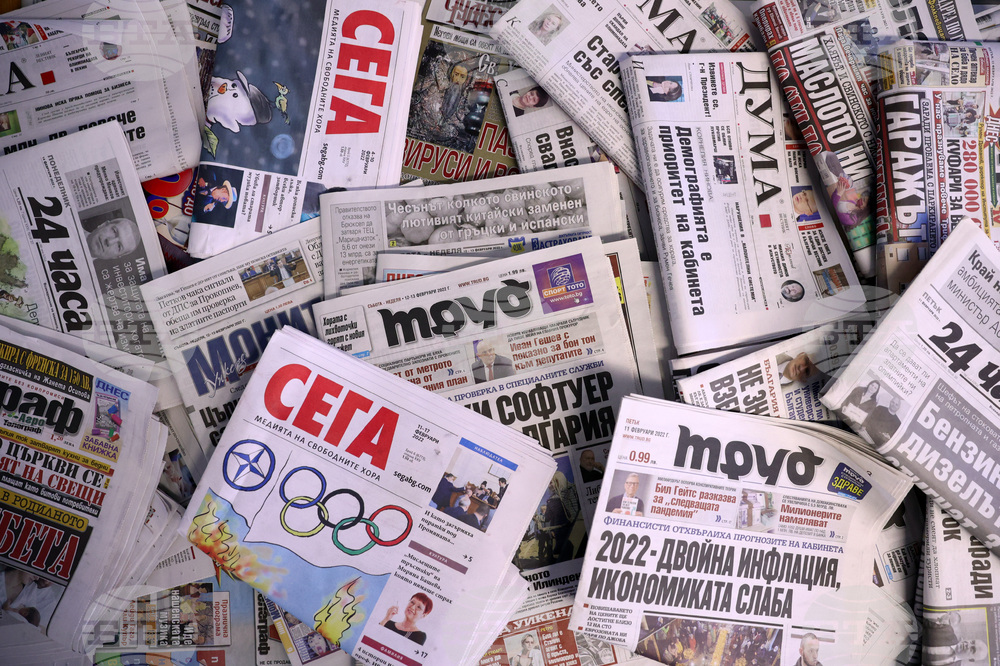
Wednesday’s print media front pages highlight a mix of health statistics, economic developments, and cultural reporting. 24 Chasa leads with data showing a slight decline in cancer incidence in Bulgaria, while noting that the country continues to top European rankings for child mortality. Trud reports on expected limitations to wage growth. Telegraph features a story investigating the origins of a Darth Vader depiction, presented as part of a cultural or urban-art focus. Duma’s front page headline reads that the son of Ukraine’s Ambassador to Bulgaria Olesya Ilashchuk has been arrested for murder.
Newspapers’ inner pages include several prominent interviews reflecting on the country’s economic outlook, political history, and holiday travel trends. In 24 Chasa, communications expert Maxim Behar argues that Bulgaria is not facing a traditional crisis, but rather entering a new long-term reality that society must adapt to. Trud features former parliamentary speaker Ognyan Gerdzhikov, who reflects on Bulgaria’s political trajectory and says that former monarch Simeon II would have been an excellent president capable of accelerating the country’s progress. Telegraph focuses on holiday mobility, with tourism analyst Rumen Draganov reporting that around 900,000 Bulgarians are expected to travel around the New Year period.
The Bulgarian National Radio (BNR) on Tuesday featured interviews touching on political participation, eurozone accession, and civic attitudes. Dilyana Velichkova commented that “the real battle is not on the day of the protest, but at the elections,” stressing the importance of voter engagement. Svetlin Tachev said the government is “playing for history” with its push for eurozone entry. Adela Kachaunova noted that Bulgarian society “has awakened once again to seek justice,” while Alexander Tanev argued that only active voting can counter what he described as a “captured system.”
The morning programmes of the Bulgarian National Television (BNT), bTV, and Nova TV featured various topics such as the upcoming protest against Movement for Rights and Freedoms (MRF) – New Beginning leader Delyan Peevski and GERB leader Boyko Borissov, Tuesday’s protests in support of the government, protests of medical specialists regarding the draft budget of the National Health Insurance Fund, the protests of Greek farmers blocking the Greek-Bulgarian border and long queues at the Bulgarian-Turkish border, Nova TV reported receiving viewer signals about fraud involving guesthouses and rental villas advertised for New Year’s Eve.
PROTESTS IN SUPPORT OF AND AGAINST THE GOVERNMENT
Nova TV reported that a new large-scale protest is expected in the so-called Triangle of Power in central Sofia, as well as in cities across and outside the country. On Tuesday, the MRF–New Beginning held counter-protests in more than 20 cities, which President Rumen Radev described as “more of a manifestation.” Discussing how long the protest wave may continue and what it could mean for the government, journalists Petyo Tsekov (Sega) and Eduard Papazyan (24 Chasa) offered forecasts on the morning programme of Nova TV. Tsekov described the counter-protest format, or demonstrations “in support of the government,” as “a strange, undemocratic and somewhat foolish genre,” arguing that such actions resemble attempts to attack the opposition rather than authentic civic mobilization. Papazyan added that these events aim to project “a show of force,” but this rarely overcomes the energy of a genuine protest. “Nothing that is ‘for’ can ever beat what is ‘against’,” he said. Both journalists noted that the MRF rallies introduced signals of ethnic tension – an issue that had not previously been part of the public debate. Papazyan warned that if demonstrations continue, “questions from Sofia will spill into the provinces,” where dependencies are deeper. The analysts agreed that the protest movement against the status quo is supra-party, which they said gives it strength. They also commented on ongoing speculation about whether President Rumen Radev might launch his own political project. According to Tsekov, Radev could play a key role in resolving the current situation. Both guests predicted prolonged protests and early elections. “This protest will spill over into the spring,” Tsekov said, advising the ruling majority to consider the timing of a possible exit and prepare a plan. He added that the government is prepared for elections, while the opposition must focus on turnout and on “doing politics, not only on getting people off the couch.” Papazyan concluded that a political force will be needed to “catalyze the strength of the protests” in the run-up to potential elections.
* * *
Dilyana Velichkova said in an interview for BNR that she first took part in a protest in 2013 in Berlin at the age of 20, with the trigger again being Delyan Peevski. She said she will once more join a demonstration in the German capital on Wednesday to express dissatisfaction with the situation in Bulgaria. “People know what this is about. There is information even in the local newspapers,” she noted. Velichkova stressed that “the real battle is not on the day of the protest but on election day,” adding that she hopes the energy generated on the streets will be sustained. Bulgarians will be protesting not only in Berlin but also in other German cities. She explained that over the years a group of active citizens has formed – “not as members of one party, but as alert citizens”, and that they have built a network which “wakes up from time to time.” The network, she said, includes Bulgarian communities in other European countries as well.
* * *
BNT reported that Sofia Municipality has cordoned off part of the Largo area in downtown Sofia due to damaged pavement. The official explanation links the decision to the protests in the capital, noting that the tiles were broken by demonstrators and must be fenced off and repaired to prevent accidents. The Sofia Regional History Museum, which manages the site, has commissioned an inspection and technical assessment of the load-bearing structure by a team from University of Architecture, Civil Engineering and Geodesy. The tiles are attached to steel plates placed on plastic supports, which form part of the drainage system above the Largo’s domes. Deputy Culture Minister Assoc. Prof. Todor Chobanov told BNT that the elements in question are not tiles but covers for the drainage system. He explained that the area has a strong natural slope where water accumulates and that the large drainage structures between the domes are not designed to withstand heavy loads. Chobanov urged protesters to move through the zone with caution on Wednesday evening, when a protest against Peevski and Borissov is scheduled, as there is a risk of further damage or accidents. bTV also reported on the matter.
* * *
BNT hosted a discussion studio on the protests in support of the government which took place on Tuesday evening. Supporters and sympathizers of the MRF–New Beginning expressed approval of the cabinet under the slogan “No to Hate.” Prof. Mihail Konstantinov, Director of Electoral Analysis and Forecasting at Gallup International Balkan, said that “a government that faces no protests decays,” adding that demonstrations are both “interesting and necessary.” He noted that a new political project had until recently been assessed at around 50 seats and potentially a second-place finish, while the country’s leadership is currently not unified on whether elections should be held. Prof. Konstantinov forecast that elections are likely at the end of February 2026, accompanied by “technical chaos” both psychologically and in day-to-day terms. Journalist Vladimir Yonchev commented that Delyan Peevski “showed he is ready to fight and did what he could,” saying that while some situations appeared comical, there were also genuine supporters. He pointed to the case in Svoge, where buses of protesters were brought but could not be redirected to Botevgrad, resulting in two competing demonstrations – one in support of the government and another booing them. “There has always been a certain degree of arrogance in Bulgarian politics. This time it came in excessive amounts,” Yonchev said. He stressed the importance of the narrative that will prevail, noting that it makes a significant difference whether public dissatisfaction is framed as a reaction to political arrogance or as ethnically motivated hatred.
* * *
BNT reported that recent protests in Sofia have contributed to negative perceptions of the police. Assoc. Prof. Nedelcho Stoychev, criminal psychologist and former rector of the Interior Ministry Academy, said that in recent years there has been a tendency to blame the police for everything. “Reasons are constantly being sought to put the police against the wall, with facts and circumstances often taken out of context,” he noted. Stoychev emphasized that the Interior Ministry is one of the few state institutions that subsequently investigates who committed a violation and applies the corresponding sanctions. He added that clear regulations govern how officers must act in crisis situations. “The main goal has always been to seek consensus between protesters and the police. Both sides want events to pass peacefully. Police officers should not be assigned preconceived guilt – they carry out orders and the operational plan drawn up by their superiors,” he said. He suggested that some provocateurs may have been pre-emptively identified and noted that such groups cannot be treated separately once they merge into a larger protest. “If such groups exist, sooner or later the services will reach them,” Stoychev said.
ECONOMY
Duma reports that the practice of paying a 13th salary at Christmas has largely disappeared from the private sector, according to a survey by Adecco Bulgaria covering more than 300 companies in the IT, outsourcing, telecommunications, finance, trade and manufacturing sectors. Adecco notes that few employers now provide a full additional monthly salary as a holiday benefit, with businesses showing greater caution in planning end-of-year expenses. Nevertheless, many companies continue to offer some form of material bonus, albeit smaller than in previous years. Christmas bonuses vary widely across sectors. Manufacturing companies most commonly pay between BGN 100 and 250 or offer vouchers of similar value, while some organise corporate celebrations or gift their own products to employees. Only a small number of employers provide bonuses above BGN 500. In traditionally more generous sectors such as technology, holiday bonuses have been reduced to around half a monthly salary. Gift cards loaded with a set amount are becoming increasingly popular, often differentiated by employee level to support a more flexible and equitable internal policy.
CRIME
Nova TV reported a growing number of complaints about fraud involving rental villas advertised on social networks in the days leading up to New Year’s Eve. According to the broadcaster, dozens of people have paid deposits and received what appeared to be official reservation documents, only for communication with the supposed landlords to cease shortly afterwards. One of the affected, Maria, told NOVA that after she transferred the money, “communication completely disappeared,” adding that her group had paid a deposit of BGN 1,200, another group from Burgas also lost BGN 1,200, and a third group lost BGN 1,000. NOVA noted that New Year’s celebrations have become a prime target for such schemes. Aya, another victim, said that she and her friends found a villa near Bansko through a TikTok video and later discovered they had been deceived.
/YV/
news.modal.header
news.modal.text