site.btaNorth Macedonia Trade Unions Demand Pay Rises, Threaten Institutional Blockades and General Strike
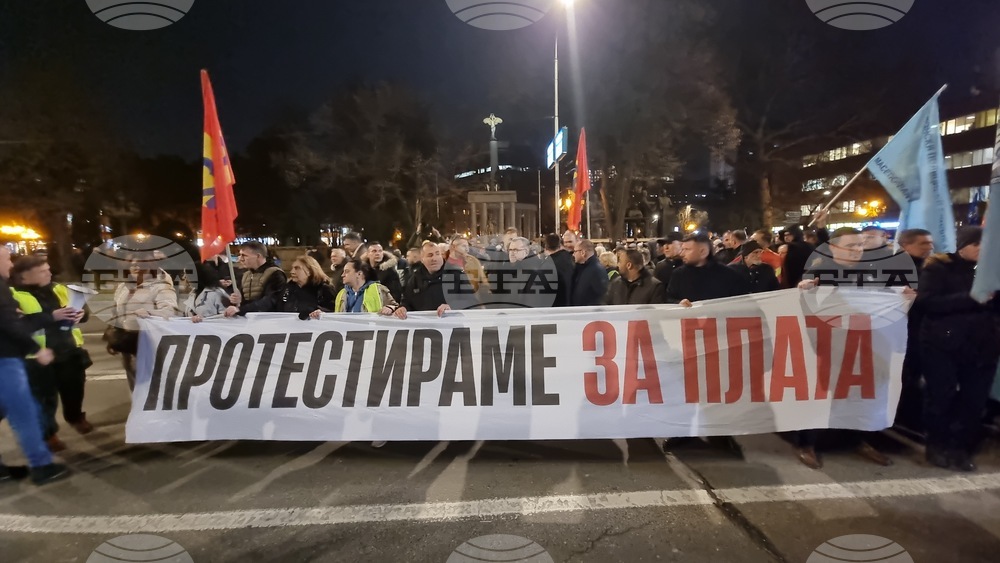
Slobodan Trendafilov, president of the Federation of Trade Unions of North Macedonia, on Monday called on "a representative of the government" to sign a collective labour agreement that would raise the minimum wage in North Macedonia from around EUR 400 to EUR 600. Otherwise, the trade unions will move ahead with institutional blockades and a general strike, he said.
According to Trendafilov, there have been numerous attempts to sabotage the trade unions’ protest, but despite this, a large number of workers and employees took to the streets of Skopje on Wednesday.
Responding to a parliamentary question on Thursday, Prime Minister Hristijan Mickoski said that in 2025 the government had proposed increasing wages of public administration employees by nearly 40% over the period from March 2026 to March 2028, an offer that was rejected by the trade union federation.
"We are protesting for a minimum wage of EUR 600 now, not in 2028. Come back from the future, comrades, come back to reality," Trendafilov said. He added that if blockades take place, the first institution to be blocked will be Parliament, where the wages law has still not been considered. "We will wait for them [the MPs] to greet them and remind them that they are there because of us and that they must vote. They will have to come to work by bus and on foot, just like many workers who do not receive compensation for travel expenses," Trendafilov stressed.
On Friday, Mickoski wrote on his Facebook profile that his government had proposed raising wages of public administration employees by about 40%, but the trade union federation rejected the proposal. "As for the minimum wage, we must act in accordance with the law. The moment workers and employers reach an agreement, we will support it and implement it,” Mickoski said.
"There can be money for criminal tenders, but no money for workers. Instead of justifying why wages are not being increased, Mickoski’s government should secure funds to raise the minimum wage to EUR 600. Today, [North] Macedonia has the lowest minimum wage in the region and in Europe. The consequences are already visible: skilled workers are leaving the country en masse, young people are emigrating, and ‘economic migrants’ are being brought in," the opposition party SDSM said in a statement, recalling that it has proposed new legislative solutions to raise the minimum wage to EUR 600 and freeze the salaries of senior officials.
/NZ/
news.modal.header
news.modal.text