site.btaJanuary 28, 1998: Sofia Metro’s First Section Goes into Service
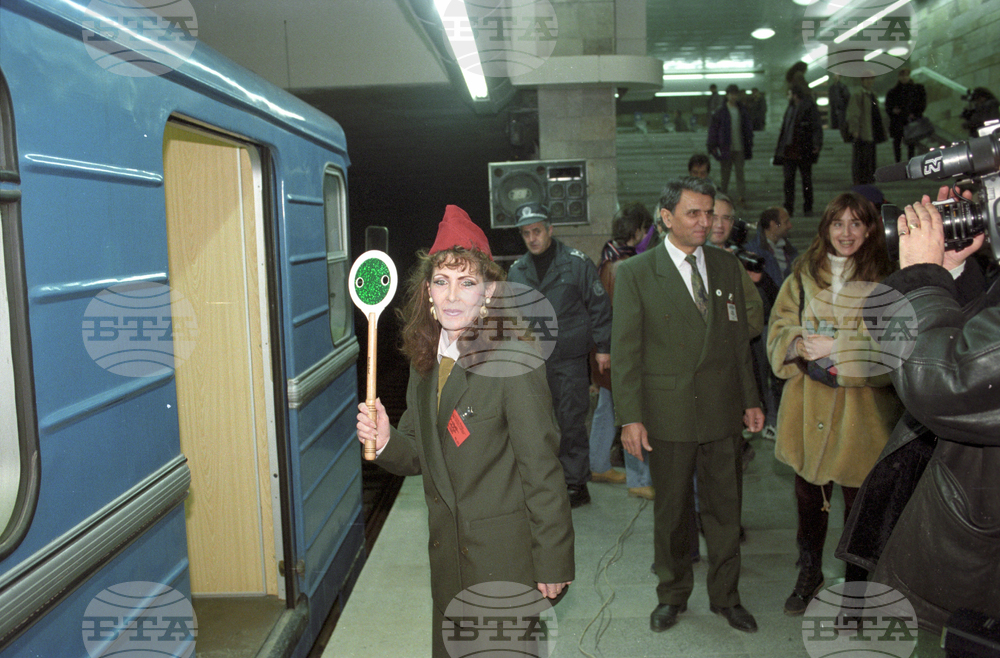
Twenty-eight years ago on Wednesday, then Sofia Mayor Stefan Sofiyanski opened the first section of the first line of Sofia's underground railway system. The section had a total length of 6.5 km with five stations: Slivnitsa, Lyulin, Zapaden Park, Vardar and Konstantin Velichkov. It connected central Sofia and the Borough of Lyulin in the northwest. The line was later completed and extended to the Business Park in the Borough of Mladost.
At present, the Sofia Metro consists of four lines, with a total length of 52 km and 47 stations. It has an hourly capacity of 50,000 passengers and around 470,000 passengers use it daily. The average train speed is 80 kmph. The development of the metro system continues, with three new stations planned to open in 2026 and seven more in 2027.
The first proposals for an underground transport system in Sofia date back to the late 1960s. Traffic in the capital needed to be eased because of a growing population, narrow streets, and scarce tram services. New neighbourhoods were built far from the city centre, and travelling between some of them was time-consuming and expensive.
Between 1967 and 1968, the Sofia City Council's Department of Urban Planning and Architecture began developing a comprehensive design concept for the future transport system. Initially, the focus was not on a metro system proper but on a 'high-speed tram', which would run both above and below ground. The team of specialists ultimately produced twelve volumes of diagrams, maps, drawings, tables, sketches titled "Sofia Metro".
In 1972, the Council of Ministers approved a feasibility study and established the Metroproject Directorate to oversee the future construction of the metro. In 1974, the Sofia City Council adopted a master plan for the development of the underground. Three metro lines, totalling around 60 km with 60 stations, were planned to intersect in the city centre in the shape of a triangle. In March 1978, construction of the first metro line, which was to link Lyulin and Mladost, began in stages.
Progress of the effort was slowed down by various problems. Hydrogeological studies confirmed the presence of groundwater in the city, prompting a debate over which excavation method to be used. Work proceeded at fits and starts, but nevertheless continued, and the tunnels and metro stations gradually took shape. In central Sofia, excavation work uncovered numerous archaeological monuments, some of which were preserved and exhibited.
Here is how BTA's English service covered the inauguration of the underground railway system of the Bulgarian capital:
"After 30 Years and 200 Mln Dollars, Sofia's Metro Pulls Out
Sofia, January 28 (BTA) - Sofia Mayor Stefan Sofiyanski inaugurated the first stretch of the Sofia underground railway Wednesday. The opening ceremony came complete with a prayer service.
The ceremony was attended by visiting Moscow Mayor Yuri Luzhkov, National Assembly Chairman Yordan Sokolov, Deputy Prime Minister Evgenii Bakurdjiev, the Russian Ambassador in Sofia Leonid Kerestedjiants, MPs and government ministers.
After hearing Mr Sofiyanski's address, the officials and Sofianites attending the ceremony were the first passengers on the underground. During the first day, everybody could ride free of charge.
Sofia's underground is the world's 105th to go into operation but probably took the longest to build of them all. The idea dates back to 1966, and site investigation and design work began in 1967. The master plan was approved in 1975. When the ground-breaking ceremony took place in 1979, the system was scheduled for completion in 1985.
Construction of stations 2 and 4 of the first stretch, however, did not actually start before January 1985. The project was severely underfunded, with investment increasing after 1987, when the bulk of construction work was finished. The next inauguration deadline, 1990, was not met, either, because the budgeted investment was not utilized. The last-but-one target date, set in 1990 - January 1993 - was also missed.
Finally, the first stretch of the 18.7 km Northwest-Southeast line, 6.1 km from the depot in Obelya via the terminus in the Lyulin Housing Estate to Konstantin Velichkov Boulevard with five stations (Lyulin, Zapaden Park, Konstantin Velichkov, Slivnitsa and Vardar), was inaugurated Wednesday.
The entire 52-km, 46-station system will consist of three lines: a Northwest-Southeast line between Lyulin and Mladost via Sveta Nedelya Square, Sofia University and Izgrev (17 stations), an 18 km North-South line between Iliyantsi and Hladilnika via Nadezhda, the Central Railway Station, Sveta Nedelya Square, the National Palace of Culture and Lozenets (17 stations), and a 15.4 km Southwest-Northeast line (15 stations) between Knyazhevo and Vrazhdebna via Ovcha Koupel, the National Palace of Culture, Sofia University, the Poduyane Railway Station and Botevgradsko Chaussee Boulevard. The three lines will intersect in a triangle enclosed between the National Palace of Culture, Sofia University and Sveta Nedelya Square.
Services run from 5:00 a.m. until 11:30 p.m. Four trains operate in both directions in rush hours, arriving at the stations every 3 minutes and carrying an average 14,000 passengers per hour, and three trains cover the route in the rest of the time, arriving at intervals of 6 to 10 minutes. The 48 second-hand Russian-made trains have four carriages with 40 seats and standing room for 230 each and travel at an average 41 km/h (with allowance for stopping, passengers getting on and off, and restarting) and a maximum 90 km/h. They take the whole distance in 6 to 8 minutes, and stop at each station for 12 seconds. The distance between the stations is 1,100 m. A ride costs 200 leva (as much as by other modes of public transport).
The walls of the orange Slivnitsa Station (below Slivnitsa Boulevard, between Obelya and Lyulin) are of beige marble, with ceramic- tile bands, and the flooring is grey granite. The pale violet Lyulin Station (in the centre of the Lyulin Housing Estate) has grey marble walls, two rows of tiled columns on the platform, and a polished granite floor.
The green Zapaden Park Station (not far from the eponymous park) has walls of gneiss stone and a floor of polished black and grey granite. The Vardar Station (below the intersection of Vardar Street and Pirotska Street) is floored with ceramic tiles and its walls are decorated by orange-red silk screen. Ceramic tiles cover the walls and the floor of the dark red and beige Konstantin Velichkov Station (below the intersection of Konstantin Velichkov Boulevard and Naicho Tsanov Street). The station platforms are 120 m long.
Another stretch of the same line, 2 km from Konstantin Velichkov Boulevard to Sveta Nedelya Square with two stations, has also gone under construction. A third stretch, 1.6 km from Sveta Nedelya Square to the intersection of Czar Osvoboditel Boulevard and Vassil Levski Boulevard with one station, is fully designed. The tunnels are dug at a depth of 8 to 12 m.
Some 200 million US dollars have been invested in the project by 1998. Construction costs about 30 million dollars/km, as against an average $80 million in Europe, because of the cheaper building materials and labour.
Once the underground system is entirely completed (by 2020, according to the latest estimates), 53 per cent of all commuters are expected to use it (compared to 35 per cent in Moscow and 52 per cent in Vienna). This will help discontinue part of the tram services and 60 to 70 per cent of the bus services, cutting exhaust pollution by 30 to 40 per cent. MM,LG/TK,LG/18:44:38 28-01-1998 -0-"
/LG/

news.modal.header
news.modal.text