site.btaDecember 23, 1933: Bulgarian Defendants in Reichstag Fire Trial Acquitted
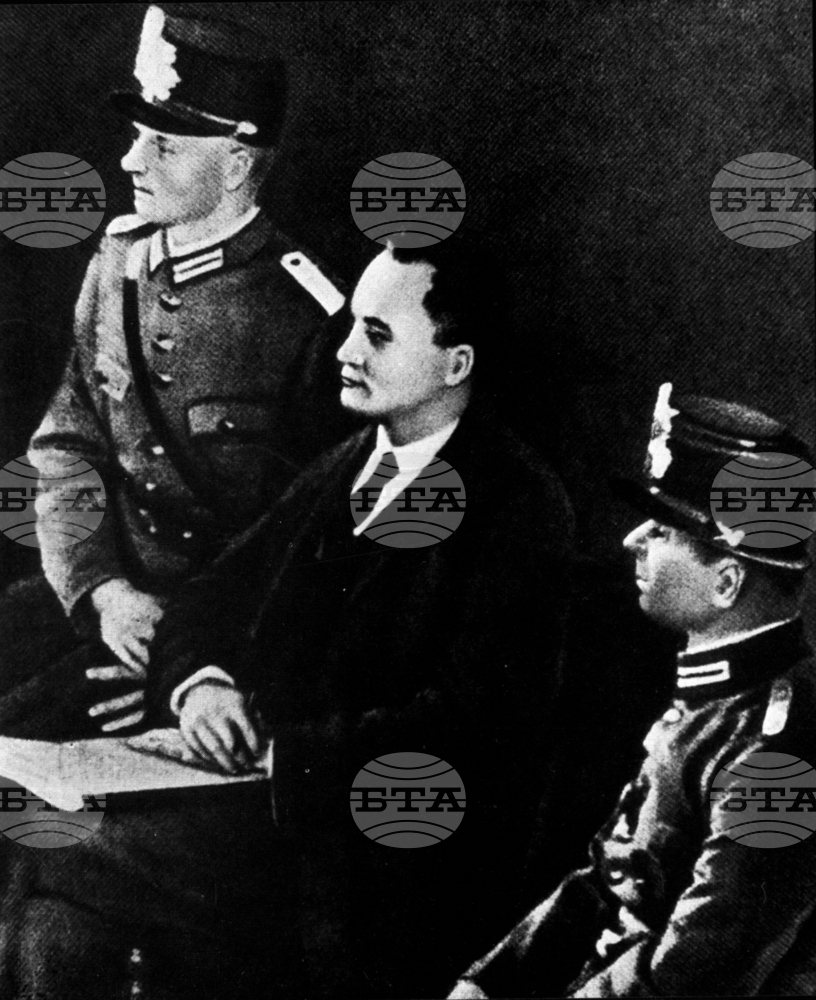
Exactly 92 years ago, the Imperial Court in Leipzig, Germany, acquitted Georgi Dimitrov, Blagoy Popov and Vasil Tanev for lack of evidence of the three Bulgarians' involvement in the Reichstag arson attack of February 27, 1933. The three men were arrested in Berlin on March 9, 1933, and the trial against them, Dutchman Marinus van der Lubbe and German Ernst Torgler lasted from September 21 to December 23, 1933.
Here is how the Bulgarian News Agency reported on the trial's end:
Leipzig, December 23, 1933 (Reuters) - Van der Lubbe was sentenced to death. Torgler, Dimitrov, Popov and Tanev were acquitted.
Leipzig, December 23, 1933 (Reuters) - Van der Lubbe was convicted of treason. He showed no emotion, listening to the verdict with his head bowed and completely motionless. The three Bulgarians remained impassive, while Torgler, looking very pale, displayed signs of anxiety caused by the trial. There was no special security guarding the church court. Only a few policemen were preventing the curious from gathering. However, combat units and police officers were ready to intervene in case of unrest.
Leipzig, December 23, 1933 (Wolffs Telegraphisches Bureau) - In delivering the verdict in the Reichstag fire case, the presiding judge first addressed the slanderous allegations published in certain biased outlets that had questioned the court's impartiality and made outrageous accusations against individuals. He stated that it had been proven that van der Lubbe's accomplices and instigators were in the communist camp, and that the Reichstag fire was an act of communism intended to incite civil war. Cornered, van der Lubbe told the truth about his route through the Reichstag before reaching the plenary chamber, but lied about setting fire to it. It was proven that the fire in the plenary hall had been planned and that van der Lubbe had started it with the complicity of others.
Regarding the other defendants, the presiding judge stated that the witness testimony did not permit any conclusion to be drawn regarding direct guilt. Dimitrov's absence from Berlin on the day of the fire does not rule out his complicity or incitement in any way. No irrefutable evidence of complicity was presented, but there are various areas for improvement. The same applies to Popov and Tanev.
Although Torgler's and the Bulgarians' complicity could not be proven beyond reasonable doubt, there is no doubt as to which camp the accomplices should be sought from. The Reichstag fire is undoubtedly a political act that can only be attributed to the communists. The president has conclusively proven the Communist Party's complicity, which, as numerous facts prove, was aimed at provoking a civil war.
As van der Lubbe's sentence is not open to appeal, it is final.
How did the acquittal in Leipzig come about? The story began on February 27, 1933, when a fire broke out in the Reichstag, as reported by BTA.
Berlin, February 28, 1933 (Wolffs Telegraphisches Bureau) - Communists set fire to the Reichstag building. Only a small part of the west wing can probably be saved; the rest of the building has been destroyed. Rebuilding it will take several months. It took the firefighters from Berlin, who rushed to help, an hour and a half to extinguish the fire. The damage is estimated to be worth several million marks. It is believed that the building was set on fire in 20-30 places. Glass bottles containing gasoline were found in seven places. A communist was arrested leaving the Reichstag. He is the 24-year-old Dutch communist van der Lubbe, who was carrying a Dutch passport and identity documents from the Dutch Communist Party. Van der Lubbe stated that he was a member of the party and admitted setting fire to the Reichstag, but denied acting on anyone's orders. According to documents found in the Karl Liebknecht House, the Reichstag fire was to be accompanied by the burning of all government buildings, museums and large enterprises of vital importance. The discovery of these documents prevented the planned Bolshevik revolution from breaking out. The Reichstag fire was intended to signal the start of the revolution, which was due to begin that morning with looting, terrorist attacks and civil war. All deputies and officials of the Communist Party were arrested. All communist newspapers and magazines were banned in Prussia for four weeks, and all socialist newspapers and magazines were banned for 15 days. The government had sufficient resources to prevent any attack on peace in Germany, and consequently on European peace.
BTA also reported on the arrest of the three Bulgarians.
Berlin, March 22, 1933 (Wolffs Telegraphisches Bureau) - In order to stop the spread of false reports, the court investigating the Reichstag fire stated that the inquiry had revealed that, shortly before the fire, the Dutch communist van der Lubbe had been in contact with German communists, as well as with foreign communists, some of whom had been sentenced to death or forced labour for the 1925 bombing of the church in Sofia. The individuals in question have been arrested. The investigation has found no evidence of non-communist involvement in the fire.
Berlin, April 1, 1933 (Wolffs Telegraphisches Bureau) - Three Bulgarian citizens who participated in left-wing radical action and were in contact with the Reichstag arsonists have been arrested.
Here is how BTA covered the Reichstag fire trial:
Leipzig, September 21, 1933 (Wolffs Telegraphisches Bureau) - The trial of the Reichstag arsonists began today in the presence of 120 journalists, two-thirds of whom were foreign correspondents and diplomats.
In his opening speech, the presiding judge noted that the court would not be influenced by preconceived opinions and ideas expressed outside the courtroom and that the public would be admitted without restriction.
According to the indictment, all five defendants attempted to violently overthrow the Reich and committed an act of treason by setting fire to the Reichstag in order to spark a revolution.
Leipzig, September 22, 1933 (Wolffs Telegraphisches Bureau) - The presiding judge became angry several times during Dimitrov's testimony, which contradicted that given during the preliminary hearing. Dimitrov claimed that his initial testimony had been inaccurate and biased in order to portray him as the Reichstag arsonist at all costs. The presiding judge indignantly rejected this accusation. In stark contrast to Dimitrov, Popov answered questions freely. He stated that he had joined the Communist Party at the age of twenty, but vehemently denied participating in any armed uprising on several occasions.
Berlin, September 23, 1933 (Wolffs Telegraphisches Bureau) - During the Reichstag fire trial, the defendant Dimitrov said that he regretted that he and his party had not been true Bolsheviks during the Bulgarian uprising ten years ago, as they could then have organised it better. In response to a question from the chief prosecutor, Dimitrov confirmed that he had been a member of the Executive Committee of the Communist International. He then stated that he had known the other two Bulgarian defendants, Tanev and Popov, since their emigration to Yugoslavia, and that he had met them in Berlin periodically since November 1932. However, the presiding judge pointed out that this testimony contradicted Dimitrov's previous statement that he knew very little about Popov, whom he had only met once in Moscow before his arrest in Berlin. Dimitrov then stated that he had initially intended not to expose the other two defendants.
After Popov asked a question, the issue of when Dimitrov had met the other Bulgarian defendants was raised again. It was established that Dimitrov had not met them in Yugoslavia, but later in Moscow. When asked by the presiding judge whether he had visited communist circles in Berlin, Popov replied that he had only been concerned with the political situation in Bulgaria, adding that he had come to Germany solely to await amnesty in Bulgaria before leaving for Paris. He added that his party had ordered him to go to Berlin to help Bulgarian emigrants.
Berlin, November 1, 1933 (Wolffs Telegraphisches Bureau) - Dimitrov was taken back to prison for contempt of court.
Berlin, November 3, 1933 (Wolffs Telegraphisches Bureau) - In the Reichstag fire trial, Dimitrov, who had been admitted to the hearing, was excluded from two sessions for insulting the prosecutor's office, despite repeated warnings from the presiding judge.
Berlin, November 4, 1933 (Wolffs Telegraphisches Bureau) - "Today, communism is no longer dangerous," said Prussian Prime Minister Goring, "because I have taken care to greatly reduce the communist threat." I did not need to burn down the Reichstag to defeat the communists; in fact, this fire hindered me because it forced me to change my plans. I had intended to wait for an attack by the communists, after which I would destroy them. However, the fire forced me to launch the attack on the night it occurred. When I learned at around 9 p.m. on February 27, while working at the Ministry of the Interior, that the Reichstag was on fire, it did not even cross my mind that the fire could have been deliberately set. As President of the Reichstag, I went there immediately. When a police officer informed me that the Reichstag had been deliberately set alight, I immediately suspected the Communist Party of being responsible. Initially, I considered ordering van der Lubbe's immediate execution, but I refrained because I thought he could serve as a witness. When I learned that the two Communist deputies, Torgler and Koennen, had left the Reichstag about an hour before the fire started, I ordered their arrest. I then mobilised the entire police force, and since that was not enough, I also mobilised all the auxiliary combat units, in order to arrest the Communist leaders and their assistants. During the night, 5,000 of them were arrested...
After Dimitrov asked Goring questions that were nothing more than communist propaganda, the chairman cut him off. Dimitrov then asked Goring if he was afraid of the questions he was asking. Goring replied: "What is this nonsense, you swindler?" The chairman then ordered Dimitrov to be taken back to prison.
Berlin, November 8, 1933 (Wolffs Telegraphisches Bureau) - In the Reichstag fire trial, Propaganda Minister Mr Goebbels, who was testifying as a witness, answered questions from the chairman. Regarding the fact that all ministers were in Berlin on the day of the fire, and that none of them had held election rallies that day, the witness stated that the ministers were in the habit of meeting in Berlin two to three days a week to discuss matters amongst themselves. By chance, the fire broke out on such a day. Mr Goebbels added that he had been warned by telephone, and that he had arrived with the chancellor. Half an hour after the fire broke out, they were convinced that it was a communist attack. The minister highlighted several cases in which the communists had attempted to blame the National Socialists for attacks and murders.
Berlin, November 9, 1933 (Wolffs Telegraphisches Bureau) - Continuing his testimony in the Reichstag fire trial, Mr Goebbels stated that the claim in the "Brown Book" that he was the author of the plan to burn down the Reichstag was ridiculous, given that there were other means of propaganda against the communists. He expressed his conviction that the Communist Party not only fails to condemn terror, but considers it the most effective means of defeating its political opponents.
The minister then responded to questions from the defendant, Dimitrov, about the National Socialists' struggle against communists and social democrats. He noted primarily that the National Socialists had always remained within the bounds of legality, and that they could not be blamed for the political assassinations that preceded the foundation of their party. Mr Goebbels stated that he wanted to answer all of Dimitrov's questions, in order to avoid giving the world press any reason to claim that he had backed down on these issues.
In conclusion, Mr Goebbels stated: "I have endeavoured to refute the accusations made in the Brown Book against the National Socialist movement and the German government with great precision. It is unacceptable to continue to cast suspicion on an honest government and an honest people in front of the whole world".
Leipzig, November 23, 1933 (Wolffs Telegraphisches Bureau) - The Reichstag fire trial is on its 42nd day. Then a sensational incident occurred. Van der Lubbe suddenly stood up and asked freely: "When will the sentence be pronounced and carried out?" The chairman replied: "That depends on you - tell us who your accomplices were." Van der Lubbe replied: "I made it clear during the trial that I set fire to the Reichstag alone". He spoke at length, reiterating that he had no accomplices. Despite his feigned apathy, van der Lubbe's sudden outburst gave everyone present the impression that he had been following the proceedings closely.
Paris, November 29, 1933 (Havas) - Around midnight, around 150 people attempted to demonstrate outside the German embassy, shouting, "Down with Hitlerite fascism! Free Dimitrov!" The police dispersed the crowd, but several people managed to throw bottles of minium at neighbouring buildings. Twelve people were arrested, including one Bulgarian and one Italian.
Leipzig, December 14, 1933 (Wolffs Telegraphisches Bureau) - In the Reichstag fire trial, the prosecutor sought the death penalty for van der Lubbe and Torgler, and the release of the three Bulgarians.
/DS/
news.modal.header
news.modal.text