site.btaMoldovan President’s Remarks on Country's Unification with Romania Spark Strong Reactions in Chisinau and Bucharest
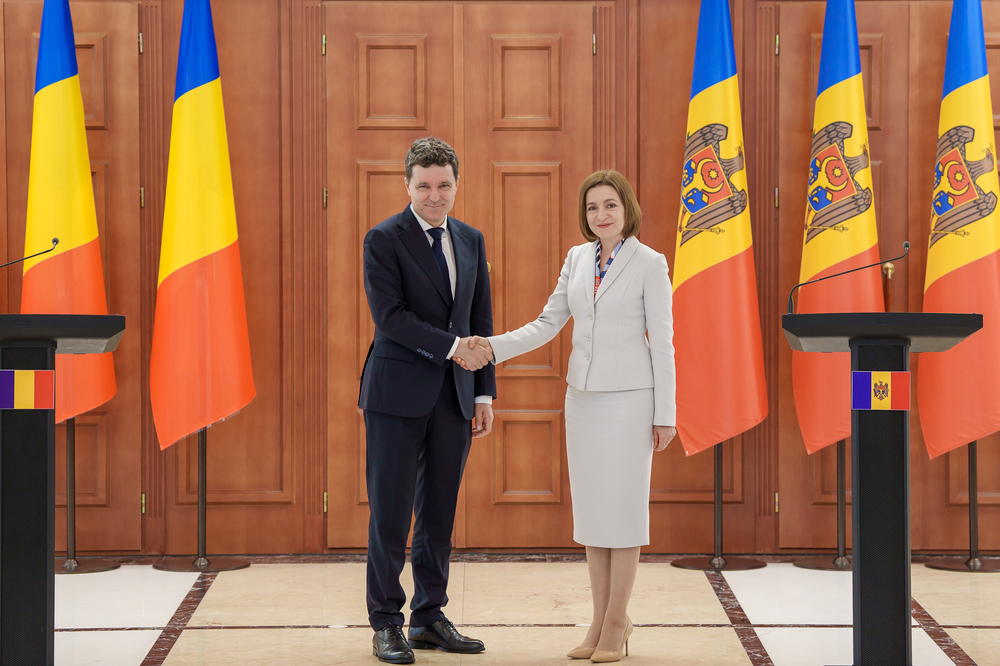
Moldovan President Maia Sandu sparked strong reactions with her Monday interview on the British podcast The Rest is Politics, in which she said she would vote in favor of unification with Romania. In Chisinau, some accused her of state treason, while in Bucharest her remarks were welcomed.
Speaking on the podcast, Sandu addressed security challenges and Moldova’s democratic future. She said that given developments around Moldova and globally, “it is becoming increasingly difficult for a small country like Moldova to survive as a democracy, as a sovereign state and, of course, to resist Russia.” In this context, she stated: “If there were a referendum, I would vote for unification with Romania”. The Moldovan President emphasized that her personal position is not currently backed by a majority of the population, but that there is majority support for EU integration, which she described as the goal she will fight for, “because it is more realistic and helps us survive as a democracy.”
Sandu has previously expressed support for unification with Romania, even before being elected President in 2020. She also holds Romanian citizenship, which under Moldovan law does not prevent her from holding high public office.
At the end of 2024, Sandu was re-elected president, and in the parliamentary elections in September 2025 her Party of Action and Solidarity (PAS) won a parliamentary majority, promising rapid EU integration. Alongside the presidential elections in October 2024, Moldova held a referendum on whether EU accession should be enshrined in the constitution as a strategic goal. The proposal was approved by 50.38% of voters, while 49.62% voted against.
Moldovan media recalled that according to the latest Public Opinion Barometer survey, conducted by the Institute for Public Policy, 33.4% of Moldovans would vote for unification with Romania, while 45.7% would oppose it. Another 2.5% would not participate, and 16.7% are undecided. The survey was conducted in September 2025 and does not include residents of Transnistria, the pro-Russian separatist region, nor data from the Moldovan diaspora, estimated at nearly one million people.
Reactions in Moldova
Moldova’s largest opposition force, the Party of Socialists of the Republic of Moldova (PSRM), led by former president Igor Dodon, accused Sandu of state treason and called on the Prosecutor General’s Office, the Security Service and all competent institutions to launch an urgent investigation.
“The statement of the illegitimate president Maia Sandu regarding her readiness to vote for the liquidation of the Republic of Moldova and its absorption by Romania is not a personal opinion or an abstract speculation, but an open act of political betrayal directed against Moldovan statehood,” the Socialists said in a statement published on Facebook.
“De facto, Maia Sandu has publicly admitted that she does not consider the Republic of Moldova a value worth preserving and that she is ready to support its destruction. This is a direct betrayal of national interests,” the statement added. The Socialists also accused Sandu of using the highest state office as a platform to promote the project of unification and external dictate.
The PSRM said that Sandu should resign immediately and called on “all patriotic forces in Parliament, local government and civil society to unite against the Sandu regime, which is pushing the country toward loss of sovereignty, social division and national catastrophe.”
The Party of Communists of the Republic of Moldova (PCRM) has described Sandu’s statement as an act of state treason and a gross violation of the presidential oath. “The fact that Sandu has publicly spoken about the denigration of her own country indicates that such plans have long been nurtured by pro-Romanian forces and have now entered a stage of practical implementation,” the party said.
The PCRM said that what it described as national betrayal is the claim that a small country like Moldova is allegedly “unable to withstand a threat such as Russia” and that, within Romania, Moldovan citizens would supposedly be better protected. According to the party, such a situation would be unimaginable in any other country, where governments seek to preserve and strengthen sovereignty and to foster national pride among their citizens.
“Only in Moldova do those who came to power through falsification, fraud and the bribing of voters, while at the same time holding citizenship of another country, advocate the liquidation of the Republic of Moldova,” the statement said.
Reactions in Romania
Sandu’s remarks prompted numerous reactions in Romania. Most Romanian politicians stressed that any unification must take into account the will of Moldovan citizens. Some warned of the risk of politicizing the issue and its use for propaganda in the context of the war in Ukraine and pressure from Russia, according to Radio Free Europe/Radio Liberty’s Romanian service.
Presidential adviser and MEP Eugen Tomac said in an interview with Calea Europeană that any conscientious Romanian, regardless of which side of the Prut River they live on, views unification as a natural process, reported G4Media. Tomac recalled that Romania officially committed itself through a declaration adopted unanimously by Parliament on March 27, 2018, marking 100 years since the 1918 vote in Chisinau to unite with the Kingdom of Romania. The declaration states that Romania is ready to enter negotiations on unification when Moldova is ready.
“This is the official position of the Romanian state. It has not changed,” Tomac stressed. At the same time, he noted that Bucharest cannot ignore the situation in Chisinau, where the majority expressed in parliamentary elections and several referendums supports EU integration. He said any initiative for unification must come from Moldova and should not become a divisive political topic.
Asked whether Romania is ready for unification with Moldova, including in terms of international support, Tomac said that “all our partners know that the same people live in Romania and in the Republic of Moldova.”
Titus Corlatean, chair of the Senate Foreign Policy Committee from the Social Democratic Party, described Sandu’s remarks as “an important but partial step.” He said unification would be legitimate, following the model of Germany. “The German nation was not denied unification in 1989. The same cannot be denied to the Romanian nation,” he said.
Other Romanian political figures echoed similar views, while stressing that unification would require referendums in both countries, constitutional changes and international recognition, and that sensitive issues such as Transnistria would need to be resolved.
Romanian Academy President and historian Ioan-Aurel Pop described Sandu’s statement as “historic,” noting that for the first time since Moldova’s independence in 1991, a sitting president has openly said she would vote for unification. However, he stressed that under current conditions unification would be extremely difficult and that European integration remains the most appropriate path for bringing Romanians on both sides of the Prut River closer together.
Historical background
Part of present-day Moldova (the region of Bessarabia) was part of the Principality of Moldavia, a medieval state that was under the suzerainty of the Ottoman Empire. The region had been annexed by the Russian Empire in 1812 following the Russo-Turkish War and remained under Russian rule until the collapse of the empire during World War I. After World War I, Bessarabia joined Romania in 1918 and remained under Romanian administration until 1940. In 1940, following an ultimatum by the Union of Soviet Socialist Republics (USSR) based on the Molotov–Ribbentrop Pact, Romania ceded Bessarabia to the USSR. The territory was incorporated into the Moldavian Soviet Socialist Republic, with some areas transferred to the Ukrainian SSR. After the collapse of the Soviet Union, the former Moldavian SSR declared independence in 1991, becoming the Republic of Moldova.
/NF/
news.modal.header
news.modal.text