Summer Leadership Academy
![Crisis Communication Expert Doychinova: Leader Should Make Decisions Based on Facts, Not Hypotheses]()
![Crisis Communication Expert Doychinova: Leader Should Make Decisions Based on Facts, Not Hypotheses]() Dr. Dilyana Doychinova, an expert in crisis communications and crisis management and Chief of Staff to the Deputy Prime Minister for Economic Policy, at the 9th International Summer Leadership Academy in Sinemorets, on the Black Sea, June 6, 2026 (BTA Photo/Stanimir Dimitrov)
Dr. Dilyana Doychinova, an expert in crisis communications and crisis management and Chief of Staff to the Deputy Prime Minister for Economic Policy, at the 9th International Summer Leadership Academy in Sinemorets, on the Black Sea, June 6, 2026 (BTA Photo/Stanimir Dimitrov)
site.btaCrisis Communication Expert Doychinova: Leader Should Make Decisions Based on Facts, Not Hypotheses
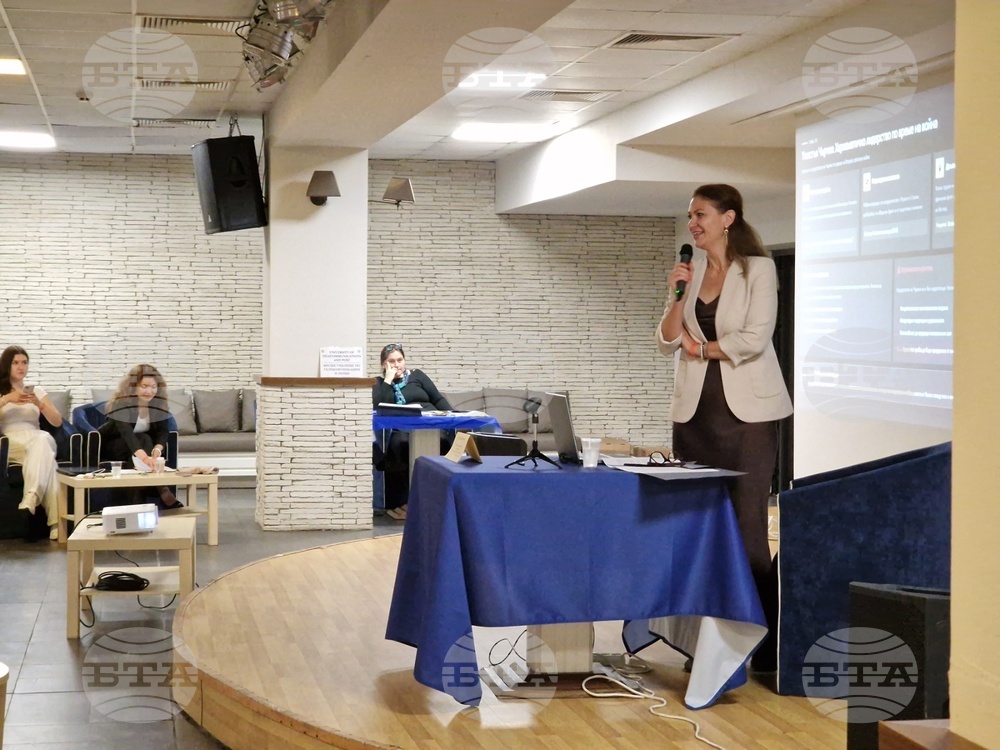
Addressing the 9th International Summer Leadership Academy here on Saturday, Dr. Dilyana Doychinova, an expert in crisis communications and crisis management and Chief of Staff to the Deputy Prime Minister for Economic Policy, said that a leader must make decisions based on facts, not hypotheses, and combine emotional intelligence with a long-term vision. The forum, titled “Leadership Beyond Algorithms: From Data to Decisions”, was organized by the University of Telecommunications and Post (VUTP).
According to Doychinova, the most important qualities of a modern leader include emotional intelligence, the ability to build trust, a long-term vision, transparent communication, adaptability, and the ability to base decisions on verified facts and analysis rather than on assumptions.
In her presentation, Doychinova examined various models of leadership through the lens of historical and contemporary examples. She cited British statesman Winston Churchill as an example of charismatic leadership in times of crisis, and former New Zealand prime minister Jacinda Ardern as the embodiment of empathetic leadership in the modern world.
Doychinova also highlighted the differences between European and Asian models of governance. According to her, in Eastern societies, leadership is traditionally based on a stricter hierarchy, prioritizing the group over the individual, a pursuit of harmony and consensus in decision-making, as well as long-term planning. In contrast, the European model is characterized by a more pronounced individualism, public debate, transparency, and democratic governance mechanisms. Doychinova also commented on the political situation in Bulgaria in recent years. She noted that between 2020 and 2025, the country went through seven early parliamentary elections, three caretaker governments, and a prolonged political crisis, which posed serious challenges to society and institutions.
During the discussion with the students, she was asked whether men or women make better leaders. In her view, leadership does not depend on gender, but on a person’s ability to assess a situation correctly, to be transparent in their decisions, and to instill confidence and hope in times of uncertainty. She added that emotionality should not be perceived as a weakness, but decisions should be made rationally and after careful analysis of the facts.
In response to a question about the challenges facing leaders, Doychinova noted that every crisis also brings opportunities for growth. In her words, it is precisely difficult situations that provide a chance for improvement for both individuals and organizations and institutions. As an example of a successful combination of firmness and empathy, she told the story of a psychologist who founded a centre for children with disabilities and succeeded in building a strong team and achieving results through a balanced management approach.
On the topic of Bulgaria’s place between East and West, Doychinova expressed the view that Bulgaria has the potential to combine the advantages of both models. According to her, a balanced approach is needed, one that takes into account Bulgarian socio-political and educational traditions. She noted that despite existing difficulties, Bulgaria is moving in a positive direction and that stable governance is a key condition for creating prospects for young people.
During the discussion, the question was also raised of how a formal leader can become an informal leader for their team. According to Doychinova, this is possible only if they have first earned the trust and respect of the people around them. She further emphasized that a successful leader does not act impulsively, but relies on expertise, team support, and objective analysis when making decisions.
The International Summer Leadership Academy is an annual event that brings together undergraduate and graduate students from various Bulgarian universities, who exchange ideas and experiences with representatives from academia, business, government, and the media. The forum is aimed at developing leadership skills, strategic thinking, and decision-making abilities in a dynamic professional and social environment. This year's edition is held under the President's auspices and is part of the events marking the 145th anniversary of the founding of the University of Telecommunications and Post.
/DS/
news.modal.header
news.modal.text