Wrap-up
![Media Use of AI Discussed at Roundtable in Sofia]()
![Media Use of AI Discussed at Roundtable in Sofia]() Roundtable discussion on “Artificial Intelligence and Ethical Standards in the Media” at UNWE, Sofia, February 10, 2025 (BTA Photo/Minko Chernev)
Roundtable discussion on “Artificial Intelligence and Ethical Standards in the Media” at UNWE, Sofia, February 10, 2025 (BTA Photo/Minko Chernev)
site.btaMedia Use of AI Discussed at Roundtable in Sofia
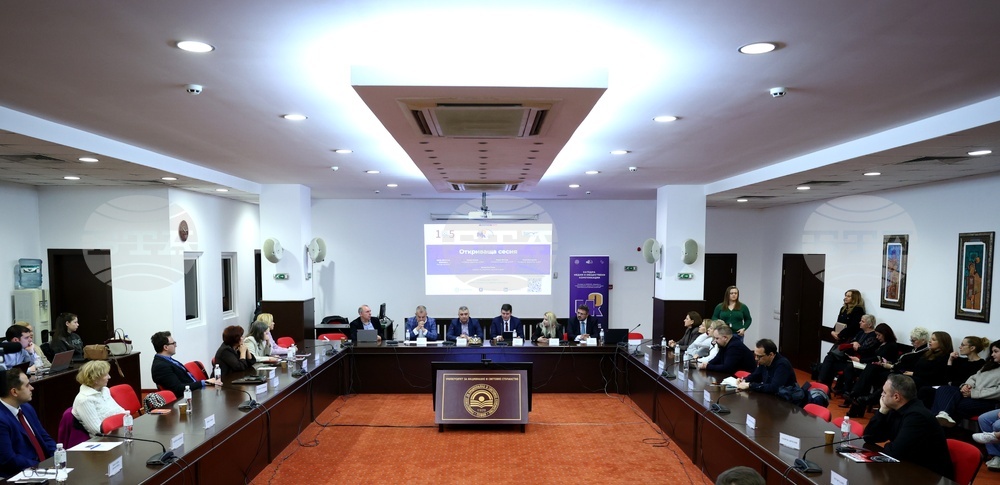
A roundtable discussion was held at the University of National and World Economy (UNWE) on Tuesday on the topic “Artificial Intelligence and Ethical Standards in the Media”. The event was organized by the Department of Media and Public Communications at UNWE, in partnership with Bulgarian National Radio (BNR).
It featured UNWE Rector Dimitar Dimitrov, BNR Director General Milen Mitev, Bulgarian News Agency (BTA) Director General Kiril Valchev, Bulgarian National Television (BNT) Director General Emil Koshlukov, as well as publishers, representatives of the academic community, media professionals, regulatory and industry organizations, and professional unions.
UNWE Rector Dimitar Dimitrov said that the university can contribute to artificial intelligence and its application. “Some may ask why the topic of media is being discussed at UNWE. At UNWE we have a very strong department under the auspices of UNESCO that deals with media - two degree programmes in the fields of media, economics and journalism. In addition, communication, media literacy and financial literacy all require the involvement of the media and of people who understand media and understand that the topic of artificial intelligence is something that, in one way or another, must be discussed with society,” he explained.
BNR Director General Milen Mitev said that people should manage the artificial intelligence (AI), rather than being driven by it, without compromising the quality of journalism. Mitev believes that the topic of AI is interesting and important for the future of the media. According to him, whether it will change the world for better or worse depends on people like those who work in media and journalism. In his view, the media plays a corrective role in society and will undoubtedly need to play such a role in the field of AI. He presented ten lessons learned from public media practice in Europe. These included the need for AI to be adapted to the specific media’s mission, for journalists to be methodical but also to consider the ethical and legal implications of using AI, and for there to be investment in AI literacy both internally and externally.
BTA Director General Kiril Valchev said that people should not fear AI, but rather learn about it and use it. According to him, the printing press made knowledge widespread, while artificial intelligence now makes it instantaneous. Traditional media, however, remain responsible for the credibility of contemporary knowledge, because AI cannot replace the journalist - the reporter on the ground who creates the information that AI can then use, he stressed. He went on to list the ways BTA uses AI in its work. “Before investing in artificial intelligence, we must invest in natural intelligence,” he noted. "Salaries in public media, as well as in private media, remain dramatically low compared to similar sectors, such as education. The difference is about 25%, which is why many choose to leave journalism to become PR specialists or teachers," Valchev explained, adding that this situation must finally change.
BNT Director General Emil Koshlukov said that “artificial intelligence will not replace humans, but those who use it will replace those who do not.” He added that there is already an AI news television channel - Channel 1 AI. "There are anchors who can instantly present news in any language you want. Like any technological product, this television will continue to improve, but even now, if you watch it, it will pique your interest,” Koshlukov said. “Instead of narrowing, we should aim for expansion with our artificial intelligence. By the way, that is what algorithms do. AI can watch a match and produce highlights — goals, offsides — in seconds, something no editor, scheduler, or editor can do. It can instantly output short videos and distribute them online. That is why AI is beneficial,” the BNT Director General added. “This transformation with artificial intelligence must happen for BNT, BNR, BTA, and all of us - we must urgently and comprehensively transition into the digital world,” he argued.
/MR/

news.modal.header
news.modal.text