BTA interview
![Engineer Ivaylo Nachev: Antarctica Provides Clear Data on Solar Activity]()
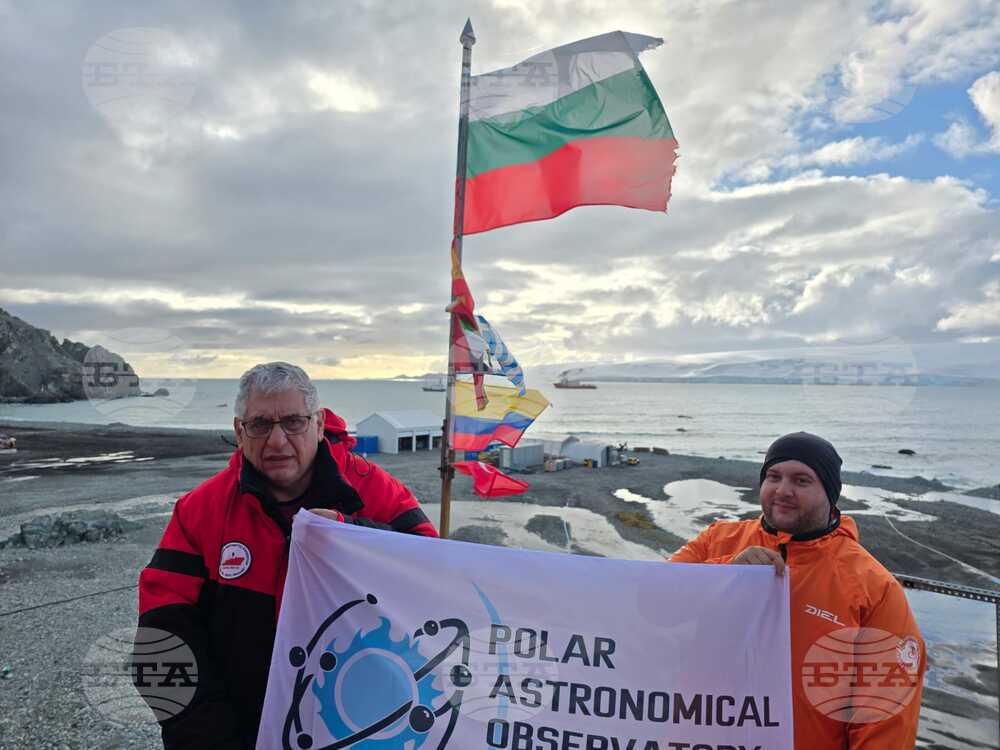
![Engineer Ivaylo Nachev: Antarctica Provides Clear Data on Solar Activity]() Livingston Island, February 2, 2026. Pictured: Admiral Boyan Mednikarov (Ret.) and researcher Ivaylo Nachev (R) (BTA Photo/Simona-Alex Mihaleva)
Livingston Island, February 2, 2026. Pictured: Admiral Boyan Mednikarov (Ret.) and researcher Ivaylo Nachev (R) (BTA Photo/Simona-Alex Mihaleva)
site.btaEngineer Ivaylo Nachev: Antarctica Provides Clear Data on Solar Activity
Antarctica is a place where polar astronomical projects can be carried out with much greater precision, says the team led by engineer Ivaylo Nachev. He is currently at the Bulgarian Antarctic Base St. Kliment Ohridski on Livingston Island and has already collected data on solar flares, allowing specific conclusions to be drawn about their types.
“Antarctica is an open laboratory with low industrial noise and a quiet radio-frequency spectrum,” Nachev told BTA. “With our solar energy data, we are a step ahead of nations that have been studying these processes for decades.”
Ivaylo Nachev is a chief assistant professor at the Faculty of Telecommunications at Sofia’s Technical University. He works in the field of radio communications and telecommunications technologies and is head of the university’s radio club.
Nachev is currently in Antarctica as part of a project carried out jointly with the Institute of Astronomy, the LOFAR radio telescope (LOFAR), and the Nikola Vaptsarov Naval Academy. The goal of the project is to expand scientific knowledge about space weather and solar–terrestrial relationships, and it is already producing significant results.
The initial stage of the project included the design of the equipment, which has now been installed on Livingston Island near the Bulgarian base.
“During the 33rd expedition, we conducted our first experiments,” Nachev said, adding that thanks to last year’s monitoring, the team now has fully operational equipment and extremely valuable data.
“Antarctica’s radio-frequency spectrum is extremely clean. (…) Antarctica is an open laboratory with low industrial noise and a quiet radio-frequency spectrum,” he said, adding that their systems study solar activity precisely within the radio-frequency spectrum.
Nachev explained that the research is conducted at frequencies used by all communication devices that facilitate our daily lives, but which at the same time create serious interference for this type of scientific observation.
“For example, the frequencies at which our car remote controls operate can cause interference during such measurements, making it impossible to summarize and attribute them to a specific solar event,” he explained.
The first part of the project is focused on detecting solar bursts during solar flares, coronal mass ejections, and other processes associated with increased solar activity. According to him, a radio signal is registered which, when detected by their system and similar systems, shows that each specific solar event has a recurring pattern.
“By capturing this radio echo from the Sun, we can apply it to specific solar events as a whole,” Nachev emphasized.
In parallel, another system is studying how solar flares directly affect the Earth’s ionosphere and which part of it is most strongly impacted. “Separately, we monitor the Earth’s magnetic field and how it changes in response to the flares,” he added.
According to him, the project makes it possible to collect unique data on the regional and local magnetic field of Livingston Island.
Nachev pointed out that the team’s greatest achievement is the strong solar flare recorded between January 16 and 19, during which the K-index, the parameter used to measure solar activity, exceeded 9.
“There were major auroras, even in Bulgaria, as well as disruptions to navigation systems, and we have very good data for determining and characterizing the flare,” he said, adding: “These events disrupt communications in aerospace engineering, aviation, emergency communications, and navigation systems.” According to him, the collected data also contributes to more accurate forecasting of solar activity.
Nachev noted that the team hopes in the future to build more measurement stations not only in Bulgaria and Antarctica, but also to create a global network of similar systems.
Admiral Boyan Mednikarov, who also visited the Bulgarian base this year, and Ivaylo Nachev unfurled the flag of Bulgaria’s first polar astronomical project and called on school pupils and university students to apply to take part in it.
RSV 421 departed for Antarctica from Varna (on the Black Sea) on November 7, 2025. After a month-long voyage across the Atlantic Ocean, the ship arrived at the Argentine naval base in the city of Mar del Plata on December 13.
BTA has had a national press club on board since 2022 and another on Livingston Island since February 2024. These are added to the agency’s other 41 national press clubs (33 in Bulgaria, seven abroad in neighbouring countries and in nations with large Bulgarian communities, and one mobile National Book Press Club).
BTA's Director General Kiril Valchev announced ahead of the fourth voyage to Antarctica on November 7, 2025 that the national news agency would send a special correspondent in January-February 2026. He said the press clubs exist thanks to the generous support of the Bulgarian research vessel St. St. Cyril and Methodius and Bulgaria’s St Kliment Ohridski Base, which provide the necessary facilities.
The news items of the BTA special correspondents on RSV 421 and Antarctica are freely available in Bulgarian and English on the agency's website. They can be used free of charge by all media with reference to BTA.
/YV/

news.modal.header
news.modal.text