site.btaMedia Review: May 11
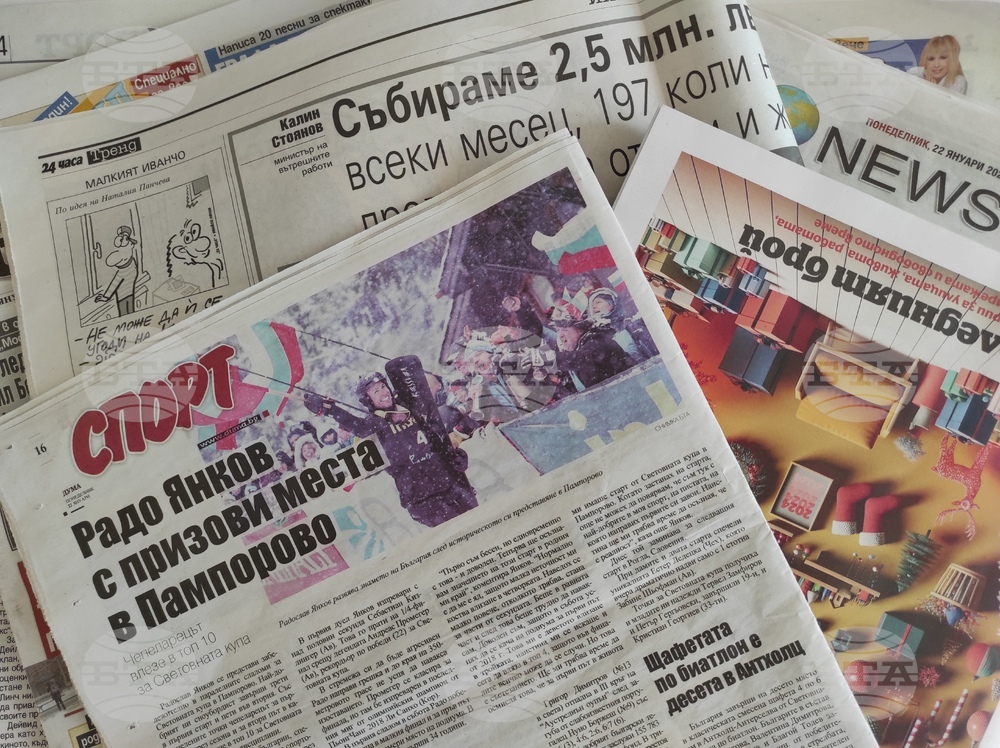
The expectations from the Rumen Radev government of Progressive Bulgaria now that the ministers have taken office dominate Monday's news media.
POLITICS
24 Chasa has an interview with Vladislav Goranov of GERB-UDF, who says his parliamentary group will be supportive of decisions shrinking the budget deficit, including unpopular ones, but only if taxes are kept unchanged. “Unless bold solutions are proposed immediately, the political prospects of the Government will worsen, I share President Iliana Iotova’s position that people can accept unpopular decisions but not being misled and lied to.” According to him, a budget deficit under 3 %, low external debt and no increase of taxes is an impossible achievement, despite Progressive Bulgaria’s election campaign promises. A deficit exceeding 3% is the most likely scenario, Goranov believes. He was finance minister in two governments, from November 2014 to January 2017 and from May 2017 to July 2020.
Ivaylo Mirchev of the Democratic Bulgaria parliamentary group told bTV's morning show that they will be a constructive yet firm opposition. "Our role is straightforward because we always act on the basis of principle. In other words, no matter what happens or what is done in the National Assembly, we have the same goals. We pursue these goals, and they are not opportunistic. We will continue in the same manner."
Trud has an interview with political scientist Assoc. Prof. Stoycho Stoychev, who comments that despite all governments claiming to fight corruption and budget deficits, those go up every year. Regardless of who has nominated the ministers in the new government, the responsibility for their work and what the cabinet gets or does not get done will rest with Prime Minister Rumen Radev. His problem is rather in the foreign policy – his voters will forgive him for not taking Bulgaria out of NATO and the eurozone and for not sending some corrupt politicians to prison, but his messages will be monitored suspiciously by the EU. He was not invited to many countries as president, and the situation will probably be the same now when he’s head of government. That may cause trouble for EU funds, the expert believes.
In an analysis for Segabg.com, Petyo Zekov argues that for now, “there is a puppet show instead of progress” when it comes to the new government of Progressive Bulgaria. In his words, it is time for statespersons with a backbone, not political background actors. Judging by the ministers, it is clear Rumen Radev was not ready to garner enough votes in the elections to form a government on his own; he expected to be part of a coalition government in which to put his closest people. Because of voters’ powerful support, he had to “go looking with a candle” for people to head the ministries he would otherwise have left to his coalition partners. The ministers are yet to prove they are not puppets on strings, but for now they are following the well-used scenario of “those before us ruined everything, and now we are yet to make analyses” of the situation. “For now, the steam of progress is just in the whistle,” Zekov concludes.
Telegraph has an interview with political scientist Hristo Panchougov, who comments that the Bulgarian people voted for the person with the raised fist. He was referring to Radev’s raised fist as he exited the President’s Administration building to join a protest outside in 2020, declaring he - as president at the time - would fight against corrupt politicians and for the rule of law. According to Panchougov, the biggest challenge facing the new cabinet is drafting the 2026 state budget. "The question of how quickly this situation will be resolved and discussions on the next budget will begin, as well as this government’s ideas on what that budget will look like, are of interest not only to the public sphere but also pose the greatest threat to the cabinet itself. Beyond that, there are related issues. The biggest of these is actually the payments under the Recovery and Resilience Plan, which are once again beginning to be delayed, with the risk of being lost. I suspect this will also be a very sensitive issue that the Cabinet will have to tackle immediately. From this perspective, establishing the macro-financial framework within which policies will be formulated going forward is the most important issue that needs to be resolved," the expert said.
On bTV's morning show, former energy minister Miroslav Sevlievski commented that so far, he has not been surprised by a single name in the new government. "All these names have been discussed not just over the past two months, but for the past nine years, ever since we have been waiting for President Radev to become prime minister." In Sevlievski's words, one should not expect these people "to do something so grand in the first few days, for some kind of fireworks to go off." This week will show what the new power holders will do with their defeated opponents. Sociologist Kolyo Kolev commented that there are no real surprises in the new government. "It was clear that the backbone of the new cabinet would consist of the people who served in Rumen Radev’s previous caretaker cabinets. I do not see any particular surprises in that regard. And will there be a purge, will there be a shake-up? Yes, of course. And I think that is just part of the game. To seize political power, you must, of course, decide who to remove and who to put in their place. That is normal,” Kolev argued. Anti-Corruption Fund head Boyko Stankushev commented that "Radev is a bit blind and overly confident that he has extensive political experience." "Being president for nine years is one thing, but taking on this entire complex machine called the executive branch - where a lot depends on you, but also on the people around you - is quite another," Stankushev argued.
On bTV's morning show, former caretaker justice minister Andrey Yankulov said that Borislav Sarafov’s resignation as acting prosecutor general immediately after the elections creates a troubling impression that the leadership of the Judiciary is dependent on the political climate. “Even if this is not the case, the impression itself is concerning enough for the state of the judicial system,” Yankulov commented. According to him, the Judiciary should have resolved the issue of Sarafov’s legitimacy on its own, rather than having it appear to be a consequence of a shift in the political landscape. Yankulov also commented on his meeting with the new Minister of Justice, Nikolay Naydenov. The conversation between the two was lengthy and gave him grounds for cautious optimism. "I am encouraged by the things we discussed, if work is actually done in this direction,” Yankulov said. Among the first steps announced are changes to the rules for electing members of the Supreme Judicial Council (SJC), amendments to the Judiciary Act, and a possible moratorium on appointments to leadership positions by the SJC.
On Bulgarian National Radio, Ivan Bregov of the Institute for Market Economics commented that the Justice Minister could be a very powerful figure. "If he is given broad latitude and is not pressured by the two powerful figures in this administration - one of whom will undoubtedly be Radev, the other former justice minister Demerdzhiev - and knowing the system’s problems from the inside very well, because this is a person who has worked his way through every level of the judicial administration, I think there could be some pleasant surprises,” Bregov said. "Let us see what amendments they will propose to the Judiciary Act," he added, noting that is the first thing that will indicate what actions will be taken by the new government in the Judiciary.
On Nova TV's morning show, political analyst Lyubomir Stefanov commented that everything went according to the rules. "There are no surprises with such a majority. The opposition was more interested in stealing the show and nitpicking every word and comma,” he added. According to him, it is strange that no one is paying attention to the person chosen for foreign minister. In his opinion, Radev is choosing these people to keep the Judiciary and foreign affairs under direct control. Sociologist Kolyo Kolev commented that the backbone of the Government is built around the former caretaker governments led by Rumen Radev. In his words, that is extremely important for the swift consolidation of power, which they have yet to achieve. Political scientist Ivo Indzhov described the Cabinet’s composition as controversial. “The message to the public conveyed by this lineup is that it includes proven professionals whose expertise and authority carry weight, but there are also those whose names and backgrounds certainly raise questions. For example, the Justice Minister, who is not known in the public sphere for having advocated any concepts for reforming the judicial system, and this is one of the priorities," the expert recalled. PR expert Arman Babikian believes it is “quite strange to appoint a bodyguard as head of counterintelligence.” Regarding the Justice Minister, he said: “We have not heard whether he wants reform or what form it should take.” Regarding the fight against high prices, Babikian believes that “we should be fighting for the market, not for prices,” and added that he finds it ridiculous when people talk about this issue. Political scientist Stoycho Stoychev believes that the appointment of the Justice Minister is “an attempt to break out of the current vicious cycle, namely that reforms in the judicial system are being imposed from the outside as a political decision.” Sociologist Svetlin Tachev believes that “the Cabinet has a communication problem, as such statements inflame the situation.” He said that some of the changes require 160 MPs, and if conflicts begin now, such a consensus will not be reached.
Bulgarian National Television's morning show focuses on what measures the Government will take to curb price hikes and inflation. Economist Assoc. Prof. Grigor Sariyski of the Economic Research Institute at the Bulgarian Academy of Sciences, and Georgi Angelov, a senior economist at the Open Society Institute, commented on public finances, prices, budgeting, and the economy. According to Sariyski, there is a way to get public finances in order, but not without paying a high social cost, because the financial problems have been going for four or five years now. "We have now seen that by the end of March we have a record deficit - 1.4% of GDP - and this is the period when taxes are collected, meaning we should not have such a large deficit. For comparison, last year it was under 1%. So, given that your expenses are growing at a faster rate, it is very difficult to get your finances in order under these circumstances,” he noted. Angelov underscored that an imbalance has built up, and balance in the system should be sought. "Several sectors fought to secure their own formula for wage increases, which gave them very large raises. The Judiciary was a pioneer many years ago. Then, in recent years, the security services, the Interior Ministry, and education. There were protests in healthcare as well; there are problems, but no solutions were reached there. There is, in fact, an obvious shortage of nurses - job postings go out, but no one applies. Meanwhile, in other ministries, when a job posting goes out, there are many applicants, but no one quits their job - obviously, we have overpaid there, while in other places the salaries are lower than necessary."
ECONOMY
24 Chasa reports on its front page that this summer, a beach umbrella may cost under EUR 4 but a whole day under it may be some EUR 60.
Telegraph’s headline reads that it costs more to fill a fridge with food in Bulgaria than it does in Italy and Spain. Bulgarians have been posting photos on Facebook after trips abroad to show food costs more for Bulgarians, despite them having lower incomes than Italian and Spanish citizens. The daily compares prices of cherries, tomatoes, coffee, and poultry meat.
Trud’s front-page story reads that spring’s variable weather has given rise to viruses and allergies. Medical professionals quoted by the daily say over 30% of Bulgarians have an allergy.
***
Capital.bg reports that Bulgaria’s prolonged real estate boom is facing a correction, with the market entering a cooler phase by the end of 2025. In the first quarter of 2026, transactions fell by 15.5% year-over-year nationwide and by 12% in Sofia, reaching levels close to those seen at the start of the COVID-19 pandemic. The “buy before the euro” euphoria has run its course. The market is shifting from “panic buying” to “rational consideration.” Decision-making times are lengthening, and the supply-demand ratio is changing: the number of transactions is decreasing, while the supply of properties is growing by over 25%. As a result, although asking prices are not falling, negotiated discounts of 5% to 10% are becoming the new norm, especially for property that has been on the market for a while. The article explains that said changes to the real estate market are important, because construction has been the fastest-growing sector of the Bulgarian economy in recent years, and together with real estate transactions, it has made a significant contribution to economic growth. In Bulgaria, however, the importance of the real estate market far exceeds that of construction. Real estate is a primary means of saving, a driver of lending, a source of consumption, and an important psychological indicator of perceived well-being. The turning point in this market’s cycle promises changes with a wide range of effects for different categories of market participants. The hope is that, after cooling off from last year’s fever pitch, the country’s real estate market will stand on solid ground.
SPORTS
Duma quotes Ivan Peshev, sports minister of the Bulgarian Socialist Party in the Zhelyazkov government (2015-2016), as saying on Facebook that as the start of the Giro d’Italia cycling race in Bulgaria comes to an end, the efforts, work, and faith were worth it. “It was a true honour for me to be part of the team that first proposed the idea of bringing the Giro d’Italia to Bulgaria and to hold dozens of meetings and discussions to ensure that this highly prestigious event became part of our country’s sporting calendar. As early as March 2025, we believed that Bulgaria could host an event of such scale and global stature. We believed that our country deserves to be part of Europe’s major sporting map, and we made every effort to make this happen. The road was not easy; there were many challenges, but today I am convinced that every single step was worth it,” the post reads.
Mediapool.bg quotes Sofia Mayor Yordan Terziev as saying after the end of the Giro d’Italia Grande Partenza in the capital on Sunday that over 200,000 people came to watch in Sofia. Over 25,000 cyclists, including children, rode bikes down the race’s route on Sunday. In his words, the organizers themselves said that the Grande Partenza in Bulgaria was perhaps one of the best Giro d’Italia races outside of Italy.
On Bulgarian National Television's morning show, Dimitar Petrov, the national coordinator of the Giro d'Italia, recalled that the cycling tour's executive director, Paolo Bellino, had said that this was its best start yet, and that there have been 16 editions held outside Italy so far. When asked whether hosting the event was costly for Bulgaria - given that the State paid EUR 15 million to the event organizers - he replied: "I do not include in that amount the money that was invested in infrastructure. No one is going to take away our asphalt and roads, so this is not money spent on something we do not need. Of the budgets allocated to the various ministries, some were spent at one-tenth of their amount, while others were spent at half. In other words, the amount we spent is certainly many times less than the benefits we received." Petrov emphasized that the positive assessment by the Italian organizers is also thanks to the spectators along the race route.
/DS/
news.modal.header
news.modal.text