site.btaMedia Review: February 23
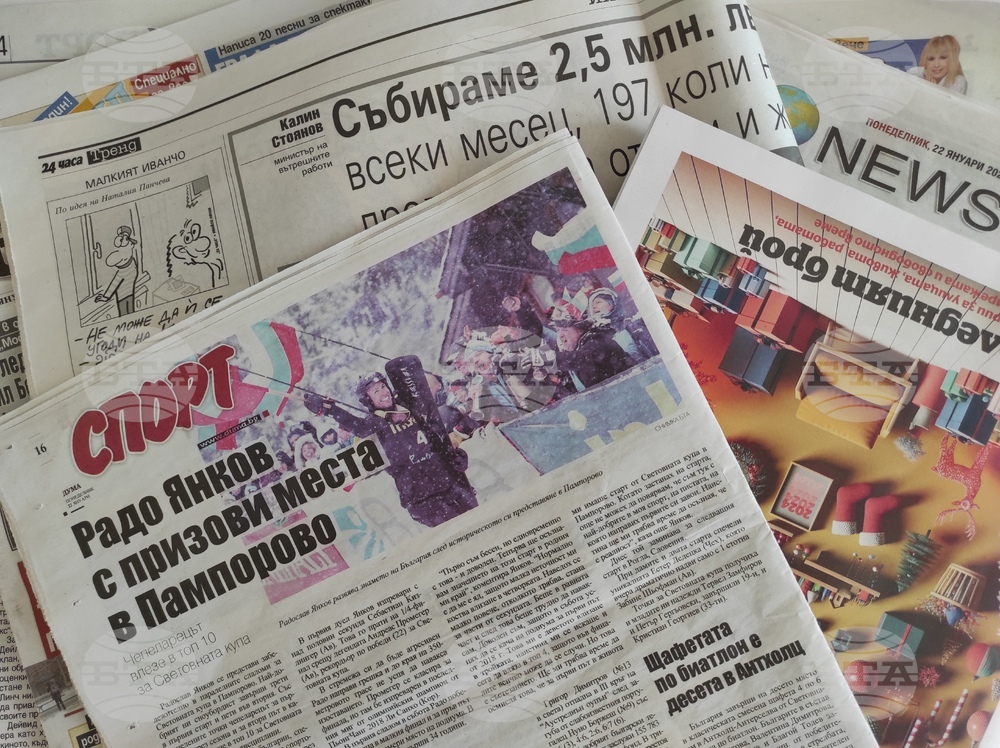
The topics of the newly appointed caretaker government and the Petrohan case dominate Monday’s press.
POLITICS
24 Chasa presents the results of a Trend opinion poll, according to which if elections were held today, the coalition of former president Rumen Radev would win 32.7% of the votes, followed by GERB -UDF with 20.4%, while Continue the Change - Democratic Bulgaria (CC-DB) and the Movement for Rights and Freedoms (MRF) would battle for the third place with 10.9% and 10.5%, respectively. Also expected to make it into the next National Assembly is Vazrazhdane with 7.8% of the votes, while the Bulgarian Socialist Party (BSP) and MECh are just under the entry threshold with 3.8% and 3.6%, respectively.
In an interview on the poll’s results, Dimitar Ganev from Trend tells 24 Chasa that the key to forming a government is whether Radev will have more than 100 MPs. The sociologist describes the support for Radev as something between a wave and a tsunami; he basically has one-third of the votes of those planning to exercise their voting right on April 19, or around 1 million votes. Still, new formations do not yet have a stable core of supporters, meaning that the election campaign might influence the result in either direction. If Radev wins over 100 MP seats, he could try to form a minority government that seeks support for every situation; with less than 100 MPs, he would have to seek a coalition partner – CC-DB or, if they make it into Parliament, the Socialists, Ganev comments.
Telegraph has an interview with Prof. Rumyana Kolarova, political expert, who argues that Radev does not have natural partners among the political formations.
On Nova TV’s morning show, experts commented on the newly appointed caretaker government. According to entrepreneur Tanya Skrinska, the position of deputy prime minister responsible for fair elections is strange, given that there is an Interior Ministry and a justice system, but since such a position exists now, the person appointed must be honest and disclose to those appointing them any problems they may have had in the past. The choice of Stoil Tzitzelkov was thus a mistake and could create an issue both for the cabinet and voters, Skrinska said. Former deputy energy minister Elenko Bozhkov commented that this government is implementing a new alliance between GERB and CC-DB, and there can be no minister of fair elections, given that the entire job of a caretaker cabinet is to conduct such elections. Political expert Petar Cholakov said that Rumen Radev will need a partner but not a very strong one. If Radev’s formation wins the snap elections, he will partner with CC-DB but only for a short time.
The theme of Bulgarian National Television’s (BNT) morning show is the first days of the caretaker government. Anton Kutev, former spokesperson of several caretaker cabinets, commented the new one is off to a false start, which is not good for either itself or the citizens, but it is still possible to reverse the trend. A negative attitude towards the caretaker government is being maliciously created, which will certainly hinder it in implementing more serious measures, Kutev argued, but added that with more meaningful actions, the cabinet could reverse the trend. Understandably, the focus is currently on the Interior Ministry, because when it comes to elections, what the government can do is ensure order, stop criminal vote buying, and stop the election mafia. Regarding the judicial system, Kutev is adamant that a consensus must be sought on how to change the system so that it works. Mathematician and election expert Prof. Mihail Konstantinov believes that acting Prosecutor General Borislav Sarafov will not be replaced. "Obviously, not only will he not be replaced, but there is no one to replace him with, because this position cannot remain vacant. A procedure and discussion may be initiated, but there will be no change now." According to Konstantinov, a restart with the old people is impossible. Journalist Silviya Velikova, too, believes that for now, there will be no great changes in the Judiciary.
Segabg.com has an interview with Vladimir Nikolov, former chairman of the Association of Prosecutors in Bulgaria and, as of a few days ago, former district prosecutor of Pleven, removed from office by the Prosecutor’s College of the Supreme Judicial Council at the request of acting Prosecutor General Sarafov. Nikolov claims that his disciplinary case is based on false and manipulative allegations. When asked if there has been any reaction from Sarafov since he began speaking publicly, Nikolov said that colleagues had relayed comments to him "that after my statements, I had committed suicide." "I realize that with all this I have painted a target on my forehead. I am fully aware of what will befall me," he said. Nikolov also shared that he had received the support of hundreds of prosecutors. "Even today, I responded to a colleague who said that I am a precedent: in order to achieve what we all want, to have upward development, a prosecution service that we can be proud of, modern, European, and democratic, this should not remain a precedent, it must become practice." "The prosecuting magistracy is currently run not as a State-owned public institution according to the relevant rules, but as a private company, corporation, or feudal estate in the personal interest, based on intrigue, behind-the-scenes actions, and the desire to remove any colleague with authority who dares to defend a certain position," Nikolov said.
On Nova TV’s morning show, Nikolov reiterated that he had received a warning through intermediaries that speaking out against the acting Prosecutor General is suicide. Nikolov categorically denied that he had been promised political support or had held talks about becoming a candidate for prosecutor general, stating that he did not want his name to be mentioned in a political context in any way.
On bTV’s morning show, caretaker Justice Minister Andrei Yankulov commented that there currently is no prosecutor general, because under the law, Sarafov cannot carry out the functions of a prosecutor general. This is an institutional problem – the prosecution service cannot function normally unless a legitimate acting prosecutor general is elected. In the Minister's words, is impossible to elect a permanent prosecutor general when the Supreme Judicial Council's (SJC) term in office has expired, but appointing an acting prosecutor general is a necessary step that cannot be avoided. According to Yankulov, it is the SJC Plenum that should decide, and not just the Prosecutor's College, which in 2023 appointed Sarafov as acting prosecutor general after the dismissal of Ivan Geshev. “This happened literally the next day - extremely quickly, without any debate,” Yankulov recalled. Asked whether such a change now should be left to the next parliamentary majority, Yankulov replied that this was not a matter of reform but of overcoming the crisis. “Restoring constitutional order is not judicial reform. It is a normal action to end a serious constitutional crisis,” he argued.
***
Trud’s front-page article is about the link between the Petrohan case and CC-DB, with the daily claiming that the high-profile criminal case is a project of the green mafia. [In the case, five men and a 15-year-old boy met a violent death between February 2 and 8, their bodies found in two remote mountain locations in Northwestern Bulgaria with weapons on site; the deceased were associated with a non-governmental conservation group called National Protected Areas Control Agency (NPACA)]. The article reads that back in 2022, during the government of CC leader Kiril Petkov, the MPs of CC-DB were discussing amendments to the Protected Areas Act to allow private nongovernmental organizations to manage and protect Natura 2000 areas, which constitute 35% of Bulgaria’s territory. That would have been a continuation of the controversial framework agreement between the Environment Ministry and the NPACA from that time. It is that agreement that legitimized the activity of a private NGO in the heart of Natura 2000 protected areas. Precisely the combination between private property over a key site, paramilitary vision, serious equipment, international contacts, and political legitimation through an agreement with the State turned the NPACA into a structure that for years has existed in the grey area between a civil initiative and a private security formation. When this model results in corpses in the mountains, the question is no longer just who fired the killing shots but also who has allowed all of that to exist for so long under the cover of "a cause", the article reads.
On Bulgarian National Radio, criminologist and Bulgarian Arms Association head Ivan Savov commented on the Petrohan case. “To stop the speculations, I can only call on the new leadership of the Interior Ministry to conduct an audit of the entire case and come out and say, ‘There is nothing wrong with what happened. There are previous cases that also show a vicious practice of sweeping things under the rug.’” Since the Ministry and the security services are not in the habit of disclosing information in a way that makes things clear to people, because in the past no one has held them accountable to the public for telling the truth, they are currently at a standstill and do not know exactly what to show and what to say, Savov argues. What the services are revealing simply supports all the conspiracy theories, because they are revealing things little by little and everything is endlessly confusing. Even in the latest recordings that have appeared, there are voices in the background that have no connection to what can be seen in the footage. There are constantly things that do not fit with the picture, he commented.
On bTV’s morning show, criminal psychologist Todor Todorov commented that this is the first time so much information has been released about a case. “The information was released in bits and pieces, allowing people to fantasize. In my opinion, it was a grave mistake to present to the public. It turned into a public investigation. If there was any purpose, it was rather to dilute people’s attention,” he argued. In his words, the Petrohan case is nothing more than a grave criminal offence committed by NPACA head Ivaylo Kalushev; the mafia has nothing to do with it. Based on the information he has, Todorov believes that there were three murders and three suicides; the murders were committed because those three people failed to kill themselves, requiring another to pull the trigger.
***
Duma reports on its front page that the BSP has elected a new Executive Bureau. At its meeting on Saturday, the BSP National Council also voted on the top-of-the-list candidates from 21 regions for the April 19 snap parliamentary elections. The rest will be nominated through dialogue and at the proposal of the local party structures, and the vote will be held on March 7. The Executive Bureau has 19 members and four deputy chairs; they were elected almost unanimously with 102 votes in favour, one against, and three abstentions. The coalition formula for the elections will be BSP – United Left.
***
Capital.bg has an analysis by financial expert Plamen Monovski about countering corruption in politics. He describes as “a fatal, recurring misconception that haunts the fight against deep-rooted corruption and mafia-controlled countries” the myth of the flawless reformer. “This is the naive assumption that those who seek to overthrow a rotten regime must themselves be morally pure, stepping onto the political battlefield dressed in shining white shirts,” he argues. According to him, history and human psychology reveal an opposite truth: the destruction of corrupt systems “is the harsh, morally complex work of flawed human beings.” “Those who have navigated the grey areas that bear the scars of past compromises have a deep, mechanical understanding of how the corrupt system works. They know where the bodies are buried, how bribes are structured, and how legal loopholes are exploited. You cannot hack a system if you do not understand its code,” the expert argues. To defeat the mafia, the reformists must abandon the vanity of moral perfection. The goal is not to pass a purity test; the goal is to win back the State, Monovski says.
***
Mediapool.bg has an article about the use of AI-generated videos of Bulgarian politicians on social networks. While these videos are mostly parodies aimed at rallying supporters of certain politicians or undermining rival parties, there are also those that are used to influence public opinion, collect personal data, and even generate financial gain. The e-zine recalls a case from 2023, when a deep fake video was circulated featuring the image of then-prime minister Nikolay Denkov, with the aim of collecting personal data. It was created based on an actual recording of a press conference given by Denkov; artificially generated sound "made" the prime minister announce that citizens could earn BGN 9,200 per month by investing in Lukoil. Against this backdrop, the debate on regulating the use of artificial intelligence, not only in Bulgaria but also in other European countries, is increasingly coming to the fore. At present, however, there do not appear to be sufficient mechanisms in place to restrict the use of large language models for commercial purposes.
***
Trud has an interview with diplomat Lyubomir Kyuchukov on the four-year anniversary of the war in Ukraine. In his words, the result of these four years is war and more war, with destruction and hundreds of thousands of victims on both sides. “Russia has won territories that it will probably keep, but it has also lost influence - its most valuable political resource, given to Russia by the Russian and Russian-speaking population not only in Ukraine, but also in most post-Soviet countries. By formulating as a goal the protection of those people’s rights against encroachment and restrictions (not always well-grounded), Russia has achieved the opposite effect: that population’s full isolation and marginalization,” the diplomat argues. According to him, in the peace negotiations the Russian President is most interested in the results, while the US President in the time. Kyuchukov thinks the most likely scenario for Ukraine is a new Cold War, this one of higher risk that the original due to the absence of even minimum mutual trust, readiness and willingness for any kind of dialogue. In such conditions, any accidental event or purposeful provocation could trigger a new, larger-scale war in Europe, the diplomat argues.
ECONOMY
24 Chasa reports on its front page that as of 2030, new requirements will replace road vignettes, making drivers pay for the distance travelled. According to National Toll Administration Director Oleg Asenov, drivers have become more disciplined, and the number of those exceeding the average speed has dropped several-fold.
Telegraph’s front-page story reads that 163,995 cars were caught polluting Sofia’s city centre – the low-emission zone – from December 1, 2025, to February 20, 2026. Despite the broadening of this zone, the number of violations has dropped, Sofia Municipality’s data show. Plovdiv (South Central Bulgaria), too, is planning to restrict the access to the city centre for older cars.
/DS/
news.modal.header
news.modal.text