On this date
![February 27, 1981: Lyudmila Zhivkova Concludes Official Visit to India]()
![February 27, 1981: Lyudmila Zhivkova Concludes Official Visit to India]() Lyudmila Zhivkova (second from left) at the “Thracian Art in the Bulgarian Lands” exhibition in Delhi, February 17-27 (BTA Archive Photo/Veselin Seykov)
Lyudmila Zhivkova (second from left) at the “Thracian Art in the Bulgarian Lands” exhibition in Delhi, February 17-27 (BTA Archive Photo/Veselin Seykov)
site.btaFebruary 27, 1981: Lyudmila Zhivkova Concludes Official Visit to India
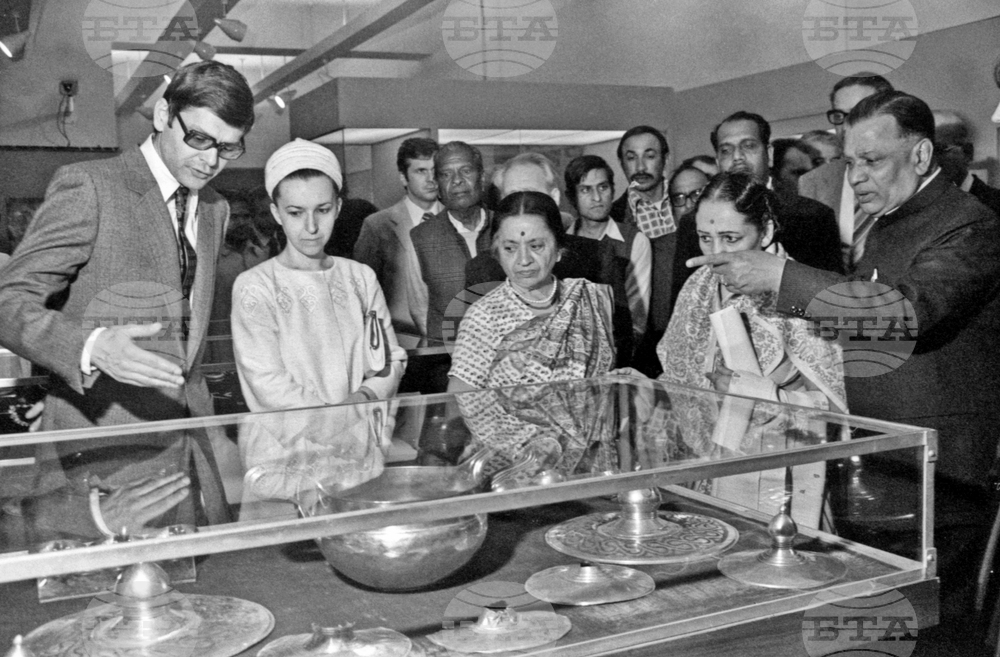
On February 27, 1981, the official state visit to India by Lyudmila Zhivkova (1942-1981), Chair of the Committee for Culture and daughter of Bulgarian Communist leader Todor Zhivkov (1911-1998), came to an end. The Bulgarian delegation, which included Lyubomir Levchev, Chair of the Union of Bulgarian Writers, Svetlin Rusev, Chair of the Union of Bulgarian Artists, writer Bogomil Raynov and Thracologist Prof. Alexander Fol, had arrived in the capital, Delhi, ten days prior.
The programme included a meeting with Indian Prime Minister Indira Gandhi and other senior officials, a visit to the then under-construction spiritual centre of Auroville, where 1,300 Bulgarian roses were donated and planted, and the presentation of the exhibition “Thracian Art in the Bulgarian Lands” at the country’s National Museum. The emphasis on Bulgaria’s cultural heritage was linked to the forthcoming celebrations marking the 1,300th anniversary of the establishment of the Bulgarian state.
Another cultural initiative discussed during the diplomatic talks was the International Children’s Assembly “Banner of Peace.” In India, the children’s assembly was widely promoted through the Indian national centre for creativity and children’s extracurricular activities Bal Bhavan.
The ten-day visit was followed by a week-long trip to Mexico, where Zhivkova opened the exhibition “Medieval Bulgaria – Art and Civilization.” According to her biographers, the prolonged travels exhausted her and worsened her health, leading to her death on July 21 of the same year.
Zhivkova’s visit to India was covered by Bulgarian News Agency international correspondent Veselin Seykov. Information about the event was published in the International News bulletin.
Lyudmila Zhivkova (26 July 1942 – 21 July 1981) was a prominent Bulgarian political and cultural figure during the later decades of communist rule. The daughter of long-serving Bulgarian leader Todor Zhivkov, she rose rapidly within the Bulgarian Communist Party and became one of the most influential figures in the country’s cultural policy in the 1970s.
Born in Sofia, Zhivkova studied history at Sofia University and art history at Moscow State University, and later conducted research at St Antony’s College, Oxford. Initially encouraged toward an academic career, she entered politics after her mother’s death in 1971. She became Chair of the Committee for Art and Culture in 1975, with the rank of minister, and served as a member of the National Assembly and of the Communist Party’s Politburo.
As the de facto head of Bulgarian cultural affairs, Zhivkova promoted an ambitious international cultural programme aimed at raising Bulgaria’s global profile. She championed major exhibitions of Bulgarian art abroad and played a leading role in preparations for the nationwide celebrations marking 1,300 years of Bulgarian statehood in 1981. Her initiatives gave artists somewhat greater creative latitude at a time when ideological controls across the Soviet bloc were generally tightening after 1968.
Zhivkova was also known for her interest in Eastern religions, mysticism and teachings, an unusual stance within an officially Marxist-Leninist system.
She died suddenly in July 1981, just days before her 39th birthday, and was accorded a large state funeral. Her legacy remains debated in Bulgaria: some view her as a reform-minded cultural modernizer who broadened intellectual horizons, while others see her as a privileged representative of the communist elite whose influence was inseparable from her father’s power.
/MY/
news.modal.header
news.modal.text